Gen Z aren't lazy - I commute four hours a day to work in the office
Lily-May Edwards loves living in north Wales, but she also loves her job at the University of Liverpool.
So rather than choosing between the two, she sets her alarm at 05:30 most mornings to make the four-hour round trip to the office.
"I love getting up, I love getting ready, physically going somewhere and feeling like I've got a purpose," said Lily-May, 24.
Working from home became the norm for millions during the pandemic. More than a quarter of Brits still spend at least some of each week working remotely.
Sir Alan Sugar made headlines last year when he said workers should "get their bums back into the office" and accused young people of just wanting "to sit at home".
But a 2025 survey of 12,000 workers from 44 countries suggested younger workers were "leading the return to the office", with so-called Generation Z more likely to be in the office than their older counterparts.

 Lily-May Edwards
Lily-May's two-hour morning commute involves a 45-minute drive to the train station, followed by a train journey into Liverpool and finished off with a walk to the office.
She works as a social media officer and said there were a lack of similar opportunities in her hometown.
"I feel really lucky to live in such a nice little town, so why would I wanna move away?" she said.
"But it's still really nice to sort of have a bit of a double life, and I love [Liverpool] as well."
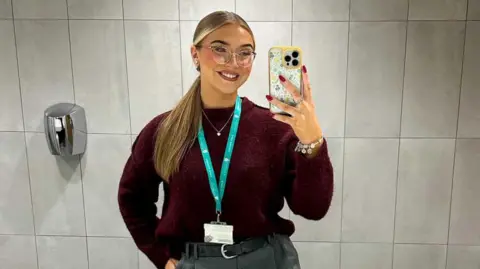 Lily-May Edwards
"From north Wales to Liverpool, it's very chilled, I'm just editing, or I'm reading or I'm just having a little bit of time to decompress before the day actually starts."
While the long journey means she opts to work from home two days a week, Lily-May said she preferred the office and would be in "a lot more" if she lived closer.
"I've made some really nice friends where I work as well and it's nice to see them when I go in."
Lily-May said hybrid or remote working was not "necessarily about being lazy", and instead showed how people valued flexibility.
 Lily-May Edwards
Workers aged between 30 and 49 are the most likely to have a hybrid working arrangement - meaning some days at home and some days in the office - according to the ONS.
Some business leaders have said home working could be contributing to reduced productivity, with JPMorgan's CEO Jamie Dimon recently saying "younger people are being left behind" by remote working.
However, there is "no compelling evidence" that working from home negatively impacts on performance, according to Claire McCartney from the Chartered Institute of Personnel and Development (CIPD).
 CIPD
CIPDShe said flexibility had become more valuable to workers since the pandemic, but there were "lots of benefits" of going into the office.
"From younger people's perspective, or if people are new into jobs, then there's a lot more support, learning and development together as well, that sense of social community cohesion," she added.
"[But] for employees that work for employers that offer flexibility, they're more likely to feel motivated and engaged and I think retention is really important," McCartney adds.
Flexibility is something that Daisy Willis values, having moved from an office-based role to a fully remote job in the travel industry.
 Daisy Willis
Daisy, 21, said while she liked her office-based job "at the time", she found it expensive paying more than £60 a week on travel from her home in Essex to London.
"The biggest difference I've noticed is just the work-life balance. I feel like there's so much more flexibility."
Daisy now walks her dog on her lunch break and says no commute means she does not miss out on family time.
"I also just enjoy my work much more when I know that my life also comes around that as well," she added.
For Eleanor Cotton, 24, a split between office and home is part of the job.
She works as a marketing executive in Manchester and her company shares its office with two other businesses, meaning that Eleanor - who has a two hour commute from Birmingham - and her co-workers can only go into the office twice a week.
 Natalie Argent
Eleanor said: "Working at home is fine, but in the office you've got people and you're speaking to them.
"You can get so much more collaboration and bits of knowledge that you wouldn't otherwise get when you're working at home."
For now, Eleanor said she was "glad" she only had to be in the office twice a week.
"The actual work I do is incredible and it's just about worth the two-hour commute."
Lily-May, who regularly shares reels on TikTok and Instagram, documenting her daily commutes, said she had received a "mixed reaction".
"A lot of people call it a waste of time - why would you do that to yourself? You're wasting your life away.
"There's definitely are a few people who leave lovely comments. I didn't realise a lot of people do have long commutes, because I thought I was the only one."
