NI hospitality facing struggles even as tourists return

 Getty Images
As the sun came out this week, the first tourists of the spring season could be spotted in Belfast city centre.
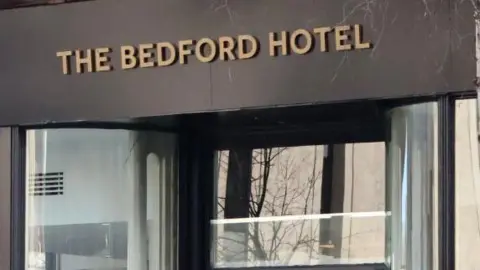
Opposite the City Hall the smart new Bedford Hotel is nearing completion.
But amid the optimism new official figures pointed to some of the struggles for the hospitality industry across Northern Ireland.
They suggest that over the course of 2025 the number of jobs in the sector fell by 2,000, from around 57,000 to 55,000.
That decline of 3.5% is in contrast to the economy as a whole where the number of jobs was up by 1.3% last year.
Most of the fall in hospitality jobs appears to have happened in the final quarter of the year, traditionally one of the busiest times.
An important piece of context is that hospitality jobs had reached an all-time high in the summer of 2025, before that decline later in the year.
But for Colin Neill of Hospitality Ulster, the data is proof of the industry's warnings about the cumulative impact of rising costs.
Across the UK those concerns have focused on employment costs, particularly the increase in employers' National Insurance contributions which was imposed in April 2025.
"The level of taxation that we have arrived at has made it impossible for some businesses to open days they don't make a profit. It's unsustainable," he said.
Neill said the impact was not so much about venues closing, rather that they are operating on reduced hours.
"We've seen businesses cut lunches and open partial weeks," he said.
"If businesses are cutting opening times, then they don't need as many staff.
"And that's where the job losses are coming from."
 PA Media
Neil Moore from the Unite trade union agrees that the sector is facing real cost pressures.
His concern is not just for people losing jobs, but those who face increasing stress at work as businesses try to operate with fewer people.
"Energy costs, business rates, National Insurance changes and wider economic factors are all having an impact," he said.
"But that cannot be used as a blanket explanation for what we are seeing in hospitality.
"What matters is how those pressures are responded to.
"Too often, the default is to cut labour costs.
"Hours are reduced, staffing is tightened, wages are squeezed, insecure contracts are relied on more heavily."
He also points to what economists refer to as underemployment, where someone has a job, but is not working as many hours as they would like.
"We are seeing people move into roles, even at slightly higher pay, and leave within weeks because the hours are too unstable," he said.
"Workers are fed up being at the beck and call of employers when it suits the business.
"When trade dips, workers carry the risk. That means taking second jobs, struggling between pay days or trying to piece together enough hours to get by."
Colin Neill defends the sector's employment practices: "We have casual labour, yes, but employees often prefer that. They value that flexibility."
He says that to ease the pressure on the industry it will take a big government intervention.
"It is going to take something seismic to turn this situation around. To make a difference, we need changes to VAT or something massive."
