Water problems are stopping me from moving back to my home village

 BBC
BBCPeople from rural communities and businesses say areas are being left "devastated" as the company that oversees Northern Ireland's wastewater network admits it is at "breaking point".
This means that in parts of Northern Ireland new houses cannot be built and businesses are unable to expand.
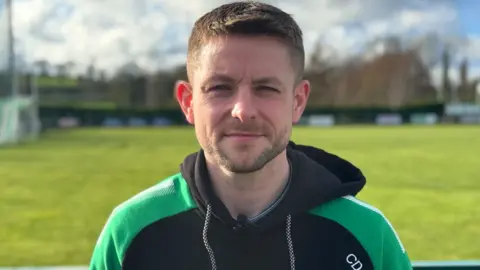
One man told BBC News NI he cannot move back to the area where he grew up due to a lack of houses, adding it was "extremely frustrating".
NI Water (NIW) acknowledged that the wastewater system "cannot cope during heavy rainfall" and that without further funding and urgent change there would be "persistent and worsening pollution".
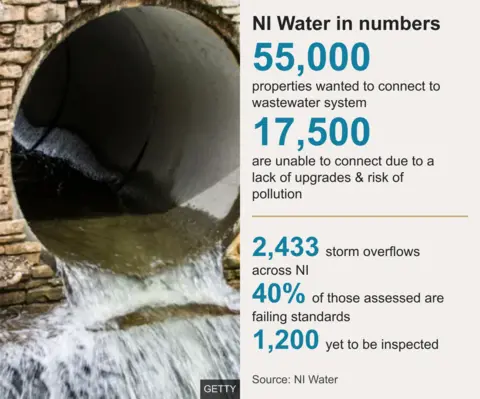
New figures obtained by BBC News NI show that by the end of last year, NIW estimated that more than 50,000 properties across Northern Ireland wanted to connect to the wastewater system.
However, almost 20,000 were unable to due to a lack of upgrades and the risk of environmental pollution.
'Many people are annoyed'
Ciaran Devlin's family have lived in the Loup area for more than 100 years - this rural village lies near Magherafelt, on the western shores of Lough Neagh.
But he is unable to move back there due to a lack of houses and the availability of a proper water infrastructure to connect new properties.
"It's extremely frustrating, because when you grow up somewhere rural like this you have a bond with the place," he said.
"I know a lot of young people who want to raise their families here but can't, and it's left many people very annoyed."
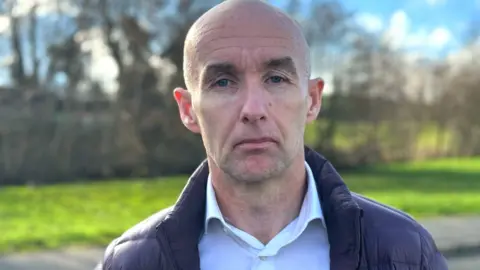
Architectural Technologist Ryan Dougan says that in the last 25 years there have only been about 10 or 12 houses built in the Loup.
"Unfortunately this has led to the Loup losing people to other areas and this impacts things like numbers attending the local GAA club and the school," he said.
"There's a proposal for 65 new houses in the Loup and the response from NI Water is that there simply isn't enough water capacity, and people in this area are pleading for houses."
Last week, the infrastructure minister announced plans for a voluntary scheme for developers to contribute to the costs of upgrading NI Water's wastewater infrastructure.
The scheme was criticised by house builders' lobby groups.
NIW has also confirmed that there are issues with the wastewater network in Cookstown.
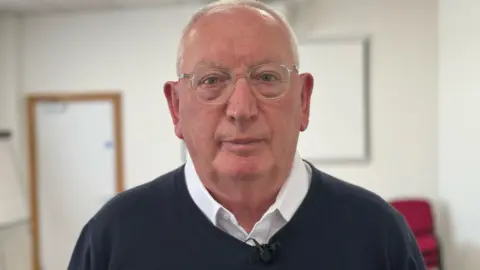
Jim Eastwood from Cookstown Enterprise Centre says water constraints in the town were a devastating blow to growing businesses in the area.
"A busy bakery we've supported on the main street of Cookstown can't move into a bigger premises because they cannot get a water connection," he said.
"It's devastating for a town like this, I'm just surprised and disappointed it has been allowed to get to this stage."
Mid Ulster Council's Chief Executive Adrian McCreesh said it was "extremely disappointing" that development was being hindered.
Speaking at a recent council meeting, McCreesh said: "There are ratepayers and citizens who can't live in the communities in which they were born and reared.
"It is soul destroying to hear this year after year. The message doesn't change."
McCreesh was speaking as NIW gave a presentation to the council last month.
NIW acknowledged that some parts of the country were experiencing "severe restrictions on new housing developments" and that this was also leading to "slower business development".
It outlined the "significant funding constraints impacting delivery of upgrades needed to support housing, economic growth and environmental protection".
But it said there was investment in a number of wastewater treatment works including in Dungannon, Ballygawley and Moyola.
What about pollution?
 Leslie Crozier
NIW also said that without urgent change to the wastewater system Northern Ireland faces another big problem - "persistent and worsening pollution".
Figures from the Northern Ireland Environment Agency show that agriculture remains the largest overall source of water pollution in Northern Ireland, although NIW is also a significant contributor to pollution incidents.
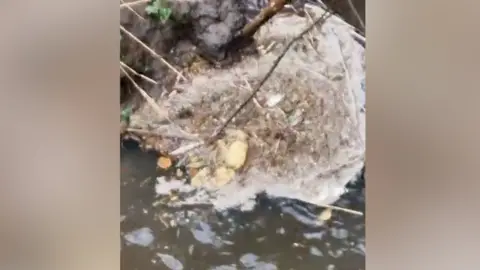
Fisherman Leslie Crozier has filmed discoloured water in Omagh's River Drumagh recently, as well as baby wipes and what appears to be human waste in the River Strule.
Crozier said: "I couldn't believe what I was seeing, I saw actual toilet sewerage material and things like sanitary products. So how can that be treated water?"
"NI Water often puts the blame onto others, when their own website shows how many times they discharge sewerage into our rivers and there should be tougher punishments for them when they break the rules."
A spokesperson for NIW said its investigation found that it was "operating normally in the area" and that it believed the discoloured water in the River Drumragh could be "mud silt arising from a construction site further upstream".
NIW said it had not been made aware of any issues in the River Strule, but that blockages could add to pollution incidents urging people to be mindful.
For almost 20 years, NI Water has been protected from the severest pollution fines because of a special arrangement that acknowledges its outdated and underfunded infrastructure.
Earlier this month the Environment Minister Andrew Muir said reforms could see NI Water face tougher punishments for issues in the waterways.
Is there a solution?
Northern Ireland is the only part of the UK where households do not pay directly for their water.
Instead, NI Water receives a government subsidy which diverts more than £300m annually from the Stormont Executive's budget.
Households previously paid for water through a portion of their rates bill but that link was broken in 1998.
However, a report in June 2025 suggested that a £100 increase in the average household rates bill could largely solve Northern Ireland's water infrastructure crisis.
