The secret group exposing bogus veterans like the fake admiral
While many would have been shocked to see a retired teacher posing as a fake admiral at a Remembrance Sunday ceremony, for a secretive group of ex-services personnel it was unsurprising.
For more than a decade, a group of anonymous veterans known as the Walter Mitty Hunters Club say they have made it their mission to help expose frauds posing as military service men or women.
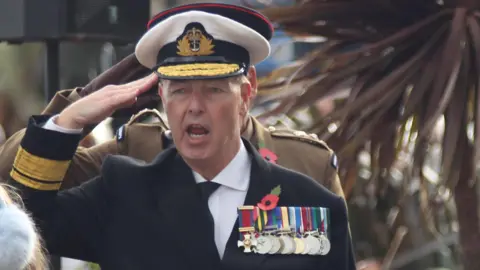
Imposters like Jonathan Carley, who was fined £500 for dressing as a rear admiral without permission, complete with an array of impressive but unearned medals he bought online.
"The reality is that these groups have emerged because our formal systems struggle to respond quickly or decisively," said Dr Leanne Simpson, a behavioural psychologist.
She said tracking down and exposing any impostors among them helped veterans meet a need for justice.

 Tony Mottram
Carley was investigated by police and prosecuted after veterans at the Llandudno memorial event in November 2025 raised the alarm with authorities - but some who witnessed Carley's behaviour also chose to contact the Walter Mitty Hunters Club in the hope that one of the group's 48,000 Facebook followers might know more about him.
Walter Mitty is a term sometimes used to describe a person who fantasizes about a life more interesting and exciting than their own.
Those behind the Walter Mitty Hunters Club would not speak to me directly - or tell me who they are - but in message exchanges told me they were all ex-service personnel. They claimed the secrecy was necessary to protect them and their families from being targeted for exposing fakes.
Equally, they would not tell me what contacts or research they used to build cases against imposters, but their website and social media is full of exposés on individuals they claim are fake service personnel, military charity scammers or those inflating their service records.
The BBC has not corroborated these individuals or whether they genuinely have military records.
Some may disagree with the way the group publicly outs fakes, but the Walter Mitty Hunters Club claims the behaviour of military imposters like Carley is akin to having a stranger turn up at your dad's funeral, claiming to be your uncle.

With so much at stake, why would anyone say they have served in the forces when they haven't?
"In general terms people do this because it gives them status," said Neil Greenberg, a professor of defence mental health at King's College London who has dealt with military imposters in the past.
Greenberg, who himself served in the Royal Navy for 23 years, said for some people dressing up or pretending to have accomplished things they had not could act as a quick dopamine hit and an incentive to persist with the lie.
"I've probably seen 10 or 15 [Walter Mittys] over the years, I've never had anyone who has put their hands up and said, 'fair enough, you found me out'," he added.
"Mostly these people, when you push them and they're clearly going to be found out, they fall back to, 'Well, you weren't there. You wouldn't understand'.
"Secrecy is often used as an excuse for why they can't tell you something."
Those seeking to call out fakes say the Official Secrets Act is a common tactic used to dodge difficult questions and is often a red flag, along with anyone claiming to have forgotten their service number.
 PA Media
Carley, a 65-year-old former history teacher, admitted wearing a uniform or dress bearing the mark of His Majesty's Forces without permission.
But his motivations "baffled" those seeking to catch him out as he did not appear, as others have, to be doing it for money, influence or to impress a love interest.
In Carley's case, witnesses who saw him said he was actively trying to avoid talking to people despite putting on a uniform so high-ranking it made it almost impossible to avoid scrutiny.
At his police interview, Carley said the reason he dressed up as a fake admiral was to feel a sense of "belonging and affirmation".
The Crown Prosecution Service confirmed Carley was the eighth person to be charged with wearing military uniform without permission in England and Wales over the past decade.
But there is no law for those wearing unearned medals - or those who simply lie about their background without dressing up in uniform.
"It's about the disrespect, both for the people who have passed away but also for those that are currently away serving," explained Graham Jones, a former Royal Marine who spotted a different so-called Walter Mitty at a Remembrance parade near Wrexham a decade ago.
"It does play on your mind. It also makes you very cautious of someone who is not familiar to everyone else."
Jones said he spotted his Walter Mitty dressed as "a senior rank in the RAF" and "wearing medals he wasn't entitled to".
The 61-year-old said it was distressing at the time, but it was not until police later confirmed the man had been a fake that many attendees felt truly angry about what had happened.
Now Jones is CEO of veterans' charity Woody's Lodge, and said he and many other veterans closely followed the work of groups like the Walter Mitty Hunters Club to protect themselves and others from harmful fakes.
"Knowing about fakes means we can keep an eye on it and resolve issues quietly without putting genuine veterans through anything else. We want to keep our veterans from them because it can have a detrimental effect on their mental health."
Jones said many in the veteran's community felt Walter Mitty hunters were doing a public service, but cautioned there was always the risk of causing harm to the individual being targeted.
Simpson said the challenge was how to hold imposters to account proportionally on such an emotive subject for many.
"Public exposure also acts as a deterrent, reducing the social rewards that fuel this behaviour," explained Simpson, who has worked with military personnel for the past 15 years.
But she said there were risks too, with the possibility groups could accidentally target individuals "whose behaviour is rooted in vulnerability rather than malice".
"Imagine being so uncertain of your own worth that you borrow someone else's identity just to feel seen," she said.
Why risk it?
So who would risk the public shame of being outed as a fake?
"In my opinion, there isn't a single profile," explained Simpson.
"Some individuals are motivated by tangible rewards, such as financial benefits, access to housing, services, or charitable support. Others, as in the case of Jonathan Carley, are driven by social rewards: sympathy, admiration and a sense of moral credibility that military service carries."
The Royal British Legion urged anyone with information about a potential military imposter to report them to police.
"The Armed Forces community take great pride in wearing uniforms and medals in recognition of their service and sacrifice and the actions of individuals whose intentions are to falsely present themselves as serving personal or veterans in receipt of medals can cause great offence."
