The team working against the clock to resurface an airport runway

 BBC/SAM READ
Every 20 years or so airport runways need to be resurfaced to meet safety regulations, but how does it happen without flights being cancelled?
Over 95 nights at London Luton Airport a team of contractors have five hours and 44 minutes to make progress resurfacing a 1.3-mile (2,092-metre) runway before having to clear it for the first flight of the day.
The project, which began in November and is scheduled to finish in March, involves 120 people using 70 vehicles and is costing £18m.
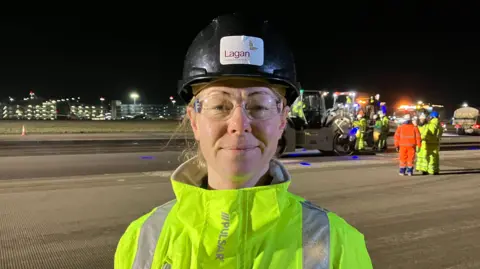
"The challenge every night is to get off on time," says Travis Biddle, who is responsible for all the asphalt laid on site.
So far the team from contractor Lagan has met the challenge and resurfaced a 66.5m (218ft) strip of runway every night.
 BBC/STEVE HUBBARD
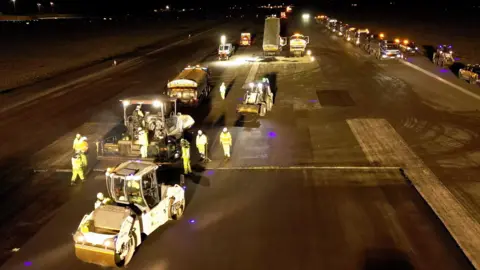
In the early hours on 5 February the contractors took control of the runway 20 minutes earlier than the usual scheduled time of 00:01 GMT.
The airport takes back responsibility by 05:45, so the first plane can leave on time.
Within a minute of taking control, the contractors light up the runway with stadium-style lighting.
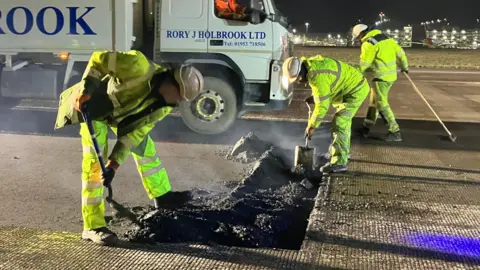
Within five minutes, planing machines have started removing 15cm of runway's surface, in preparation for new asphalt to be laid.
Across the project 30,000 tonnes of asphalt will be used, which has been made at a facility built on site.
A similar amount of material will be removed from the runway and recycled.
 BBC/SAM READ
The project also includes upgrading 905 lights and 24 miles (39km) of cable.
"The pressure is actually good to keep you on track," says Brandi Davey, the project's manager.
"You stay focused, you understand what your delivery is each shift and you make sure it happens.
"We would always like more time, but it is achievable what we are doing every single night, we've proven it," she adds.
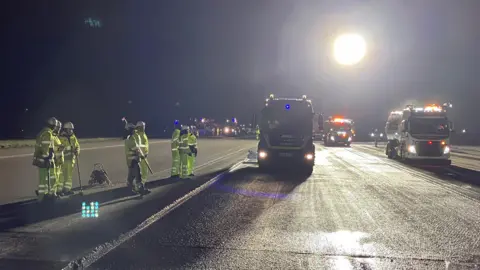
On 5 February, the night ended with a convoy of vehicles inspecting the runway to make sure no defects or debris that could interfere with an aircraft had been left behind.
Lagan handed back responsibility for the runway to the airport at 05:37, eight minutes ahead of schedule.
This allowed a smooth getaway for passengers on board the first flight of the day, the 05:50 Wizz Air departure to Bratislava.
 BBC/SAM READ
Marc Wolman, the infrastructure director at Luton Airport, says it is a "massive, significant project" and adds that watching the team in action is "impressive".
"Literally, they just know where each other is every night and they mobilise almost automatically.
"We've had snow, we've had rain, wind. If it gets too cold, or it's too windy or there is too much rain we can't resurface and that takes pressure into the programme for us to recover later on," Wolman says.
 BBC/SAM READ
The resurfacing work is required to meet safety regulations and is not part of a planned expansion of the airport.
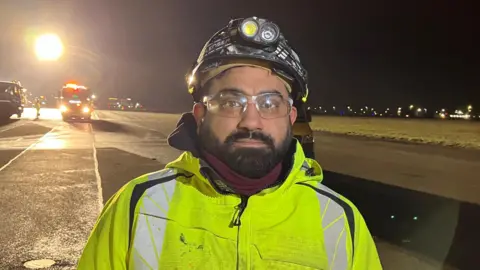
"It's the best [job] in the world isn't it?" says site agent Suresh Patel from Walsall, Staffordshire, who has worked on airport infrastructure for 13 years.
"Building airfields, working on runways, so people can go on holiday and come back safely...it's good," he adds.
Follow Beds, Herts and Bucks news on BBC Sounds, Facebook, Instagram and X.
