How Oxford to Cambridge became a 'growth corridor'

 Getty Images
The Oxford-Cambridge growth corridor may not have the most catchy name, but the government believes it will add up to £78bn to the UK economy by 2035.
Also known as the Ox-Cam Arc, or "Europe's Silicon Valley" according to Chancellor Rachel Reeves, the potential of this region has been discussed for decades. But why is this area so significant and what is East West Rail's role in the project?
Where is the Oxford-Cambridge growth corridor?
The growth corridor falls in the area between Oxford and Cambridge, including Oxfordshire, Northamptonshire, Buckinghamshire, Bedfordshire and Cambridgeshire.
Parts of Hertfordshire are also included as they lie within the "golden triangle" – the area between Oxford, Cambridge and London - which is home to many firms working within knowledge-intensive (KI) industries, such as advanced engineering, life sciences, technology and defence.
Why is the corridor important to the economy?
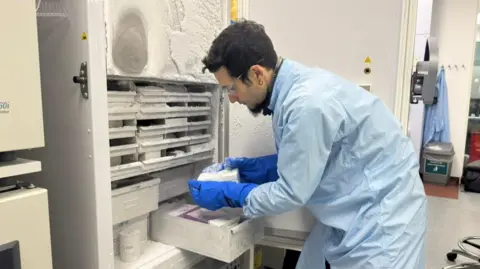
The region of the growth corridor is home to 3,000 KI companies, including AstraZeneca, GSK Ltd (formerly GlaxoSmithKline), Red Bull Racing, Airbus, Arm and Darktrace.
The KI firms employ an estimated 152,000 people and have an annual turnover of £45bn.
Overall, businesses in the corridor generate £135bn in annual turnover and employ 570,000 people, which indicates KI companies generate more money per employee.
New research from the Oxford-Cambridge Supercluster Board - a group made up of businesses, investors and universities from the region - shows over the past 10 years employment has grown 50% faster in the corridor than elsewhere in the UK, and outperformed the national economy.
The report also found growth in Milton Keynes and Stevenage is now equal to that of Oxford and Cambridge.
Why do firms want to be in the region?
The corridor is bookended by Oxford and Cambridge and their universities produce more spin-out companies than any others in the UK.
Many of the companies are founded by graduates who want to turn their research into commercial products and services, such as medical devices, new drugs and engineering techniques.
The reputation of these cities also helps the companies attract investment, which enables them to grow and create jobs.
The universities - alongside others such as Cranfield University in Bedfordshire, which is leading for aerospace engineering - produce skilled workers, which has encouraged other companies to set up in the region.
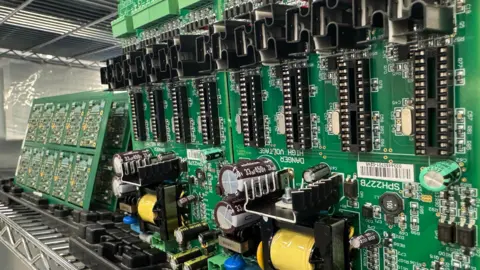
Jaltek, an electrical engineering and manufacturing firm based in Luton, has 115 employees who design and build products such as black box recorders for planes and circuit boards for medical devices.
The company says it has doubled its revenue since 2020 and grown by 38% in the last 12 months.
"Being part of the arc is brilliant for us," says Steve Pittom, its managing director.
"It's the access to the students, the start-ups spawned from the universities looking to develop products.
"Half of our work comes from the Oxford-Cambridge region, in areas like oil and gas, green energy and data centres," he adds.
He says Jaltek chose Luton because it "costs a fortune to be in Cambridge and Luton is affordable with great connections, which are only going to get better with East West Rail".
Proximity to like-minded companies also allows for collaboration and the sharing of resources.
Why is Stevenage growing?
 Supplied
Stevenage has become a hub for life sciences and defence engineering, which are two of the government's priority industries.
Pharmaceutical giant GSK Ltd employs 2,500 people in the town, conducts clinical trials at Addenbrooke's Hospital in Cambridge and prepares drugs for trial at its site in Harlow, Essex.
Similarly, Stevenage Bioscience Catalyst provides a site for start-ups to establish themselves and grow, such as biotechnology company Autifony.
Complement Therapeutics is also based in Stevenage, which has grown from two to 20 staff in the last four years. It recently gained approval to start clinical trials for a drug to treat age-related macular degeneration.
Rafiq Hasan, the firm's chief executive, says Stevenage was chosen "because of its connections to London, the access to phenomenal scientific talent, and the cost of lab space and housing for staff".
"It's also really collaborative. We can learn from each other and share resources - maybe we don't have a specific piece of lab equipment but someone else here does," he adds.
Stevenage is also home to Airbus Defence and Space, which designs and manufactures spacecraft such as satellites.
In January it opened a new facility in the town to support smaller companies developing new technology for space and defence.
What is the impact of new jobs in the region?
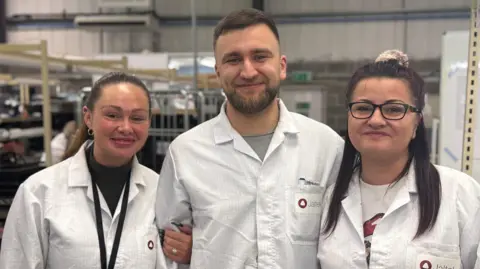
Michal Smola, 25, from Bedford, says having a company such as Jaltek nearby opened up a career he never thought he would have.
Smola says he "started off putting screws into boxes in my college holidays and now I'm a supervisor, able to programme the machines".
His parents and brother work at the company and it is also where he met his partner, Natasha.
"I was studying IT at Bedford College but I wanted to use my hands. I've done a lot of growing here. I'm really grateful," he says.
Employment opportunities bring greater demand for housing and the corridor has been earmarked for a million new homes by 2050.
Milton Keynes and Tempsford, Bedfordshire, have been identified as possible locations for new towns.
Both are on the EWR route and a new station is being planned for Tempsford, which could be transformed from a village of about 300 homes to a town of several thousand.
Stop the Arc, a campaign group, is opposing the scale of the growth and is questioning where the commitment is to build the "schools, clinics, hospitals, water and electricity supplies, waste and sewage disposal" necessary to support the new infrastructure.
The group also objects to the growth corridor's impact on the environment and disputes the claims about the region's economic potential.
What is East West Rail's role?
EWR will connect Oxford and Cambridge via Milton Keynes, Bedford, Tempsford and Cambourne.
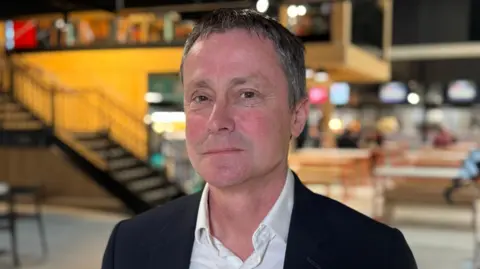
Andy Williams, the chair of the Oxford-Cambridge Supercluster Board, said: "[EWR is] critical to growth. It creates an integrated region of three-and-a-half million people and if you want to compete on a global scale, you need a global scale cluster.
"The weirdness right now is if you want to have a meeting involving Oxford, Cambridge and Milton Keynes the only place to do it is London, because it's the only place everyone can easily connect to."
In-person meetings are considered important for ideas but essential for demonstrating products.
As a manufacturing business, Jaltek said its clients often want to visit the factory. "It's partly why they choose us and not somewhere in Asia and East West Rail will make that easier," Pittom says.
Luton is not on the EWR route, however, Rachel Hopkins, the Labour MP for Luton South and South Bedfordshire, said it will open up educational and employment opportunities for the town's young population who can access EWR by changing trains at Bedford.
Complement Therapeutics in Stevenage said connections to London have been the priority so far, but EWR "could open up future collaborations with Oxford and Cambridge".
Shaun Grady, the chair of AstraZeneca UK, said: "East West Rail is vital infrastructure that will knit together labs, campuses, and urban centres into a single labour market, driving economic growth, and ensuring the UK benefits faster from scientific advances."
The Oxford-Cambridge Supercluster board has called on the government to accelerate its review of EWR's development consent order, once submitted next year, to ensure the whole project is signed off during this parliament.
The Department for Transport has been contacted for comment.
The construction of EWR is a controversial issue for many people living near the new route, as homes may be demolished and construction will cause disruption to communities and the environment.
East West Rail Company is holding another series of meetings with local communities along the proposed route to explain the impact, ahead of submitting the development consent order.
Follow Beds, Herts and Bucks news on BBC Sounds, Facebook, Instagram and X.
