Reeves says 'more to do' after sluggish GDP growth

 PA Media
Chancellor Rachel Reeves has said there is "more to do" after the UK economy saw a lacklustre end to 2025.
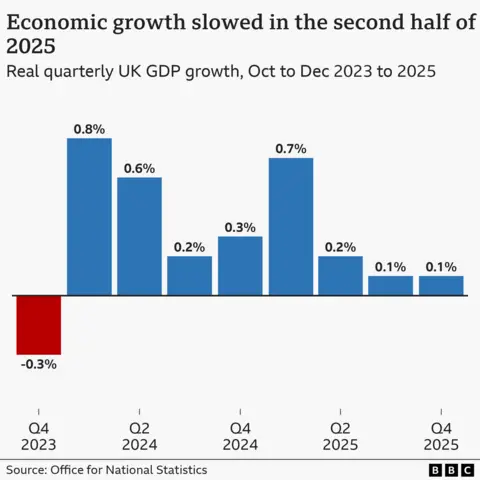
The economy grew by 0.1% in the last three months of the year, the Office for National Statistics (ONS) said, which was slightly slower than economists had expected.
The ONS said the overall picture for growth towards the end of the year remained "subdued".
Reeves pointed to the full-year figures, saying that the economy's 1.3% growth for the whole of 2025 had topped analysts' forecasts. But the Conservatives said Labour had "weakened our economy".
Labour has made growing the economy its number one priority since coming to power.
But the Office for National Statistics (ONS) said that there was no growth last quarter in the crucial services sector for the first time in two years, with the slight overall boostto GDP driven by an increase in manufacturing.
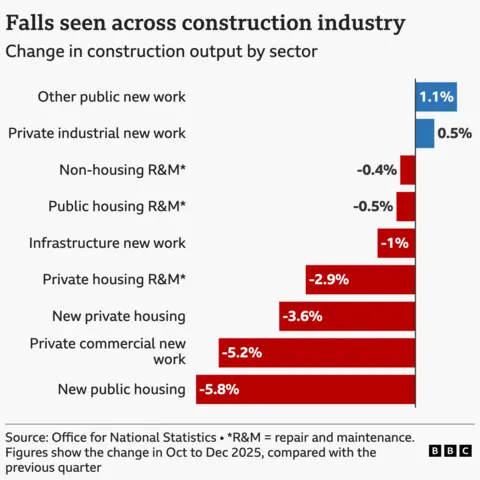
The construction sector, meanwhile, suffered its worst quarterly performance in four years, the ONS added.
Reeves said that 2026 would be the year the British public start to feel the positive impacts of Labour's changes.
Speaking to reporters, the chancellor said the UK's economy was the fastest of the European G7 economies in 2025.
"Crucially, GDP per head of the population has increased over the last year after falling in the previous parliament," Reeves added
"Is there more to do? Absolutely. But we've created the conditions for growth and I am confident this will be the year we will see the results of that," she said.
The economy is estimated to have grown by 1.3% for the whole of 2025, a slight uptick from 1.1% growth a year earlier, but lower than the 1.4% forecast by the Bank of England.
In December alone, the economy grew by 0.1%, the ONS figures showed, while November's monthly growth figure was revised down from 0.3% to 0.2%.
Construction activity fell by 2.1% over the final quarter of 2025, with a fall in repair and maintenance work, as well as a drop-off in the amount of new construction work being started.
New private housing saw the third-largest fall in output of the nine construction sectors in the three months to December.
But the ONS said it was the largest contributor overall to the fall in construction output. This is likely to be because it makes up a large share of overall construction activity.
In the services sector, which accounts for around 80% of the UK's economic output, the largest drag on growth at the end of the year was professional, scientific and technical activities.
That was following by education, arts, entertainment and recreation, and financial services.
But growth in areas such as administrative services, including travel agencies and tour operators, and IT meant the sector flatlined overall.
The economy was helped in the quarter by Jaguar Land Rover, with the carmaker bringing production back online after a major cyber-attack. But a period of uncertainty in the run-up to November's Budget, with speculation about tax changes, caused companies to withhold investment.
Liz McKeown, ONS director of economic statistics, told the BBC's Today programme: "The overall picture as 2025 drew to a close continued to be one of subdued growth."
Ruth Gregory, chief UK economist at Capital Economics, said the "disappointing" growth figures suggested Britain's economy "still has very little momentum".
Speaking to reporters, Reeves said: "The economy grew in 2025. At the beginning of last year, forecasters said our economy was going to grow by about 1%... we beat those forecasts, the economy grew by 1.3%.
But shadow chancellor Sir Mel Stride said Labour has "weakened our economy".
"These disappointing statistics show a Downing Street and a Treasury that have taken their eye off the ball," he added.
The Liberal Democrats said Reeves' first two Budgets as chancellor had "killed off the economic recovery our country so desperately needs".
Business group the British Chambers of Commerce (BCC) said 2025 had been "marked by uncertainty and rising costs for firms across the country".
It said surveys of business leaders showed taxes and rising inflation were their top two concerns.
Bosses have consistently complained about the rising tax burden, with particular concerns about how the chancellor's hike in employer National Insurance contributions drove up the cost of hiring for firms.
'We've not been able to employ youngsters'

Nigel Day, who runs a heat pump installation business in Ipswich, said uncertainty around November's Budget had left his customers wary about spending.
He added he had faced difficult choices in order to keep his company in business.
"Increases to the minimum wage have meant that we've not been able to employ the youngsters into the business - they're too expensive to have just as an extra pair of hands," he said. "And we have had to refrain from taking any apprentices."
Last week, the Bank of England kept interest rates on hold in a narrow decision, but cut its forecast for economic growth this year to 0.9%, down from a previous prediction of 1.2%.
At the same time, it raised its expectation for the unemployment rate, from an initial forecast of 5% to 5.3%.
This raised expectations of a rate cut in the next few months, and Rob Wood, chief economist at Pantheon Macroeconomics, said the latest growth figures would do little to stop those in favour from "pushing ahead with a rate cut in March".
However, he added that "economic momentum" would make it the last rate cut of the current cycle.
But Suren Thiru, economics director at the Institute of Chartered Accountants in England and Wales (ICAEW), said an interest rate cut in March was "doubtful".
He said the slight increase in economic output would give policymakers the "comfort" to wait for more evidence inflation is slowing.
