Cold water warning for New Year swimmers

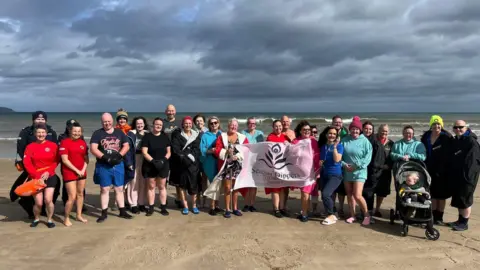 Seacoast Dippers
Swimmers set to brave the icy waters of the Irish Sea and North Atlantic Ocean to mark the start of 2026 should be aware of the potential dangers involved, the Royal National Lifeboat Institution (RNLI) has warned.
New Year's Day dips are scheduled to take place at beaches across Northern Ireland on Thursday.
Often raising money for charity, the events range from a tentative paddle in the shallows to a swim out into the bay.
The RNLI said winter sea temperatures of 6–10°C (42.8–50°F) - far below the 15°C (59°F) point where cold water shock becomes a serious risk - could quickly turn a fun tradition into an emergency.
Gareth Morrison, the charity's head of water safety, said: "We are urging anyone entering the water to be aware of the dangers, check sea conditions carefully and to understand their own limitations."
Northern Ireland recorded its coldest night of the winter on Tuesday and more cold weather is expected.
Speaking to Radio Ulster's Evening Extra programme Mr Morrison said: "The definition of cold water is anything below 15 degrees and, in fact, the water around our coastline at the moment is anywhere between six and 10 degrees, so it really is cold.
"With that in mind, never go alone. Don't be tempted to do one of these dips or swims alone, it's just not worth it," he added.
"Go with a buddy and go to somewhere you're familiar with. Don't try somewhere new for the first time tomorrow, it really isn't the right day for it."
Mr Morrison also said that wearing a wetsuit "is not cheating" and advised swimmers to wear a brightly coloured hat.
"That will both keep you warm but also help you be seen by the emergency services if indeed there is any kind of incident."
"There's no need to jump in, you don't get any extra points for jumping in.
"So walk in, go in slowly, splash some water in your face and shoulders and just allow your body that 20/30 seconds to acclimatise and that will mitigate cold water shock."
What are the dangers of cold water dips?
Cold water shock, hypothermia and swim failure are the main dangers, particularly in very low winter sea temperatures, which can quickly overwhelm the body and breathing, according to the RLNI.
Cold water shock is the body's sudden, uncontrollable reaction to cold water, causing rapid breathing, panic and loss of control.
Hypothermia happens when the body loses heat faster than it can produce it, while swim failure is when cold and fatigue weaken muscles, making it difficult or impossible to keep swimming.
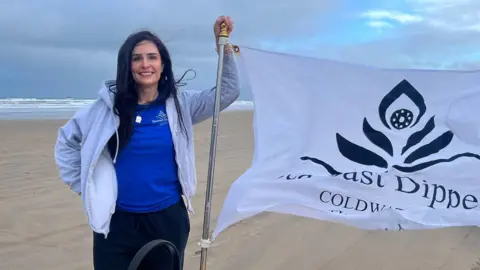 Ann-Marie Harkin
Ann-Marie Harkin runs a mixed-age group who do cold water dips at Benone Beach near Limavady.
"We're cold water dippers, we're not swimmers. On the actual day, I will give a safety talk to everyone taking part," Ms Harkin said.
"The time is what really does keep you safe out there."
She added that about three to five minutes is the maximum time people should spend in the cold water.
"It's enough to get the full benefits of it," she said.
"The main reason is for the mental health benefits side of it, and it has been proven cold water therapy is very good for that."
Research and personal accounts suggest cold water swimming may offer mental and physical health benefits, although experts say there is no established scientific consensus.
'Plenty of warm layers'
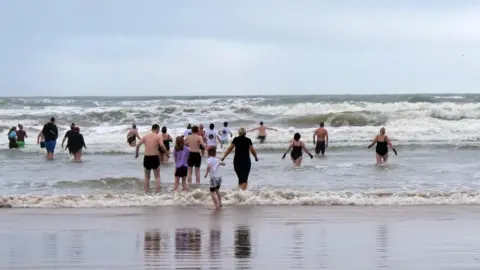 Seacoast Dippers
She advised people to bring plenty of warm layers for afterwards, as well as hot drinks and sugary snacks to help the body recover.
Ms Harkin founded the group, Seacoast Dippers, about four years ago after enjoying a New Year's Eve cold water dip in Donegal.
"I'm so excited it's a brilliant big community that just seems to be growing each year," Ms Harkin said.
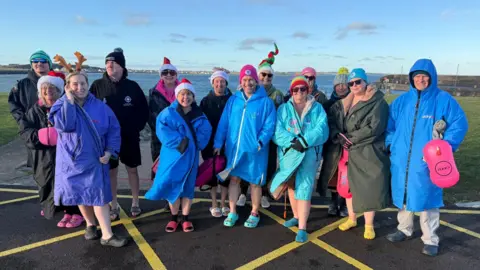 Burr Point Buoys
Stuart Reed and Jordon Higginson are members of Burr Point Buoys.
The sea swimming group swims daily outside Portavogie at Burr point, the easternmost part on the island of Ireland.
The group hold a swim event every New Year's Day and are planning to do so again on Thursday, pending a review of the weather and sea conditions.
"We're pretty confident that conditions tomorrow are going to be fine," Mr Reed said.
"Somebody's going to be down from nine o'clock basically, just to kind of make sure that a risk assessment is done ahead and we'll review that, before people get into the water."
Mr Higginson said about 50 people came to the event last year and he hopes they will see a similar turnout this time.
"It is a good event, especially down in the peninsula where there's a lack of events happening at this time of year," he said.
"It's just bringing people together for the worthy causes in the area."
Mr Reed added that the more experienced swimmers will be there to keep an eye on people and make sure everyone is safe.
"For anybody who hasn't tried it before, it's a really good way to meet new people, especially if you've just moved to an area and like there's a real brilliant sense of community from it," he said.
Mr Higginson advised people that if their planned swim was cancelled, not to go into the water by themselves.
"Just don't take any chances and make sure you just keep yourself safe and follow any advice that you can see online," he said.
