Why sauna culture is hotting up across the South

 BBC
BBCAt Studland Bay in February, the sun peaks behind a haze, the sea is a cool seven degrees celsius, and taking a quick dip has sent cold prickles up my body.
But after a swim, it is time to heat up in one of over 50 saunas that have popped up in recent years across the South of England, according to the British Sauna Society (BSS).
In fact, sauna culture is rapidly growing across the UK, with over 600 saunas available to the public, from beaches and lakes to rural settings.
So, why is this thousands-of-years-old Scandinavian tradition finding it's way to the UK?
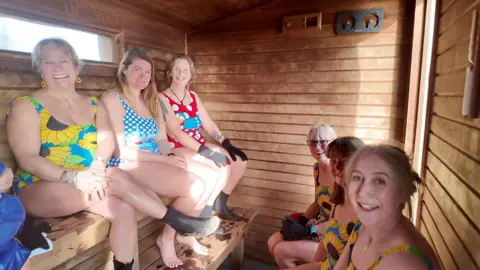
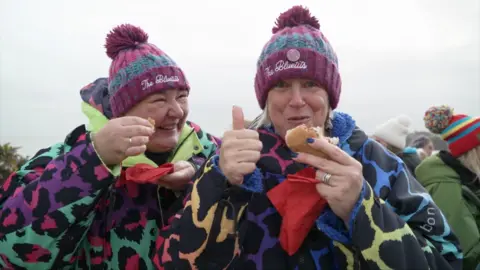
Community swimming group The Bluetits Chill Swimmers has over 150 groups worldwide, who meet to swim, chat, and soak up the sauna lifestyle together.
On my visit, the Studland group discuss the feeling of a cold swim followed by a hot sauna, with one member adding: "The rush of endorphins is like no other - it's like Prosecco without the bubbles."
Sarah Ceal, Studland Bluetits administrator said: "There's so many benefits. It helps your muscles, socialising and menopause [symptoms]."

Gabrielle Reason, director of the BSS, said it had seen an unprecedented rise in saunas since 2018, almost doubling year-on-year.
"I think there's definitely a sense for people to take ownership of their own health and community," she said.
"You feel very safe, you're in your swimmers, you see a lot of normal body types, [and] there's something about the heat that really causes people to open up and chat.
"Where we've seen a decline of things like the local pub - what people call these third spaces - we actually see saunas, and maybe cold water swimming groups, as popping up and really taking their place," she added.
New saunas are also expected this year, with Hello Outdoors planning to open in Lymington, the New Forest, and Saltwater Sauna in Boscombe, near Bournemouth.
But what is the science behind it?

Ant Shepherd, associate professor in clinical exercise physiology at the University of Portsmouth, said there was growing evidence that heat exposure can offer real benefits.
"There's some really lovely longitudinal data coming out of Scandinavia - comparing people who go in once, twice, four times - showing that if you use a sauna more frequently and more often, that your mortality improves."

But despite the benefits, he said hot environments can cause, dizziness, fainting and dehydration.
"Brits tend to stay in saunas longer than they should," Shepherd added.
"We strongly encourage people that are going to use hot and cold immersion to make sure that they're being appropriately supervised and keep properly hydrated," he said.
Where did saunas originate?
Saunas originated in Finland in 7000BC as a pit in the ground, with the wooden sauna we know today first built around 2000 years ago for health and socialising.
Today, traditional saunas are a small room - normally in a wooden building - filled with dry heat, and operating between 70 degrees and 100 degrees celsius.
The aim is to induce relaxation, sweating and additional health benefits, such as strengthening the immune system, improving cardiovascular health, and offering temporary relief of some chronic pain conditions.
Across the South, you'll find a mix of saunas, from single and private hire to communal ones, all at variable costs.
"I don't think around £10 per head for an hour sauna session is bad," Ceal says.
"There are also places now offering community saunas, so you pay what you feel it's worth, making it more accessible."
But the BSS would like to see a bigger change.
"Saunas in the UK were seen as [a] luxury [and] they were confined to spas.
"We hope leisure centres, swimming pools and lidos will have them soon, because they'll have local funding [and] would be able to [offer] subsidised rates," Reason said.
For now, after seeing the Studland Bluetits running from sea to the warmth laughing, it's clear the sauna trend is showing no signs of cooling down.
You can follow BBC Hampshire & Isle of Wight on Facebook, X, or Instagram.
