The 1975 marathon that 'opened it up for the ladies'

 Tony Wood
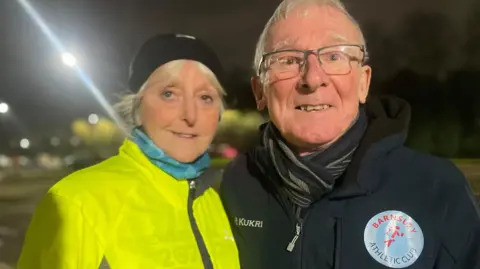
The final group session for Barnsley Athletic Club before Christmas is a bitterly cold affair, with a handful of men and women wrapped up in long-sleeved fluorescent jackets, hats and gloves huddling together in the town's Metrodome Leisure Centre.
As usual, the session is run by Dave Bennett, 77, who has been coaching at the club for over 50 years - and who, back in 1975, was responsible for a running revolution in Barnsley that changed the landscape for female runners across the UK forever.
According to a report from the time in the Barnsley Chronicle, on 30 November 1975 a total of 164 runners had lined up for only the second marathon in the town, but the headline news from the event was that six of the runners taking part were women - the first time that had happened in the UK.
As race director, Mr Bennett had made the final call to allow women to take part, and while women's participation in such events would be utterly unsurprising today, he says that at the time it was "a big decision".
"I think it was mainly the club committee and the members who decided, 'let's go for it'. I can't remember any objections," he says.
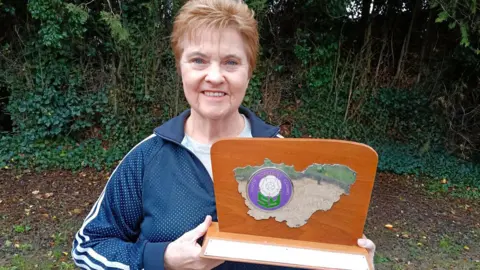 Hilary King
Today, members of Barnsley Athletic Club divide their sessions between the Metrodome and the Dorothy Hyman Sports Centre, the latter being named after the former Olympian who is from the town.
Now 84, Ms Hyman was a sprinter who won three medals at the 1960 and 1964 Olympics.
"Women were never allowed to run longer distances," she says.
In the 1964 Olympics, the longest event in which women could take part was the 800m.
In the US, women were not officially allowed to take part in marathons until 1972 when the Boston Marathon team accepted applications, and it was not until the 1984 Olympics in Los Angeles that female runners could take part in the summer games.
Ms Hyman admits she was "amazed" that Barnsley was the first to make history in the UK.
"It's brilliant because when I ran we didn't even have an athletics club in the town. I had to train in Thurnscoe."
 Simon Thake
According to the Barnsley Chronicle's report from the event in Barnsley in 1975, the six women who took part competed for the "unofficial British women's championship crown".
Hilary Matthews, then aged 22, from Blackburn, was the first woman to finish the race.
She did it in a time of three hours, 13 minutes and 27 seconds - a time which, as the Chronicle noted, "was faster than that clocked by 36 of the men".
In fact, the previous day, she had also won the Lancashire women's cross-country championship.
Now Hilary King, a retired PE teacher who lives with her husband in Toulouse and whose preferred sport these days is skiing, the 72-year-old says she vividly remembers that historic race in South Yorkshire.
"I drove over with my mum from Blackburn on the morning. The weather was shocking, though. There was freezing fog," she recalls.
"I remember my lips were frozen. I couldn't even speak at the end of it."
Ms King says that as a child she was a sporty girl, playing football before excelling in cross country for the Blackburn Harriers.
"You were a bit of an oddball if you were running," she admits.
Ms King says that in the weeks leading up to the marathon in Barnsley, there was a buzz among the local press.
"A journalist got hold of my number and was asking me daft questions like, don't you think it's too far, and, what do you think they're going to think when girls are running it?"
 Hilary King
An edition of Athletics Weekly published on 27 December 1975 shows Ms King holding her arms aloft celebrating her win.
She is pictured flanked on either side by the two other women who crossed the line first: Norma Campbell, a 47-year-old mother-of-three from Scotland, and Lesley Watson, from London.
Despite the buzz from local media - including TV cameras filming the event - according to Ms King, there was "no fuss" from the male athletes taking part.
"They were all supportive. I knew many of them from cross country events," she says.
However, Ms King does dispute one version of events from the Chronicle write-up.
At the end of the race, the paper describes how she "had enough strength left at the finish to outsprint Gordon Standish, of Barnsley Road Runners, who had run with her 'to give her a bit of help'."
"I didn't even know him," she chuckles.
"I read that this guy was pacing me and I'm, like, no, I don't think so. I just left him at the end."
When crossing the line, did she feel the significance of her win? It seems not.
"Not really. I was happy to win it, but I'm always happy to win a race," Ms King says.
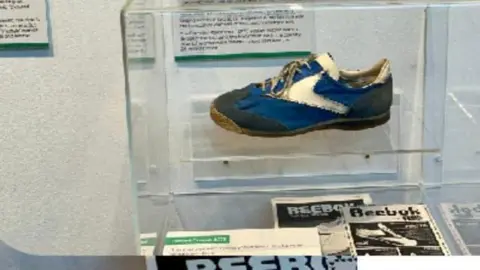
The Athletics Weekly front cover was a moment where the significance of the race started to register for the runner, who went on to receive sponsorship by local firm Reebok, although the photo itself was not one Ms King says she particularly liked.
"I was actually in bed. It must have been a Saturday morning or something, and I can remember my mum shouting upstairs, 'you've made it'.
"It looks like the other two women are trying to steal the trophy. It's awful," she laughs.
Ms King went on to an illustrious career as a club runner, taking part in three more marathons, including setting a time of two hours and 56 minutes at the London Marathon.
She very nearly represented Great Britain, too, in 1976, when she was called up for an international event on the Isle of Wight before it went on to be cancelled.
"When I look back, I think we did it. But, then again, I didn't change the rules. I just enjoyed it - not for any women's battle or anything. I just loved competing."
Mr Bennett's wife, Anne, 74, who was a volunteer marshall for the historic race in Barnsley, remembers the event was "definitely significant".
"I just helped out, marshalling at the feed station and drinks at the end, but I was very proud of those women," she says.
"It was just not right, was it? Clearly, they could run just the same as the men. I don't know why it never happened before."
Back at the last pre-Christmas session at the Metrodome in December 2025, Mr Bennett shouts out encouragement to the latest athletes braving the elements.
He admits that the 26.1-mile race in Barnsley in 1975 really did "make a difference".
"I'm proud we opened it up for the ladies," he says.
Listen to highlights from South Yorkshire on BBC Sounds, catch up with the latest episode of Look North
