Passerby lifesaver urges other tradesmen to carry defibrillators
"Did you by any chance save somebody's life in Bedford Street the other day?"
An unexpected text message for anyone to get, but for Dale Lee the answer was yes.
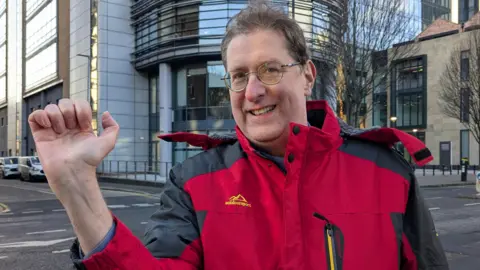
The man asking the question was Jonathan Burns who had collapsed after having a cardiac arrest on the way home from work.
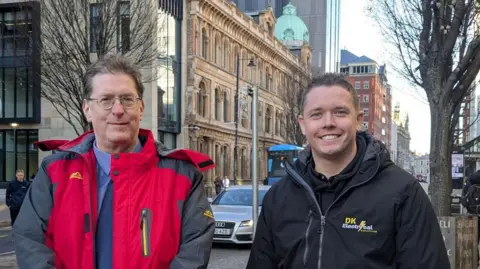
Dale, an electrician, had begun to carry a mobile defibrillator in his work van after an advanced first aid course six months earlier and this was the first time he had had cause to use it.
Now, he urges other tradesmen to carry them too, because tradesmen are "out and about in people's houses" and can be in the right place to help when things go wrong.
On his way to work in April, Jonathan started to feel pain in his back, chest and arms, followed by nausea.
"I very foolishly put it down to coming down with a cold and completely ignored the symptoms," he told BBC News NI.
The symptoms, which are indicative of a heart attack, persisted, but the seriousness of the situation did not properly register with him at the time.
Later that afternoon, he collapsed in the street having suffered a cardiac arrest.
"I don't remember the three-minute walk to Bedford Street where I collapsed," he said.
It was there that Dale saw him lying on the footpath.
An electrician for 14 years, Dale had only installed a rented defibrillator after hearing about them on an advanced first aid course.
He was motivated to get one by a family member having had a heart attack.
"I checked for a heartbeat and couldn't feel it," he said.
"I put the pads on and it told me straight away to start compressions, which we actually had done, then it told me to step back and do rescue breaths, and then hit a button and stop them, that was the defibrillator doing its work.
"When the paramedic arrived he did tell me that I had saved his life."
Jonathan said he recalled starting to hear voices.
"I woke up lying on the ground with people looking down at me. Initially I thought I was dreaming."
He was then taken to the Royal Victoria Hospital.

The British Heart Foundation said anyone could use a defibrillator, whether they have training or not.
The kit will talk users through the process with voice instructions as well as checking the person's hearth rhythm to determine whether a shock is needed.
Later that evening Dale was "in shock" and worried about whether he had done the right thing when the paramedic rang him "to say Jonathan was OK".
"It was a lot of relief," he said.
"It was a weight off my shoulder in case I had done something wrong or made things worse."
'Did you by any chance save somebody's life?'
The story might have stopped there except the paramedic slipped Dale's business card into Jonathan's bag.
After a stay in hospital where he had a stent fitted, and keen to thank the man who saved him he sent the text.
It turned out they were in fact close neighbours and met for coffee.
"I'm very lucky to be alive," he said.
"If I had stayed longer in work we would have missed each other and I would have been dead. It's one of those what if scenarios where I sort of think: 'Boy am I lucky!'
A report from the Resuscitation Council UK found one-in-four people survived a cardiac arrest in hospital, while the British Heart Foundation said the survival rate outside of hospital was fewer than one-in-10.
Heart attack symptoms
Chest pain - a sensation of pressure, tightness or squeezing in the centre of the chest
Pain in other parts of the body - it can feel as if the pain is travelling from the chest to the arms, jaw, neck, back and abdomen
Feeling lightheaded or dizzy
Sweating
Shortness of breath
Feeling sick (nausea) or being sick (vomiting)
Overwhelming sense of anxiety
Coughing or wheezing
Although the chest pain is often severe, some people may only experience minor pain, similar to indigestion. In some cases, there may not be any chest pain at all, especially in women, elderly people and people with diabetes.
