Study examines impact of under 16 social media ban

 Getty Images
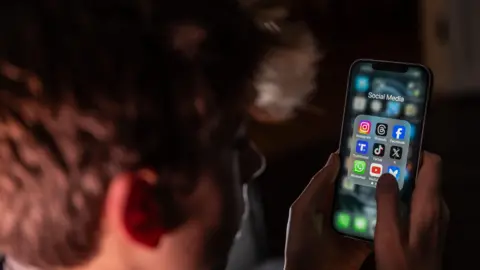
Thousands of schoolchildren are set to take part in a study to examine whether or not limiting social media use can improve the mental health of teenagers.
The IRL (In Real Life) trial will track around 4,000 secondary pupils in Bradford aged between 12 and 15, with each given a "daily budget" of time to use certain apps, as well as being barred from social media between 21:00 and 07:00.
The results of the impact on those children will be compared with youngsters who use social media normally.
Details of the study were announced as the government said it would consult over a possible social media ban for under-16s in the UK.
During the trial researchers from the Bradford Centre for Health Data Science and the University of Cambridge will compare levels of anxiety, depression and sleep between the groups.
Levels of bullying and the amount of time spent with friends and family will also be measured.
Dr Dan Lewer, lead of the Bradford Centre for Health Data Science said: "We talk a lot to teenagers. A couple of things we've learned [is that] they're very aware of the potential harms of social media.
"They talk about sleep, late-night scrolling, displacement of real-life relationships, online bullying, all those kind of mechanisms."
Dr Lewer said feedback from teenagers suggested they did not want the study to "test a total ban".
He added: "They use social media a lot - we have collected data as part of [the] Born In Bradford [study], and that shows that the average daily screen time in this age group, 12 to 15-year-olds, is around three hours per day."
Participants will download an app which will have permission to control sites such as TikTok and Snapchat, but not messaging apps such as WhatsApp.
Researchers said the findings of the six-week study, which will be reported back in the summer, would be independent of the government's consultation.
Study co-lead Professor Amy Orben, programme leader at the MRC Cognition and Brain Sciences Unit at the University of Cambridge, added that the trial had been funded before the consultation announcement.
"Regardless of what policy goes ahead in the UK, this sort of evidence is critical for other countries making decisions, as well as for us to understand what those impacts are, to potentially help provide evidence, when and where we can provide that," she said.
"There is a range of evidence that social media is harming individual children and adolescents, including very severe harms, and that is irrefutable, and it's leading to a lot of debate and questions around how we deal with making the online world safer for young people and also to encourage their healthy development and activities that will lead to both good mental health, but also good functioning in society.
"There are aspects of social media use, like extreme or illegal content, abuse and bullying, that we know are harmful to most children.
"Where we know slightly less is whether you know the time spent on social media impacts the wider populations of young people.
"To our knowledge, there has been no large-scale experimental study reducing or removing time spent on social media and healthy under 18-year-olds around the world and so this study is a world first to try to look at that question."
Listen to highlights from West Yorkshire on BBC Sounds, catch up with the latest episode of Look North.