'I still dream of owning a home in the town I grew up in'

 BBC
BBCTen years after St Ives voted to ban new‑builds from being used as second homes, the Cornish town is still grappling with soaring house prices, unstable work and young residents being pushed out.
The 2016 referendum was viewed as a national test case after census data showed around a quarter of local properties were second homes.
"I don't want to move because I have a life here, but at one point I thought about moving to be with a friend in Coventry just because it is cheaper," says Hannah Roach, 26.
She has moved between several rentals in St Ives since she was 17, three times pushed out by landlords raising rents hundreds of pounds at a time.
St Ives made national headlines when residents voted overwhelmingly in favour of adopting a neighbourhood development plan that included Policy H2- a rule that added a "principal residence" requirement to the sale of newly built homes.
H2 was a bold intervention designed to give local people a better chance at staying in the town and to deter purely investment‑driven purchases.
It made St Ives the first place in the UK to require new homes be kept for full‑time residents only.
In Northumberland, villages such as Beadnell, Bamburgh and Seahouses have enforced principal‑residence rules for years, reporting a rise in permanent residents - although some argue winters still feel "lonely" as streets empty out when holidaymakers leave.
And in Whitby in Yorkshire, more than 90% of voters backed limits on new‑build second homes in 2022 amid concerns locals were being priced out of the town.
Yet despite hopes the rule would stabilise prices, many young residents say housing is still out of reach.
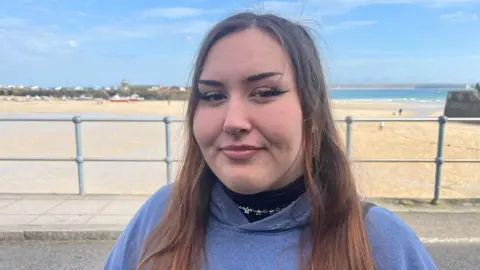
Roach describes paying £650 a month for a one‑bedroom property, then £800 for the next, before being forced out again when the landlord increased the rent to £1,200.
"The landlord lived in London, and they like their money don't they?"
Insecure housing and seasonal wages are a fact of life in St Ives.
"It is just about okay in the summer," Roach says.
"But in the winter I'm lucky to get 20 hours work a week, on minimum wage, so it is a struggle."
A town that tried to fight back
The St Ives neighbourhood development plan introduced Policy H2, aimed at prioritising local residents after the 2011 census showed 25% of properties in St Ives were second homes.
The St Ives Town Council Strategic Plan 2022-2025 puts this figure at 15% for the wider area, but it is significantly more in the middle of town.
Cornwall Council said that as of 28 February 2026 there were 1,002 second homes, out of a total 6,604 council tax accounts in the parish. This equates to 15%, compared to a Cornwall average of 5%.
Walking along the granite-fronted residential streets near the seafront, it is noticeable how many have holiday let signs outside, with names like 'Benjamin's Bolthole' and 'Vitamyn Sea', along with the letting agent details.
Reflecting on the policy that came in when she was mayor of the town, Linda Tayler says it helped but did not offer a complete fix.
"Can I say that it has worked in its entirety? No.
"Some people would have got away with purchasing a property, saying they will live there all the time and it has not happened."
St Ives was the first, and by 2021 a further 16 parishes in Cornwall introduced similar policies.
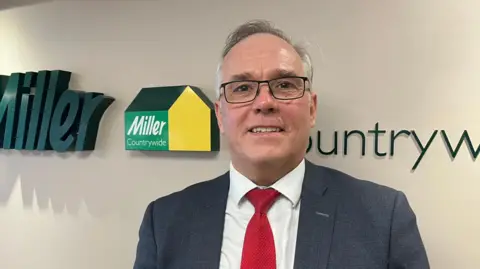
In his office on Tregenna Hill, estate agent Mark Barrett says developer caution has hindered progress.
He points to two recently built identical homes: one exempt from the rule sold for £1.17m; the restricted equivalent sold for £950k.
"This percentage is probably the profit margin plus, so you can see why developers are being put off," he says.
"The policy has created more uncertainty and not created the benefit the town and locals wanted it to achieve.
"They were hoping it was going to bring prices down and make houses more affordable for local people and that hasn't really occurred."
Policy gaps
He argues that broader economic forces, including additional stamp duty and national tax changes on second homes, have done more to cool speculative buying than local restrictions alone.
A site identified as suitable for 160 affordable homes has apparently stalled because developers have not been forthcoming.
"We all want to see more homes being built for first time buyers but this isn't happening," he says.
But, he admits: "St Ives is still a great place, and the town has a buzz all year round - I remember the old days when it would completely close in the winter and it is not like that anymore."
He says when the market is buoyant, about 60% of sales tend to be second homes and although this figure has fallen over the last two years, he does not put this down to H2.
Calculating his branch's sales for February, he says: "Of 14 sales, which is pretty good, five were sold as second homes."
High deposit hurdle
Freddie Stone, 24, is standing in his dad's fish and chip restaurant in Carbis Bay and says saving a deposit for an average £300k home is "a long shot".
Like many, he left Cornwall for education and work, hoping to return someday.
At university in Birmingham, he is finishing a Masters dissertation on second homes and the effectiveness of new developments in Cornwall - an issue close to his heart.
He expects his first property will be outside St Ives.
"The sort of areas which are a bit cheaper at the moment like Redruth or Camborne, so if you buy that as a starter home and then eventually work your way up the ladder that could definitely be an option.
"So you're sort of starting to have to creep further and further away from St Ives to be able to get on that ladder."
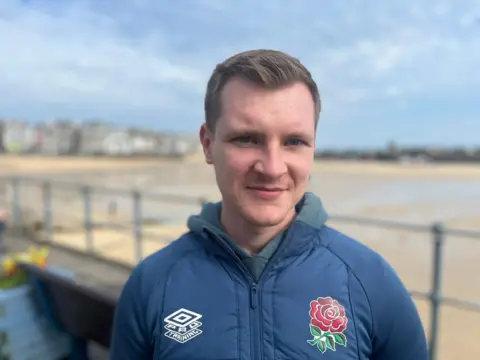
Will Williams, 23, is from St Ives and recently bought eight miles away in Pool, where a former tin mining site has been redeveloped into housing.
"We have been saving up living at home and finally have enough to move out. We love it there - it's really nice and there are loads of younger couples."
He says affordability near St Ives remains difficult due to holiday‑let demand and seasonal work.
"There's so many holiday lets that it is a struggle...you can't get a full salary job all year long. So most people have to find work outside of St Ives."
Another young parent, pushing a pram through a cobbled street in town says: "We are lucky as we had parental help.
"But it's either that, or it is a struggle."
She add: "There are seasonal jobs, but not many careers."
Wages and work
Rosana Cox, youth engagement and project manager at St Ives Town Council, sees the strain on young people every week.
"It is a beautiful place and that is the reason it faces the challenges it does but there is a really strong community here."
She says policy alone cannot close the gap: "The difficulty with legislation is that it is always playing catch-up.
"Even if new builds are ringfenced, without addressing the issue of low and stagnating wages, people can't afford to buy them."

Matt Hosking, 24, has a year round job in a pub, and for the last five months he has lived in shared accommodation arranged by his employer.
He says housing for young people has always been difficult in this, his home town.
"It's just the price of it and the wages down here.
"A lot of people I know have moved out of St Ives because it is cheaper elsewhere and there's more housing.
"It's just holiday homes, that's all it is around here.
"We need somewhere to live - you cant just have people on holiday."
Hoping to stay
Many young residents still aim to remain in the area despite limited year‑round employment and rising housing demand.
Some move away permanently, while others move further inland in the hope of someday returning.
But for Freddie, the ambition is simple: "Ideally this is the spot I want to be living in. I think eventually I will get there."
Follow BBC Cornwall on X, Facebook and Instagram. Send your story ideas to spotlight@bbc.co.uk.
