The miners who still meet up every Christmas for 'pit talk'

 Steve Jones/BBC
Though it's been more than 30 years since the closure of Grimethorpe Colliery in Barnsley, the spirit among the former miners remains as strong as ever.
On a rain-sodden December afternoon, hundreds of them are meeting up at Grimethorpe Working Men's Club to pay their respects to those whose lives were lost at the pit, and those who have passed away since it shut down in 1993.
Despite the festive rush, torrential rain and the passing of time, the annual tradition shows no sign of abating. Organisers say numbers are growing each year and there is barely a seat spare in the club's buzzing main room as old friends and colleagues reunite.
"Respect, pride and togetherness" is what keeps the community turning out, according to Johnny Wood, a former miner who has organised today's event.
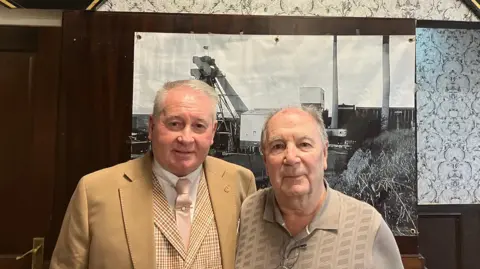
The harsh conditions of working down the pit, as well as the struggle of the strikes - which photos on the wall pay homage to - evidently forged a lifelong brotherhood among members of the mining fraternity.
"It's an age-old thing," explains Les Lang, one of the oldest attendees at 85.
"It started with our grandparents and their children, then it came to us and our children. Everyone knew everyone, anyone in trouble was helped."
"You come out every other night and you still talk about pit," says Dayle Cooke, a miner for 23 years, in a broad Barnsley accent.
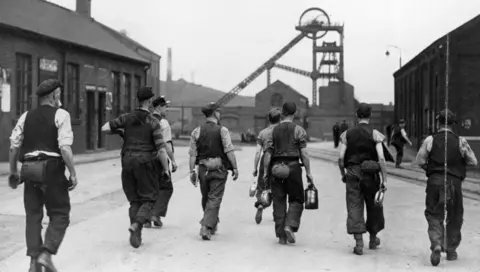
"I enjoyed every minute of it. Don't get me wrong, it was hard, heavy, dusty work. But the camaraderie that you got from them was unbelievable.
"Everybody had each other's back."
 Getty Images
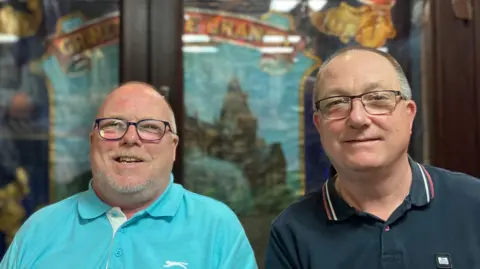
Dayle, now 71, is sitting in front of the Grimethorpe Colliery banner - immaculately preserved in a glass cabinet - next to his younger brother Allan, 60, himself a mine worker for more than 12 years.
"Like a family" is how the younger Cooke sibling recalls his time at Grimethorpe before getting back to catching up with an old comrade.
Dayle estimates three-quarters of the men in the room are people he knows, reminiscing over times when he would holiday in places like Blackpool and Scarborough and bump into members of his extended family.
"It was your life," he adds.
"You would come in here and sit in the same seat. All you saw were your same mates."
A nostalgic spread has been put on for the memorial event, with 'growlers' - pork pies - 'mucky fat' - bread and dripping - polony, black pudding and 'jam sarnies' all helping to recreate a sense of yesteryear.
 Steve Jones/BBC
"Everyone was connected through the mines and even though they have closed that has still remained," says Rev Cannon Paul Cartwright, a priest at St Luke's Church where the memorial for the miners who died at Grimethorpe is located.
"If you look at how impoverished this area is in the statistics, the spirit is still strong."
'Survivor spirit'
The closure of Grimethorpe Colliery had a destructive impact locally. Within a year, the village was listed as the poorest in England.
Many of the former miners recall Grimethorpe being somewhere where doors were left unlocked in the pit's heyday because of its tight-knit community.
But when its main source of employment collapsed, crime reportedly shot up from 30% below the national average to 20% above.
New industries have moved into the area, which has benefited from regeneration projects since the mine's closure, but economic activity remains lower than the national average, according to 2021 census data.
"People throughout West and South Yorkshire in these post-industrial areas really do have that survivor spirit," explains Mr Cartwright.
"They look after each other, they support each other - skills learned during the strike - making sure those who have nothing get something."
Adds organiser Johnny: "That community spirit that campaigned to get the village back on its feet is why we are proud to go back into our old village."
Listen to highlights from South Yorkshire on BBC Sounds, catch up with the latest episode of Look North
