Premature baby goes home after pioneering heart surgery

 Caitlin Duncan
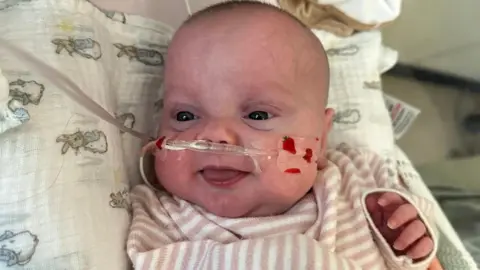
A baby girl born extremely prematurely has been allowed home after becoming the first in Scotland to undergo pioneering keyhole heart surgery.
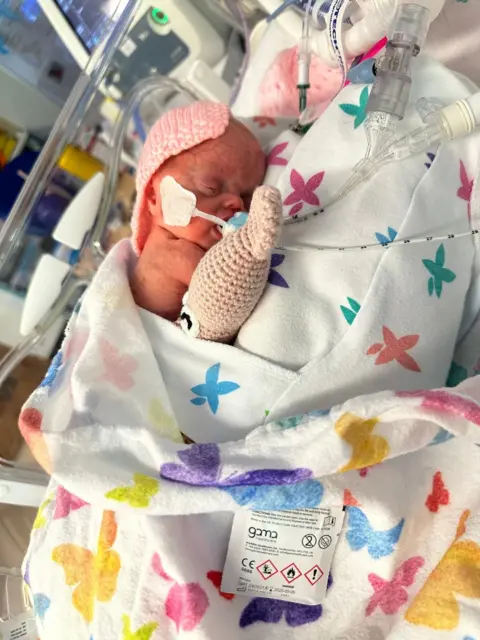
Aribella Duncan weighed just 1.1lbs (0.5kg) when she was born after only 23 weeks at Aberdeen Maternity Hospital last July.
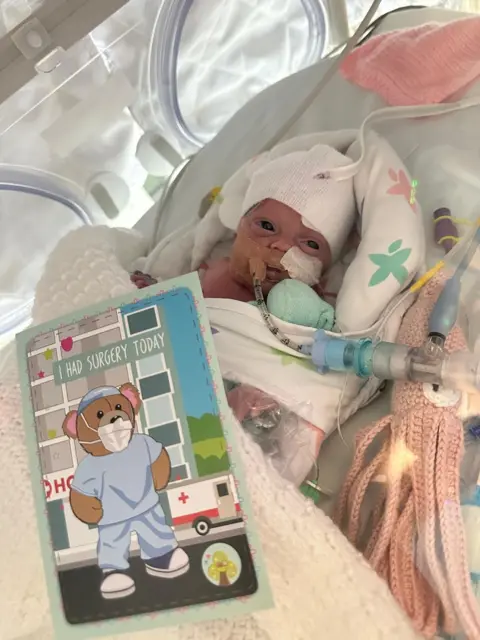
She was taken to Glasgow's Royal Children's Hospital for specialist treatment and later became the first baby in Scotland to undergo a new operation to insert a tiny device to close a vital blood vessel in her heart.
She was transferred to Aberdeen's Royal Children's Hospital in January for continued treatment and now - aged seven months and weighing 8lbs (3.6kg) - she has been able to go home with her family.
 Caitlin Duncan
Soon after she was born, doctors noticed Aribella had Patent Ductus Arteriosus (PDA), a condition where a vital blood vessel fails to close naturally after birth, most commonly seen in very premature babies.
It places significant strain on the heart and lungs, making breathing, growth and recovery much more difficult.
Once she was strong enough for transfer, Aribella was moved to the Scottish Paediatric Cardiac Service at Glasgow's Royal Hospital for Children (RHC) for specialised treatment.
Following attempts to close the PDA using medication her family were told surgery would be the next step, and that there were two options - open heart surgery or a new, minimally-invasive keyhole technique.
 Caitlin Duncan
Aribella's mum, Caitlin, said: "The doctors told us that because of her weight and size, Aribella was the perfect candidate for the less invasive option."
The procedure to close the PDA was the first performed on a baby in Scotland - the team at the RHC has since performed it on a further three babies.
Using a tiny device called an Abbott Amplatzer Piccolo, the cardiologists enter through a small incision in the baby's leg to seal the opening in the heart.
The technique is said to significantly reduce invasiveness, lower risk for the patient, and speed up recovery time for fragile babies.
 NHS Greater Glasgow and Clyde
Caitlin said the difference in her daughter had been immediate.
"We didn't know what to expect when Aribella came back from theatre, but she looked right up at us with bright eyes and was playfully kicking her legs," she said.
"We couldn't believe how quickly she bounced back.
"Over the next days and weeks, she started gaining weight and growing so much faster. She was like a completely different baby."
Aribella was transferred back to Aberdeen neonatal unit five days after the procedure where she continued her development.
She was then transferred to Royal Aberdeen Children's Hospital in January, and has now been able to go home with mum Caitlin and dad Jack.
Interventional paediatric cardiologist with NHS Greater Glasgow and Clyde, Dr Mohammad Ryan Abumehdi, said staff had been delighted to hear how well Aribella was doing.
"Being able to offer this minimally-invasive surgery to premature babies is an exciting step forward for neonatal and cardiac care in Scotland," he said.
"It shows what collaboration, innovation and compassion can achieve for our smallest patients."
Dr Natalie Smee, who has been part of the team caring for Aribella in Aberdeen, said it was fantastic to see her progress over the last few months.
"This new procedure has undoubtedly made a huge difference to Aribella's recovery and development," she said.
"Many staff across our Neonatal Unit and Royal Aberdeen Children's Hospital have got to know Aribella and her family, and we're all so pleased she is thriving."
