Scandal-hit hospital left children with lifelong conditions, MSPs told

 BBC
BBCChildren have been left with debilitating conditions due to their treatment at a scandal-hit Glasgow hospital, their parents have told MSPs.
The Scottish government has been urged to launch a probe into concerns children treated at the Queen Elizabeth University Hospital (QEUH) are suffering from conditions including chronic stomach pain and incontinence after being given anti-infection treatments for too long.
The families claim children were given prophylactic drugs due to infection risks at the hospital, but say they have been lied to by health chiefs.
NHS Greater Glasgow and Clyde said the treatment was an established method of preventing infections, and that the hospital is safe.
First Minister John Swinney's spokesman said he was looking at the issues "as a matter of urgency".
After years of denials, the health board admitted last month that issues with its water system probably caused infections in child cancer patients at the QEUH campus, which includes the Royal Hospital for Children.
A public inquiry is looking into how design, construction, and system failures led to safety issues, and whether these problems could have been prevented.
The inquiry concluded last month and its findings are expected later this year.
Separately, the Crown Office and Procurator Fiscal Service is looking at seven cases of patients who died, to establish if there is sufficient evidence of criminality such as corporate homicide or breaches of health and safety law.
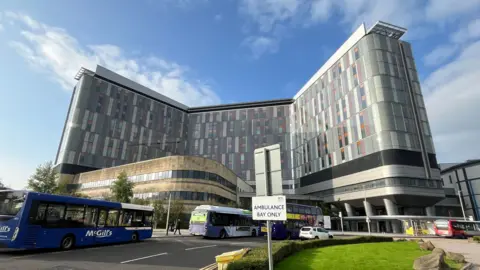
Aneeka Sohrab's daughter Eshaal was treated at the QEUH between 2018 and 2020 after being diagnosed with leukaemia. Her mother says she contracted several infections in the hospital.
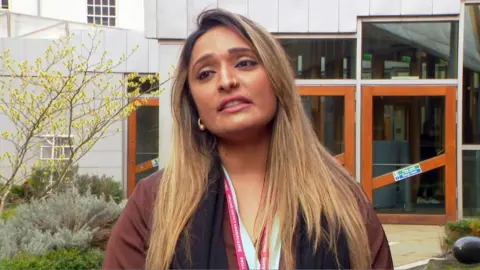
Sohrab says Eshaal was prescribed prophylactic drugs for 10 months, but that she was later told the treatment should only have lasted for two weeks. Sohrab told BBC Scotland News her daughter has been left with debilitating conditions as a result.
"My daughter wakes up with sore stomachs, sore legs, her stomach cramping to the point that she's screaming every morning," she said.
Sohrab believes her daughter was given the drugs due the infection risk at the hospital, and that she was lied to.
She said doctors at the hospital suggested her daughter's stomach pain could be due to hunger.
Sohrab said: "Why not tell me the truth and tell me that could be a side-effect of the medication. Nobody has told the truth so far?
"It's really disappointing, really upsetting and you can understand why we're angry because this is not just our children, it's the children of Scotland."
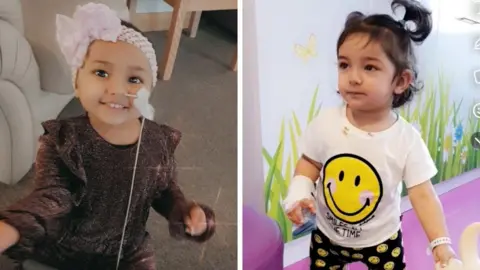 Aneeka Sohrab
Her case and others like it were raised at First Minister's Questions by Scottish Labour leader Anas Sarwar.
He said some of the children suffered chronic stomach pain and incontinence, while one boy was so sick he burned all the enamel off his teeth. He said one girl had pain in her limbs and could not attend school, while another had to take regular hormone injections.
The first minister did not rule out setting up an investigation, though he insisted the inquiry was designed to give families the "answers they deserve".
Sohrab, who watch FMQs from the gallery, said: "I feel John Swinney today did turn his back on us physically as well as theoretically."
She claimed the SNP leader was "afraid to open up a can of worms".
Sarwar called for an expert panel to review individual cases like Eshaal, which he said would not be looked at in-depth by the Scottish Hospitals Inquiry.
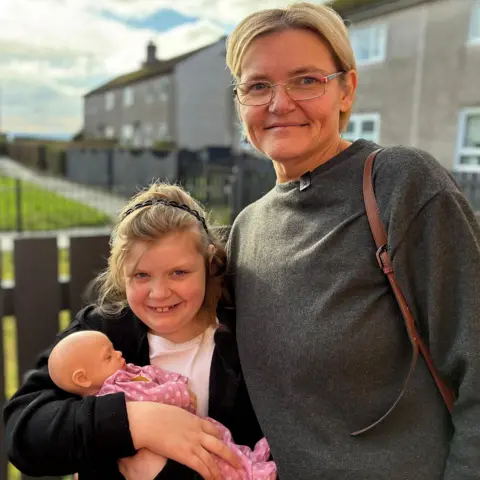
Charmaine Lacock's daughter Paige was three when she picked up a "life-threatening" infection while undergoing cancer treatment at the QEUH in early 2019.
She told BBC Scotland News her daughter was put on prophylactic drugs for 10 months, but said that a US consultant later told her the treatment should only have lasted for two weeks.
Lacock called for the government to set up an expert group immediately.
"God forbid Paige has a relapse and we have to come back to the hospital – I want to make sure that the hospital is safe because the second time round she might not be as lucky as to walk away."
Sarwar said parents had been told prophylactic drugs were a standard treatment and not related to infections in the hospital.
The Scottish Labour leader said parents had been "misled and treated appallingly", citing "cover-ups, secrecy, misdirection and downright deception".
Swinney told parliament he would "always listen with care to the perspective and interest of families" affected by the infections scandal "and do all that I possibly can to address their suffering".
The SNP leader said it was right that the government waited for the inquiry to publish its report, but said he would consider Sarwar's call for an expert review.
Speaking later, the first minister's spokesman said the government would look at the issues raised by Sarwar "as a matter of urgency".
'Children's hospital is safe'
A spokesperson for NHS Greater Glasgow and Clyde said: "We are very sorry to hear about the distress these children and their families are experiencing following their illness."
They insisted consultants were always transparent with families about medication.
The spokesperson said cancer treatments can significantly weaken the immune system of patients, and that prophylactic drugs help prevent potentially life-threatening infections.
They added: "These can be prescribed as part of routine clinical management associated with an underlying condition or as a precaution if there are concerns about environment.
"The environment at the Royal Hospital for Children is safe and this medication continues to be prescribed to some patients receiving treatment as part of patient medical protocol."
