Veg box firm marks 40 years of organic growing

 Riverford
From a wheelbarrow and a borrowed tractor to a national veg box empire - Riverford founder Guy Singh Watson looks back at 40 years that changed British organic farming.
"I couldn't sit in an office anymore… it was driving me up the wall."
The founder of Riverford, the organic veg box delivery company, has been reflecting on his decision to quit the corporate world in the US for a life outdoors in Devon.
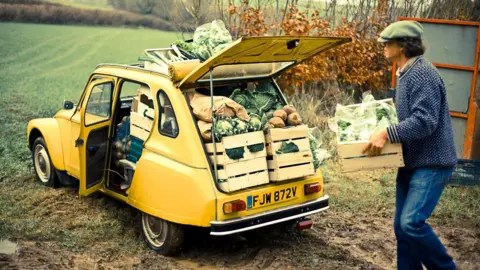
Guy Singh-Watson started his multi-million-pound business with a wheelbarrow and a borrowed tractor, selling vegetables from the back of his car. Today the company he started delivers, on average, 70,000 veg boxes a week.
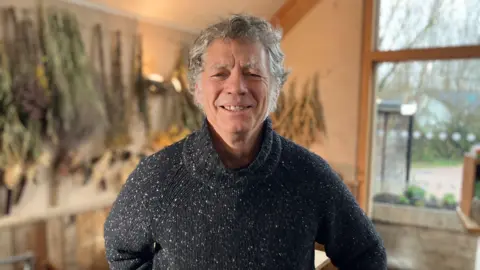
Singh-Watson was working in New York when inspiration for his future life struck him during a visit to a farmers' market in Manhattan's Union Square.
"I spent my time increasingly engaging with those farmers who had come up from upstate New York to sell their produce. I just realised this was so much more interesting," he said.
Singh-Watson decided to return to the UK and start growing vegetables on his family's farm near Buckfastleigh.
"My family were reasonably supportive but, having left the farm, I definitely had to earn my place coming back to it," he said.
 Riverford
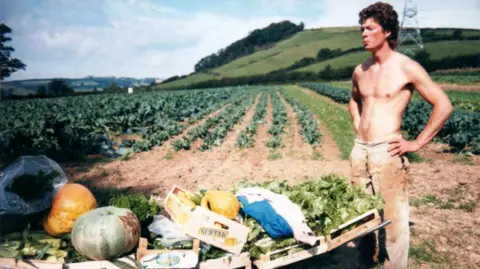
"I started on a very small scale with a borrowed tractor and a wheelbarrow, selling vegetables out the back of my car," he said.
When he initially sold produce to two or three shops in Totnes and Ashburton, there seemed little interest in the food being organic, he explained.
"They didn't really care whether it was organic," he said.
"I did try and persuade them to label it as organic and put up a few posters explaining what that meant, but they weren't really into it."
The start of the UK veg box movement
Riverford began veg box deliveries in 1993, and Singh-Watson said he questioned how popular they would be since customers were not selecting their own produce.
But his doubts were quickly proved wrong: "I knew from the first day that I delivered those first 30 veg boxes that we were on to a winner just from the reception that I got on the doorstep," he said.
"I found out that the customers did care what it tasted like. They did care how it had been grown.
"People have always been interested in good food and the exact reason for that might change over time."
Riverford grows its vegetables on its original Devon farm, three regional sister farms and a farm in France.
The company said it also used dozens of organic growers and producers to provide items it could not grow itself, and the food was "completely traceable".
Teaching people how to cook organic veg
According to the Soil Association, the UK organic market has grown for the thirteenth consecutive year and is now worth £3.7bn.
Riverford has its own restaurant and provides cooking tips and recipes on its website.
Singh-Watson has also written several cookery books.
"I want to bridge the gap between aspiration and reality; to make a celeriac or cabbage exciting and to prevent squash or romanesco from being intimidating," he said.
What does organic mean?
- No artificial pesticides or fertilisers
- Exceptional standards of animal welfare
- No genetically modified (GM) ingredients or animal feeds
- No routine use of antibiotics
- Free from artificial preservatives and colours
Source: Riverford
Riverford becomes employee owned
In 2018, Singh-Watson sold 74% of his shares in Riverford to its employees, saying employee-owned businesses were more resilient to challenges than conventionally-owned businesses.
Five years later he sold his remaining shares and the company is now 100% held by an employees' trust.
Singh-Watson said he was "immensely proud" of creating an employee-owned business.
"It demonstrates that greed is not the only way of motivating people and running a business; that it can be more inclusive and empowering to those who work there."
Production manager and co-owner Becky Reed, who has worked for the firm for seven years, said: "It's a really good feeling to know you have a say in what's happening with your business.
"It gives us an opportunity to make it a great place to work for everybody."
Singh-Watson's farming campaigns
Over the years Singh-Watson has campaigned against the use of pesticides, genetically modified crops and spoken out against the power of supermarkets to shape agriculture.
He said he had committed to organic farming at Riverford since suffering headaches and nausea after spraying pesticides as a teenager.
"It just felt right," he explained.
As well as simply being pesticide-free, Riverford's ethos is based on Singh-Watson's commitment to outstanding animal welfare, protecting the planet by reducing emissions, providing havens for wildlife and growing food that is "nutritionally different".
After 40 years of campaigning Singh-Watson said he enjoyed the power his voice still had.
"I've still got a little bit of ego in me, even at 65, and I want to use that voice to campaign for better farming, better environmental practices, and probably most of all for better business."
Riverford's 40th anniversary highlights how ideas that once sat on the fringes - from organic growing to employee ownership - had moved into mainstream discussion.
Follow BBC Devon on X, Facebook and Instagram. Send your story ideas to spotlight@bbc.co.uk.
