Teen phone survey results 'pretty shocking' - MP

 Amy Holmes/BBC
An MP has called the findings of a survey showing almost 60% of teenagers questioned had been contacted by strangers on social media "pretty shocking".
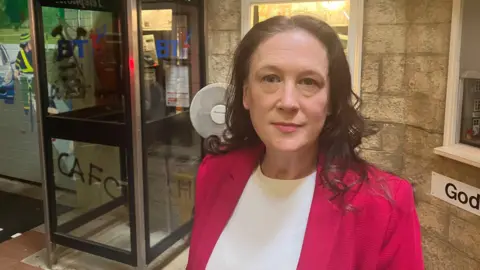
Labour MP for Milton Keynes Central, Emily Darlington, surveyed more than 500 youngsters aged 14-16 in schools in her constituency as part of her ongoing online safety campaign.
"Young people want further regulation because they are being contacted by strangers and it is not necessarily through the sites that we would know and recognise as adults," she said.
The government is consulting on a ban on social media for under-16s, and a complete ban on smartphones in school has been backed in the House of Lords.
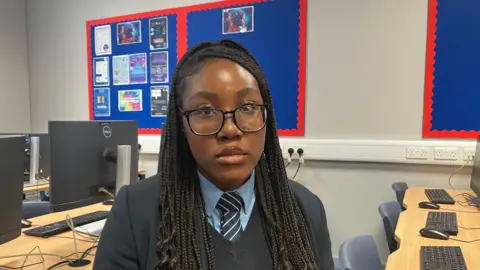
Tito, 15, who goes to Oakgrove School and spends up to four hours a day on her phone, said it was "inevitable you would see content that you do not want to see online".
In the survey, 38% of respondents said they had seen explicit or age-inappropriate content and 33% admitted they had been bullied or blackmailed on their phone.
Eleven per cent spent more than eight hours a day online and 34% said viewing inappropriate content had a negative effect on their mental health.
However, 24% said they felt they were missing out when they were not online.
Australia has introduced a ban on under-16s using social media, and Spain has unveiled plans to do the same.
However, Darlington said: "A straight ban does not have the impact we really need.
"What I'm hearing from young people and parents is that we have to clean up our act."
She said phone material had to be "age-appropriate", in a similar way to video games and movies.
 Amy Holmes/BBC
Government guidelines for schools state that they should be mobile phone-free environments by default.
Emily Beaumont, co-ordinator of PHSE (personal, social, health and economic education) at Oakgrove School, said: "We have a very clear policy for students that they have to have their phones away so learning time is protected."
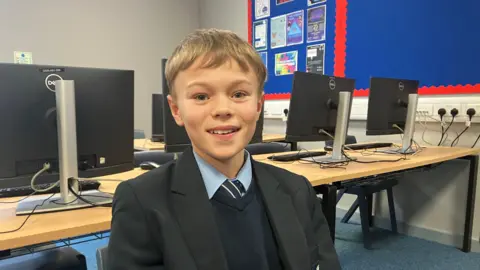
Isaac, 13, a pupil at the school said he did not use social media much and usually felt safe when he did.
He said "restrictions on websites are a lot better than they used to be" and added that his parents were "quite strict, so they would not really allow me on any app so I could be exposed to something they would not want me to see."
If a social media ban for under-16s was introduced, he said, "it would be a big shock at first but would actually help in the long run with things like schoolwork".
 Amy Holmes/BBC
Tito said she was "definitely worried about the dangers because [on some apps] you can access content that you did not want to."
She said: "People can post pretty much anything and that is quite scary."
Tito said while users could report or block inappropriate videos, it was "kind of inevitable" they would still see content they did not want to.
She said she was "not against" a ban as "having social media exposure at too young an age might mean you mature too quickly."
She added: "In the long term, I would probably be more productive and spend more time with friends and family in real life rather than behind the screen."
Gurshaan, 16, said he spent up to six hours a day on his phone but had cut down as he realised "how much more I can actually do and be more productive".
A ban would not directly impact on him but he echoed the thoughts of Spanish Prime Minister Pedro Sanchez, who called social media a "digital Wild West" .
Gurshaan said a ban "would teach kids how to be more productive with their time, rather than just sitting there".
Follow Beds, Herts and Bucks news on BBC Sounds, Facebook, Instagram and X.
