Ministers urged to 'rethink' charity funding cut

 BBC
BBCPeople supported by a Jersey charity have said they are "concerned", "upset" and "disappointed", after it told 38 staff members their jobs were at risk due to a reduction in government funding.
The Jersey Employment Trust (JET) helps people with disabilities and long-term health conditions learn new skills and find and keep jobs.
The charity said on Wednesday it was reviewing its services, after being told by ministers additional grants above its agreed budget would no longer be made available.
Minister for Social Security Deputy Lyndsay Feltham said government funding for JET remained at more than £2m for 2026, and talks were ongoing about "a long-term funding commitment".
'An incredible organisation'
Kenan Osborne, whose son Owen has been supported in recent years by JET, said the charity had "been a cornerstone of helping us help Owen be the best he possibly can."
He said his son had been "very, very upset" at the news of potential redundancies, and had asked for his caseworker to be sent a message of thanks and support.
He added: "And in ever professional style she sent back a lovely message, basically saying, 'hoping Owen's okay, hope you're all okay, of course we're here and we will help but we don't know what's going on and to what extent this will impact our clients or our services, but we're here for you.'
"That truly sums up who they are and where their heart is.
"They are an incredible organisation. They think about the individual, they add value into our local community, they help address some of the injustices that we have here - rightly or wrongly - around attitudes to people like Owen in terms of work, and they're fully inclusive.
"They really understand and listen to what people's needs are."
Owen added the government's decision to cap the charity's funding "shows a real lack of respect for everyone involved, a total lack of consideration or thoughts of inclusion for people like me."
He said JET had been "more useful to me and others than government has ever been," and his caseworker had been "reliable, understanding and patient".
He continued: "JET haven't made me jump through hoops and have treated me as an individual, focused on my needs."
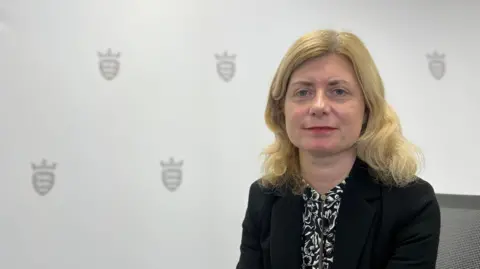
Feltham reassured people supported by JET the government was "absolutely committed" to ensuring they received the help they needed.
"We have been in discussions with JET for some time about how best we can support their work going forwards," she said.
"The government contracts JET to provide vital services for islanders, but for several years JET has been running considerable overspends and has had to come back to us for extra money.
"This is taxpayers' money, and I have a responsibility to make sure we're using it appropriately.
"Government funding for JET remains at more than £2m this year and we are working to agree a long-term funding commitment with them, to provide certainty into the future.
"I know the pressures that charities are facing, and we are working to make sure funding is directed where it is most needed and can make the greatest impact."
JET said it was not accurate to claim the charity had been overspending as all additional funding had been pre-approved.
It said demand for its services had "increased significantly over a number of years, with more clients requiring more intensive support".
It said its core funding, provided in the form of government grants, had not kept pace with rising prices over the past decade: "By way of context, the organisation's funding of £1.9m in 2015 would equate to around £2.9m today, taking into account inflation over the same period.
"Where additional funding has been required, this has been pre-approved by government and used specifically to meet increased demand and maintain agreed service levels.
"This is, therefore, agreed top-up funding to account for increasing demand and the pressures of inflation, and is not overspending."
 Government of Jersey
Responding to questions about JET's situation at a Public Accounts Committee hearing on Wednesday afternoon, chief executive of the Government of Jersey, Dr Andrew McLaughlin, said his expectation was that Feltham would have approached the case with "probity, rigour and empathy".
He said he would be "astonished if there wasn't a 12 month lead time in that particular case", and added: "Obviously we are trying to curb growth in the public service.
"We have 500 registered bodies in the charitable or third sector.
"A significant number of those bodies have come to a position over time where they're completely dependent on government for funding.
"They're not able, for whatever reason anymore, to access private funding to the extent that they were.
"So we need to have a strategic thought about how we commission, and how we procure with and what relationships we get into with these bodies."
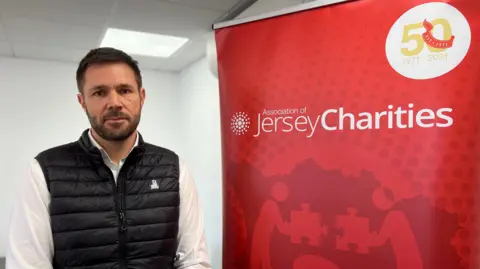
Marcus Liddiad, chief executive officer of the Association of Jersey Charities, felt "without a shadow of a doubt" other charities would in the coming months be forced to review their services as a consequence of changes to government funding.
He said his team would support JET and the government in their ongoing conversations.
He accepted the government was "in a difficult position," but added he was concerned "because these are very vulnerable islanders we're talking about here".
Liddiard warned any reduction in JET's services would create a gap in provision which would need to be filled by the government.
"They may do a good job, but that will come at a cost," he said.
"And so the key balance is, where is the best source of this delivery of service?
"Is it with JET, as they are doing today, or is it with government?"
He added: "We would like to see the real savings and the real benefits the government believe they're going to get out of this activity."

James Montgomery, who has been supported throughout his career by JET and now works in learning and development, delivering training to the next generation of employees, echoed Liddiard's concerns.
He was worried the situation could "get really messy" for all involved.
"Capping funding doesn't make the need disappear," Montgomery said.
"It pushes people back into already stretched services.
"From my understanding, JET have over 500 clients. Where are they all going to go?"
Montgomery felt the government's efforts to save money would increase funding pressures elsewhere.
"And ultimately, who loses out?" he said.
"The people. The people who need it most. The people affected. They won't vanish.
"They're just going to lose that specialist support which was keeping them in work, and once they fall out of employment, it's much harder and much more expensive to get them back."
Osborne said that in addition to helping his son find paid employment, Owen's "wonderful" case-worker had provided support in a number of other ways, including walking with him to work to ensure he arrived on time, liaising with his bosses when "he would find himself in a heightened state", facilitating a driving theory test and helping him to write a CV and secure training opportunities.
"I don't think Jersey can continue without it," he said, in relation to the charity.
"Because those vulnerable members of society really need that support, their families need support, the businesses who go to offer opportunities for people need their support.
"It hits so many people in so many different ways."
Osborne said he had personally found the announcement "very distressing and upsetting" and urged the government to "rethink" its funding plans.
"Please get back around the table and consider the vulnerable people that you're impacting right now," he said.
"Some of those clients will be on their own, without their support from JET.
"They are completely in the dark as to what is going to happen next and they will feel vulnerable - so think about those people."
Follow BBC Jersey on X and Facebook. Send your story ideas to channel.islands@bbc.co.uk.
