AI era 'not all doom and gloom' for graduates, say analysts

 Handout
"I apply for 50, sometimes 100 jobs per month," says Londoner Divine Jacob.
The computer science graduate says job hunting has been tough since completing his degree at the University of Lincoln last summer.
He feels that artificial intelligence (AI) creates extra barriers for applicants - a fear shared by many young people.
But while AI is reshaping the job hunt for young people entering the workforce, analysts say its impact remains an "evolving picture".
Consultancy firm McKinsey says that although many companies were looking at replacing staff with AI last year, they are increasingly realising the challenge is also about managing people to use these tools effectively.
Meanwhile, some AI experts say it is "not all doom and gloom", suggesting that graduates' "AI native" skills could leave them well placed for the jobs ahead.
'Human-to-human connection'
Youth unemployment is at its highest level since 2021, with 16% of those aged 16 to 25 currently out of work.
Jacob says one of the hardest parts of trying to get a job is that many employers use AI systems to sift applications, something he feels removes the personal connection.
"Typing up your motivations for the job just to see at the end your application will be under review by the likes of bots, it's just not really the most motivating thing," says the 21-year-old.
"You want to have that human‑to‑human connection."
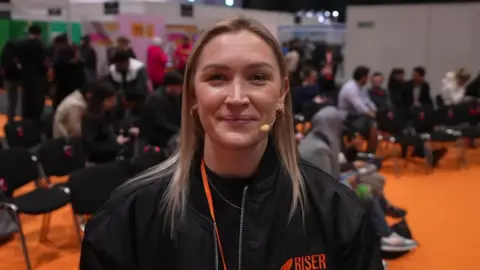
With many job hunters feeling shut out by automated screening, some new platforms are trying to help applicants show more than what an algorithm can capture.
Suz Bannister says the app she co-founded, Riser, allows applicants to upload a one‑minute video to introduce themselves and showcase their strengths.
"I think to stand out in this AI era you have to lean into both your soft and hard skills and do it beyond a generic format," she says.
But the issue is not just with the application process.
Jacob's dream industry has been particularly affected by a reduction in advertised jobs, according to McKinsey.
Drawing on last year's job‑market data, McKinsey reported in July that sectors most exposed to AI and large language models (LLMs) had seen a 38% fall in job postings.
It said some of the sharpest declines were in roles predicted to face the highest impact from generative AI.
These include software developers and other IT specialists, along with professionals in data, design, media, research, legal services, HR, finance and business.
McKinsey said young graduates were potentially facing a "triple whammy": a general labour‑market slowdown, a sharper decline in graduate‑level job openings, and reduced demand for lower‑skilled roles.
In the final quarter of 2025, unemployment stood at 5.2%, the highest rate since early 2021, with young people at the forefront of the rise.
There are signs, however, that this picture is beginning to shift.
Tera Allas, a senior adviser at McKinsey, says the effect of AI on jobs is "very much an evolving picture".
While last year "organisations were clearly thinking about where they could replace people with AI", she says it now appears that "the jobs with the biggest AI exposure are actually the ones that are booming".
According to Allas, demand is growing, particularly in the graduate job market, for people with AI skills and strong people management abilities.
"People are realising that to put AI into their organisations effectively is about how you do the management around the people who need to use these new tools," she says.
That shift is an opportunity some start-ups are trying to seize.
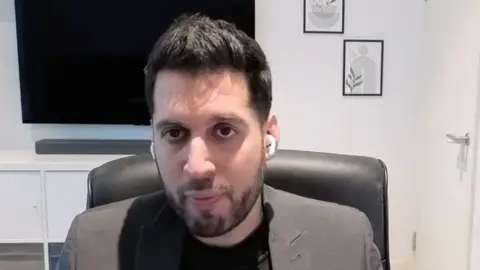
Rahan Arif's organisation BossUp AI is developing a standard to measure whether people are "AI ready".
Through university partnerships, the organisation surveyed 500 students and found that 58% felt the roles they were training for had disappeared, while 61% said AI had made it harder to find work.
Arif says he does not believe this will last, arguing that the skills graduates bring will soon be among the most in demand as young people are "AI natives".
"It is definitely not doom and gloom," he says.
"In fact, to the contrary, I predict we are going to see a reversal of what we are seeing now if we fast forward two or three years time."
For those already navigating the system, the experience can be bruising but also transformative.
For Jacob, it proved to be both.
He has now secured a job and says the long search has left him more resilient.
"I feel like at the end there will be a pretty much improved workforce based off the fact you have to go above and beyond," he says.
"When you do get past this AI blockage we will be able to go practically above and beyond, which is what we have to do to get our foot in the door in this current moment in time."
Listen to the best of BBC Radio London on Sounds and follow BBC London on Facebook, X and Instagram. Send your story ideas to hello.bbclondon@bbc.co.uk
