'The search is soul-destroying': Young jobseekers on the struggle to find work

 Lucy Gabb
Young people are bearing the brunt of the UK's weak labour market, according to new figures from the Office for National Statistics (ONS).
Some 16.1% of people aged 16 to 24 are not able to find work, compared to a national unemployment figure of 5.1%.
That does not include young people who are out of work but not looking for a job, due to ill health or who are still studying.
Businesses, particularly in sectors that traditionally gave young people their first jobs, like retail and hospitality, say higher costs are leading them to cut staff or not take on new hires, which often hits young workers the hardest.
But graduate-level roles are also proving harder to land.
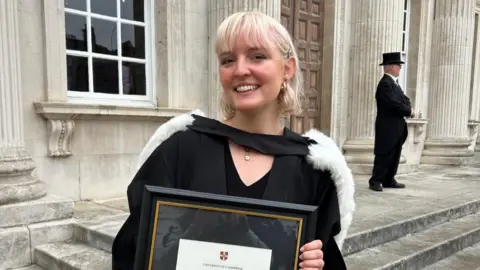
Lucy Gabb is currently working in a cafe in London while trying to break into the publishing industry. She graduated from Cambridge University in July 2025.
"Entry-level jobs are just so competitive and they're asking for experience that is just impossible to get whilst you're also studying," she said.
She says she has applied for more than 50 roles but only one has resulted in a face-to-face interview.
"All my friends are talking about is the job search. It can be really soul-destroying when you study for so long and you don't get anywhere," she said.
Businesses argue that government policies, including a rise in the minimum wage, have pushed up their costs.
But beyond that, employers are also increasingly citing artificial intelligence (AI) as the reason for layoffs.
AI is able to take on some time-consuming work such as processing data, implementing detailed instructions, or writing basic reports and communications, tasks which are often associated with first-job roles.
Danni Hewson, head of financial analysis at AJ Bell, said that "for young people in particular, already struggling to get their first taste of work, AI could result in a scarcity of entry-level posts".
Many jobseekers are also using AI to write applications, to help them increase the number they can apply for. Hiring teams are in turn using it to screen CVs — and, in some cases, even conduct interviews.
But even jobs that can't be easily be replaced by AI, like caring roles, are hard to secure.
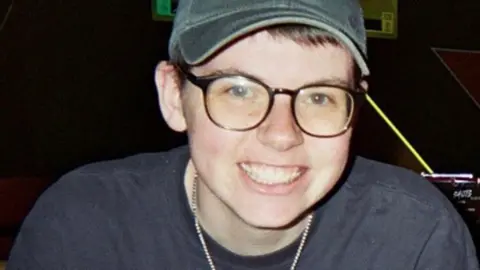
Alex Huke from County Durham was offered a job in a care home this week, having been unemployed since October. He says he applied for 40 jobs in that time, across hospitality, retail and care.
 Alex Huke
"It's quite discouraging as you don't hear back from a lot and the applications often require a lot of effort or providing data about yourself," the 21-year-old said.
He felt the Job Centre was not particularly helpful.
"It felt as though it was there more to monitor me than help me find a job," he said.
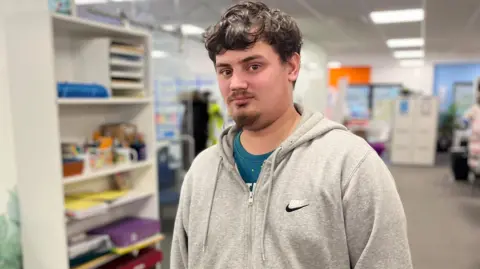
Terry Butlerhas been trying to get work on a farm, after graduating from agricultural college. But much like university graduates on the job hunt, his enquiries often go unanswered.
"I've been going to farms and asking them, and I just don't get answers back," the 22-year-old said.
"They'd rather experience than your fancy pass or merit in farming [college]."
He has been getting support from the Platform Project, a not-for-profit organisation in Swindon that helps young people get into the workplace.
It is a case of "chicken and egg" according to the organisation's chief executive Sadie Sharp. "You kind of need to have had a job to get a job".
Because entry-level jobs are few and far between, candidates have "really got to stand out," she added. "And you can't stand out when you haven't got anything on your CV".
The government has pledged to tackle youth unemployment with a Youth Guarantee Scheme. That aims to create thousands of apprenticeships and guarantee paid work for people aged 18 to 21 if they have been out of education, employment or training, known as Neet, for 18 months.
Olivia Diss from Essex said similar support should be given to university graduates.
Olivia studied Spanish and French at Manchester Metropolitan University. But she is applying to a range of jobs, including retail, just so she can have "some sort of income".
The 24-year-old is currently living with her parents and claiming Universal Credit while she applies for jobs. Her "countless" applications have all been ignored or rejected.
She accepts that this is, in part, because retail employers do not believe she intends to stay in the job for long.
But she feels she is stuck in a kind of "no-man's land" when it comes to professional roles, too, with graduate positions often requiring several years of experience that she doesn't have.
"I feel quite disheartened," Olivia said.
"I spent four years working hard towards a degree that I thought was very valuable."
She wants to see a scheme similar to the Youth Guarantee Scheme but for graduates.
"How are they going to ensure our degrees are put to use?"
Additional reporting by Mary Litchfield, Dan Johnson, Hannah Mullane and Elliot Burrin.
