Faulty surgical tools cleaner results in 1,500 delayed appointments

 BBC
BBCAlmost 1,500 surgeries and appointments have been postponed due to NHS Grampian's faulty Central Decontamination Unit (CDU) which cleans surgical tools.
The Foresterhill facility was closed in October after an unknown substance - thought to be linked to a faulty piece of equipment - was found on instruments.
NHS Grampian said a total of 753 elective surgical procedures and 739 dental outpatient appointments had since been postponed.
However, acute medical director Paul Bachoo said operations were now no longer being postponed, and it was hoped to have a refurbished facility up and running by the end of January.
Other health boards have been helping to clean equipment to allow some procedures to continue.
The Scottish government said it had provided £2m additional funding to improve buildings and equipment.
The CDU is undergoing a refurbishment in a bid to help prevent future shutdowns.
Work is continuing to identify the substance which led to the shutdown.
Staff based at Woodend Hospital in Aberdeen, as well as teams at NHS Greater Glasgow and Clyde and NHS Highland, have been turning around hundreds of crates of instruments every day to keep urgent care going.
Mr Bachoo, who is a consultant vascular surgeon, praised the "hard work" of everyone involved in the temporary process to minimise the impact.
He said: "I'd say it's almost business as usual in theatres.
"Through their efforts, and help of other people including health boards across Scotland, we are hopeful that by the end of January we will be in a new CDU system."
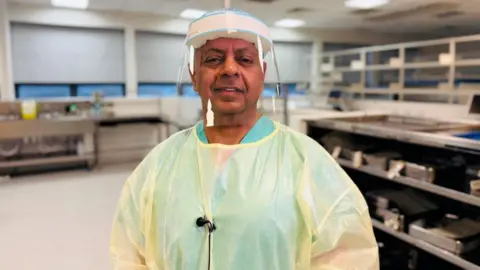
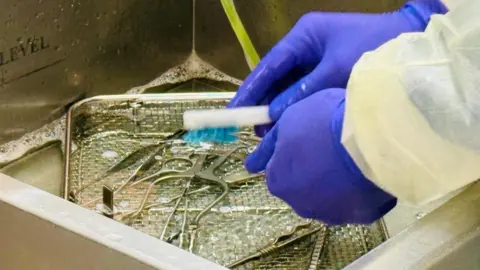
He explained that manual washing had always been part of the cycle of cleaning and disinfecting and sterilising surgical instruments, with toothbrushes currently being used at that initial stage of the process to get the worst of contamination off.
Mr Bachoo added: "We start by hand-washing our instruments so that as much contamination of the instruments is removed, so that when they go through the formal process of sterilisation and wash, it is effective and efficient."
He said he could give assurances that equipment was properly cleaned and hoped for a "more resilient" system after the refurbishment.
"We will be putting patient safety at the forefront of whatever we do, regardless of the costs," he said.
 Getty Images
Operations are no longer being postponed because of the cleaning issue and the day-to-day impact on patients was "minimal now".
Mr Bachoo said: "Though we in no way underestimate the significant impact on patients who have had operations and dental procedures postponed in recent months.
"We reiterate our apologies to those affected."
Alan Wilson, director of infrastructure and sustainability for NHS Grampian, said installation of the new washer disinfector machines would begin more than two weeks later than originally planned.
He added: "This means the programme will unfortunately be delayed into January and we are working closely with contractors to progress this as quickly as possible. We recognise the ongoing impact on our patients of any further delays and also on staff who are desperate to treat their patients."
Have there been issues elsewhere in Scotland?
Other hospitals in Scotland have also faced challenges with decontamination capacity in recent years.
This has resulted in operations being postponed.
In 2022, NHS Lothian postponed operations because of a leak in a unit that sterilised surgical equipment.
In 2023, health officials warned that units that sterilise surgical equipment in Scotland's hospitals did not have enough capacity to deal with major breakdowns.
At the time, NHS Scotland said decontamination services were facing "capacity challenges".
There is only one private company in Scotland which is able to carry out the decontamination work, and a firm in Liverpool used by NHS Lothian no longer has any spare capacity.
The Scottish government's clampdown on new NHS building projects has delayed plans for replacement decontamination facilities.
A spokesperson for the Scottish government said it had provided support to health boards.
They said: "We have provided £2m of additional capital funding this year through our national decontamination programme to improve decontamination unit buildings and equipment.
"Planning is also underway for an expansion of decontamination capacity to provide a more resilient service.
"The national programme is working to improve decontamination services and their ability to support each other."
