Why people can struggle to live in the places they love

 Ashleigh Airey
After time on the mainland for work and university studies, Martin Munsie returned home to Skye to continue his career.
But finding a home that he and his partner could afford proved to be a challenge.
Average property prices in Highland Council-area islands, such as Skye, are higher than the Scottish average.
And more than 15% of new-build housing completed in Skye and neighbouring Raasay over the past five years has been turned into short term lets - more than three times the Highland-wide average.
Mr Munsie said: "The houses that were in our kind of budget range typically had a bit more damage, had a bit more work to do long-term. They weren't viable."
By chance, the couple came across a scheme that offered an opportunity to move into Kilbeg - Skye's first new village in more than 100 years.
So far, 17 homes have been built with about half provided by Highland Council and the rest by Communities Housing Trust.
Under the scheme, Mr Munsie could buy a two-bedroom property at a discount on its market value.
Whenever he and his partner come to selling up, the housing trust will get first refusal to buy it back.
"Without that we would have struggled to be able to move back. We would have struggled to afford it," said the engineer who works as a business software solutions consultant.
He added: "It was a lot of luck and timing, but we're unbelievably grateful for the opportunity just to be able to move home.
"It's been a really good wee community we've been part of."
Mr Munsie said he understood why others, particularly under-45s, might choose to stay on the mainland - where there are more housing and job opportunities - than return to their island homes.
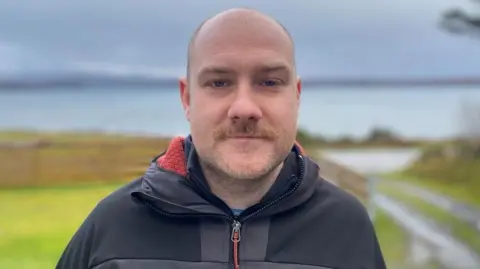
Steven MacDonald, along with his wife Sophie and their young daughter, have also faced a struggle to build a life for themselves in the Highlands and Islands.
They lived in Uist in the Western Isles for two years until Mr MacDonald was made redundant.
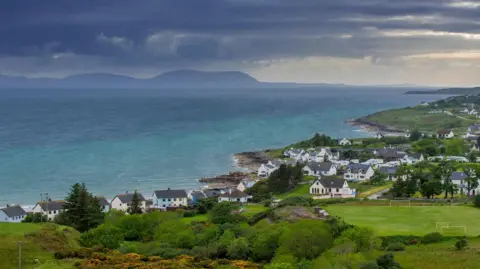
He then secured job in Wester Ross and he and his family moved to the small village of Gairloch.
"The area is lovely, the people are fantastic and the community is really, really strong here," said Mr MacDonald, an active schools co-ordinator.
He said his family were fortunate to be offered an upstairs apartment while they looked for a home.
"What we hoped would be a short-term solution turned out to be long-term," he said.
"We were there for just over two years purely due to unaffordability of homes here."
The MacDonalds eventually managed to buy a property, but it requires extensive improvements to its heating.
Mr MacDonald said options of moving again remained limited.
"Homes do come up, but they are either too expensive or require work to make them habitable, whether it's new roofs or heating, or how far they are from work or public transport," he said.
 Getty Images
Scottish Land and Estates (SLE), an organisation representing private and community landowners, said a lack of housing, jobs and services prevented rural communities from growing.
It said Scotland could adopt similar strategies used by other countries, including Ireland, Canada and Norway.
SLE has suggested establishing repopulation priority areas (RPAs) so government interventions can be targeted where they are most needed.
It also wants to see incentives for employers to create rural jobs, and some civil service teams relocated out of cities.
Cameron Gillies, head of external affairs at SLE, said: "The reality is that rural depopulation is already reshaping the social and economic fabric of Scotland.
"Schools are closing, services are being withdrawn and employers are struggling to fill roles.
"Unless we change course, many communities will simply not have the critical mass they need to survive."
The Scottish government said its Addressing Depopulation Plan set out its strategic approach to supporting communities facing population decline.
A spokesperson said: "It acknowledges that there are no quick fixes to these challenges - every place is affected differently and there is no one solution that will work for every area."
They added: "We are committed to working closely with regional, local and community partners to ensure we collectively deliver a sustainable solution to these challenges."
The Scottish government said it was funding seven local authorities in depopulating parts of Scotland to trial "innovative measures".
The spokesperson said it was taking other actions through its islands plan, and had committed to delivering 110,000 affordable homes by 2032, of which at least 10% would be in rural and island communities.
