Retired NHS staff would form reserve service under Welsh Tories, party says

 Getty Images
Retired doctors and nurses would be brought back into the NHS to form a reserve service under a Welsh Conservative government, the party has pledged.
Senedd group leader Darren Millar said former workers, as well as newly-qualified and private clinicians, would be sent into health boards "at times of peak need" if the Tories win the Senedd election in May.
One retired nurse told BBC Wales that while she would love to go back to work, she would have "real concerns" about how skills would be maintained after years away.
The Tories said it would declare a "health emergency" if it was in power, and take immediate action to increase NHS capacity and boost patient safety.
It also said a Tory Welsh government would immediately reopen closed wards in existing community hospitals across Wales, and boost spending on health and social care each year of the next Senedd term.
The party pledged to clear the NHS waiting times backlog, so that by May 2030 "no-one has an unacceptable wait for treatment".
Most recent waiting time figures showed the number of people waiting for treatment had fallen by the biggest figure on record, standing at just under 757,900.
The Welsh Conservative health manifesto says the party would set up the NHS Wales Reserves Service, to give the health service a bank of staff that can be called up during periods of crisis.
Millar told BBC Wales: "Staffing of the NHS is a disaster in Wales at the moment. There hasn't been effective workforce planning by the Labour government or indeed by their partners, so we need to make sure we've got a proper workforce plan.
"There are doctors out there in Wales at the moment who have just qualified. There are nurses who have just qualified, who don't have a job, they don't have any employment. And that's ridiculous when you consider the situation that the NHS is in."
He said the reservist plan "is to bring people back into the workforce at times of peak need, so that they can help us to get to grips with these challenges, that's our focus".
It would include "people who might have retired, people who may have left health professions for other things, other people who might work in the private sector from time to time, but might want to make themselves available to the NHS in order to serve their country".
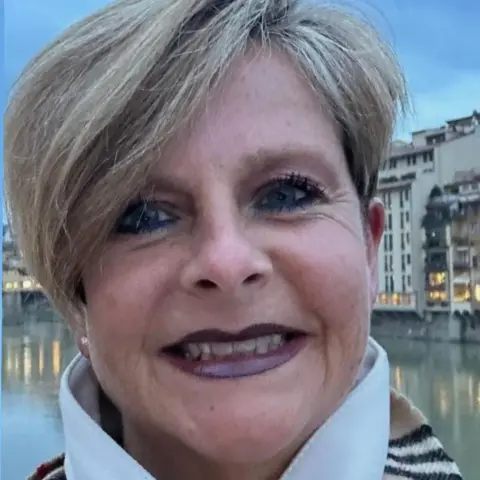 Jane Rowlands-Mellor
Retired NHS nurse Jane Rowlands-Mellor, 57, from Cardiff, said she would "love to be able to go back and help".
But she said she would have "real concerns about how skillsets would be maintained".
"This could ultimately affect quality of care and patient safety. The priority must be to safeguard our patients," she said.
"Things advance very quickly in healthcare, even basic nursing care could be a challenge with technology changes, etcetera.
"How would people keep their skills current?"
Katherine Davies, from Pembrokeshire, retired from nursing nearly 30 years ago, but continued for some years as a bank nurse, "on a list to be called in to work on short notice".
The 76 year-old has since had a knee replacement so is "in no fit state to go back to work" but said she felt there should be different priorities for strengthening the NHS in Wales.
"What the NHS needs is for staff need to be paid more and better working conditions," she said.
However, the British Medical Association (BMA) in Wales supported the proposal.
Dr Iona Collins, chair of the BMA's Welsh Council said: "BMA Cymru Wales supports the use of retired doctors to bolster NHS capacity during periods of heightened demand and to address ongoing backlogs."
But she stressed pension taxes would need to be looked at, as they currently "serve to push senior doctors out of the NHS prematurely" leading to the "unnecessary loss" of senior staff.
"In order for senior doctors to voluntarily rejoin the NHS out of retirement at times of peak need, the punitive pension tax must be removed, which would not only keep the existing senior workforce within the NHS, but enable those who have retired to consider returning in times of surge demand."
Associate director of the Royal College Nursing Wales, Sandy Harding, said: "As a qualified nurse you have to re-register every three years. You have to maintain your skills.
"If you're a volunteer, how are you keeping yourself on the register? To be able to practice, you have to pay to be on the register - how is that going to be paid? Are there going to be training days? Who's going to pay for the training?"
She welcomed the reservist plan but said there were "issues to be ironed out".
The wide-ranging Tory health manifesto also promises to end corridor care in Wales and designate 12-hour waits for patients on chairs in emergency departments.
It pledges to set up a dental school in north Wales, as well as a fund to build new hospitals and modernise the hospital and primary care estate in Wales.
The party is holding the second day of its party conference in Llandudno as it reels from defections to Reform UK, while also struggling in opinion polls which have suggested the party could finish in fourth place.
On Friday it emerged that two senior aides had quit the party to work for two Reform MSs who themselves were former Tories.
