Anglo-Saxon 'Woden ring' to go on display

 Dean Young
When metal detectorist Dean Young found an ornate gold ring with a connection to the Saxon god Woden, he "had a funny feeling this is going in a museum".
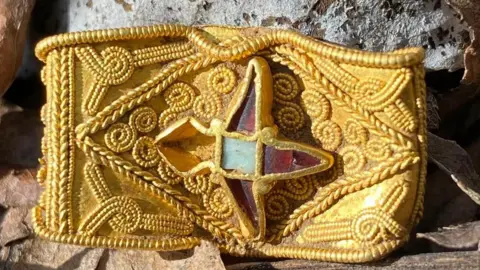
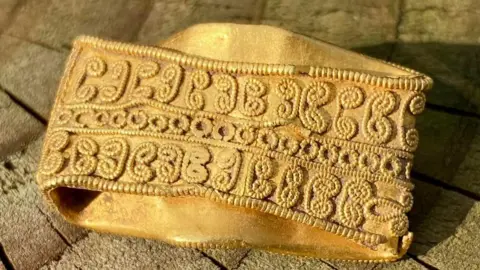
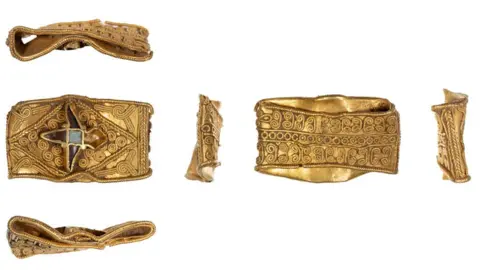
Three years later, Epping Forest District Museum in Waltham Abbey, Essex, is about to put the find, which was probably lost by a Saxon warlord, on display.
The elaborate band, which is decorated with a garnet and quartz cloisonne bird, "is going to be the jewel in our museum's crown", said museum manager Ian Channell.
Young, 49, said he was "over the moon" about it going on display, adding, "putting things like this away in a private collection is such a shame".
 Dean Young
The antiques and reclamation dealer from Wickford initially suspected he had found a piece of tin foil when his metal detector started pinging at a site near Matching Green, Essex, in 2023.
"It was not until I picked it up and by the weight of it, I knew it was gold, and my friend could see from my face I'd found something really good," he said.
Young, who took up detecting about nine years ago, reported the discovery to the Essex finds liaison officer Lori Rogerson, who described the ring as "on a par with" the many fine Saxon objects found at the famous Sutton Hoo ship burial.
The ring was declared a treasure by a coroner, making it available for the museum to acquire.
"Finds like this don't come along very often and, once on display, it will be a real star object for visitors," said Channell, who added it would have been worn "by one of the social elite - potentially a warrior or member of the Anglo-Saxon royalty".
"By showcasing these treasures locally, we offer the community the opportunity to engage with and connect to their heritage, fostering a sense of pride and identity... we can't wait to put it on display."
 Dean Young
Woden was the Saxon equivalent of the Norse god Odin - a one-eyed war god, who was accompanied by his two raven companions, Huginn (thought) and Muninn (memory).
Channell said the ring's bird design suggested "the wearer could be seeking the protection of Woden and his raven god persona".
Anglo-Saxons in Essex were initially pagans, although that began to change in the late 6th and 7th centuries.
"The kingdom of Essex was increasingly influenced by the kingdom of Kent, which converted to Christianity in about AD597," he said.
"There are multiple years when Essex bounced between paganism and Christianity - and this ring shows local paganism in the kingdom of Essex."
 Epping Forest District Museum CIO
The museum was particularly pleased to add the ring because it "fills a gap" in its collection, which has a limited number of Saxon objects, he added.
The county has a rich history in Anglo-Saxon buildings, such as Waltham Abbey church and Greenstead church, believed to be the world's oldest wooden church.
Channell said: "A wooden predecessor of Waltham Abbey church was constructed in the 7th Century.
"King Harold II, famously shown shot in the eye at the Bayeux Tapestry, rebuilt the church in 1060, transforming it into a large stone structure."
The king was believed to have been buried there after he died in the Battle of Hastings.
 Colchester and Ipswich Museum Services
The acquisition was made possible by funds from the Arts Council England/V&A Purchase Grant, the Headley Trust, the Essex Society for History and Archaeology, the Art Fund, the West Essex Archaeological Group, the Waltham Abbey Historical Society, and private donations.
It will go on display in the museum's Core Gallery in May, and Young is "really looking forward to seeing it again".
Do you have a story suggestion for Essex? Contact us below.
Follow Essex news on BBC Sounds, Facebook, Instagram and X.
