Burials tell story of life and death in Saxon England

 Discover Bucks Museum
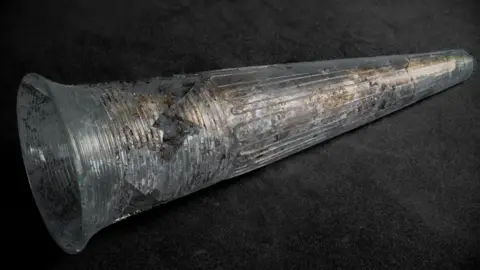
A fragile glass drinking beaker and a warrior's sword are among items on display at an exhibition revealing what life and death was like in early Saxon England.
The objects come from three burial sites in Buckinghamshire, and include never-previously-exhibited finds from Wendover cemetery, discovered ahead of building of the HS2 railway line.
Four burials will be replicated at the exhibition at Discover Bucks Museum, Aylesbury, including the princely burial at Taplow and the Warlord of Marlow.
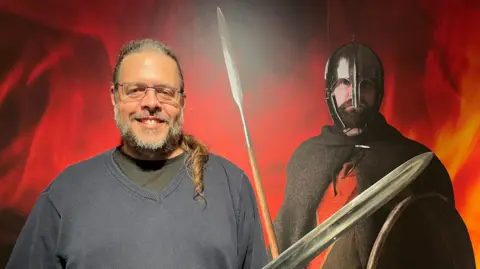
"People think of Saxon times as the Dark Ages and they're not; these people have amazing craftsmanship and clearly treasure the things buried with them," said curator Brett Thorn.
"We've got three different sites with three different layers of Anglo-Saxon society found in three very different ways," he added.
"We've got the ordinary people from the Wendover site; we've got the Marlow warlord, who's a leader of men, but not a king; and then we've got the Taplow princely burial."
 Discover Bucks Museum
 University of Reading
The sites date to the pre-Christian Saxon period, between about AD500 to 700.
Thorn, who is the museum's keeper of archaeology, said the burial chamber of the the Taplow prince, which was discovered in 1883, has been recreated, surrounded by replicas of his grave goods such as jewellery, swords, shields and drinking horns.
"The finds are all at the British Museum, who very kindly loaned us some, and it's phenomenal. Until Sutton Hoo was found, which is obviously very famous, the Taplow site was the richest Saxon burial in Britain," he said.
 University of Reading
 Discover Bucks Museum
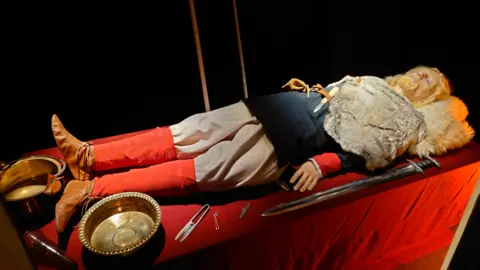
The Marlow Warlord grave was found by metal detectorists in 2018, who alerted the Portable Antiquities Scheme.
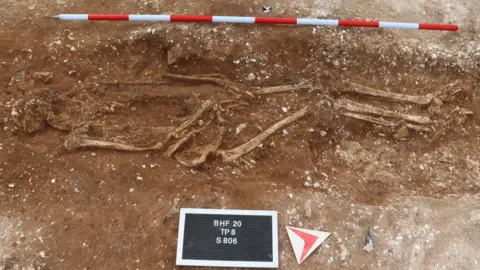
A later excavation unearthed the remains of a very tall, well-built man, who was about 6ft 4in tall (1.9m) at a time when the average male height was 5ft 7in (1.7m), according to Thorn.
"We've got him laid out as if he was just about to be taken away to be buried," he said.
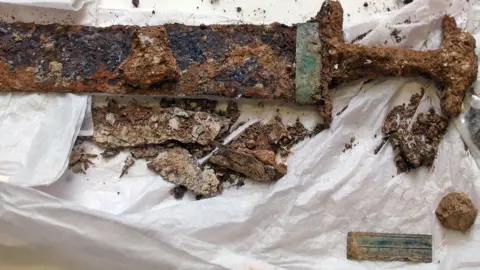
His well-preserved iron sword in its original wood and leather scabbard is going on public display for the first time, alongside a replica created for the exhibition.
 Discover Bucks Museum
The burials of a woman and a man from the Wendover cemetery will also be a key part of the exhibition.
The cemetery is one of the biggest Anglo-Saxon ones uncovered so far, containing 138 graves made up of 141 regular burials (some graves had more than one body) and five cremation burials.
Discovered in 2022, conservation work on its many finds has yet to be finished, meaning this is the first time the public can see them - and some still have mud clinging to them.
Thorn said: "HS2 kindly loaned us the stuff early for the exhibition, it will go back to HS2 for the rest of the research to be done, and it will eventually all be donated to the museum."
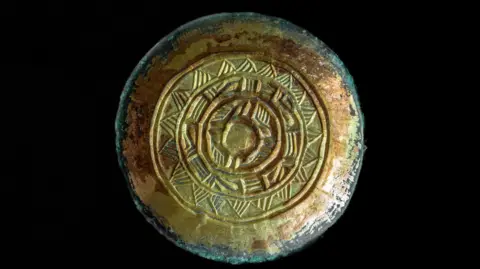
One astonishing item is cremation urn with a chunk of Roman glass in its base.
"Why they would put glass in the bottom of a cremation urn, we don't know - it's not easy but it's been done very deliberately - maybe to let the spirits out?" said Thorn.
 Discover Bucks Museum
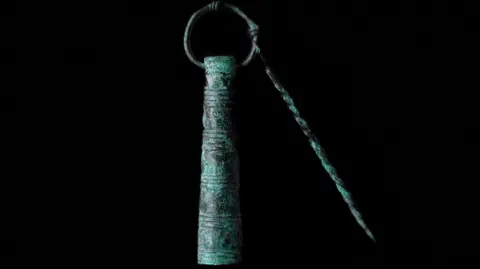
An unusual bronze toiletry set of a hollow container about 6cm (2in) long, accompanied by a thin twisted rod with a flattened end and found in a woman's grave will also be displayed.
It probably contained some sort of cosmetic, which was scooped out by the rod.
"Both men and women are often found with personal grooming items; they care about their appearance; they are not the unwashed savages they were once thought to be," said Thorn.
 Discover Bucks Museum
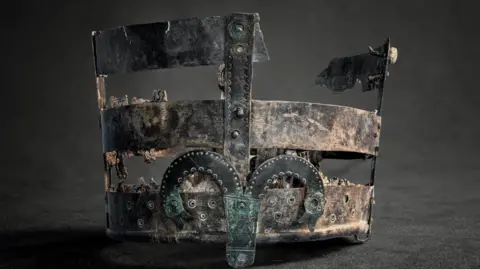
The fragile remains of a drinking bucket - about the size of a large tankard and decorated with animal heads - found with the remains of a man is another stand-out loan.
The curator said: "The astonishing thing is it still has chunks of the wood attached on the inside; it was built like a barrel out of strips of wood bound together with the bronze bands."
The museum was "really, really lucky to be able to get these three sites at different points of society and there's three different stories to tell, but all related to Buckinghamshire", he added.
Follow Beds, Herts and Bucks news on BBC Sounds, Facebook, Instagram and X.
