Man who wanted to be 'Welsh spokesman' for Islamic State jailed

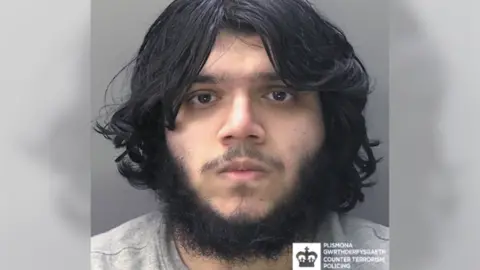 Counter Terrorism Policing Wales
A man who posted propaganda and tried to recruit a 17-year-old to the so-called Islamic State group on social media has been jailed for five years.
Shazad Ali, 21, of Newport, published hundreds of videos on Instagram and TikTok in an attempt to promote the banned organisation, and claimed he would be its next spokesman in Wales.
Bristol Crown Court heard Ali communicated extensively online with others he believed to be linked to the group and recruited six men into its ranks.
On Friday he was sentenced to five years in custody, with an additional two years on licence after his release.
The court heard that Ali became immersed in IS ideology between July 2024 and January 2025, spending much of his time in his bedroom using his phone to promote the group online.
Ali told police he had first come into contact with a man called Abu Qatada, whom he believed to be an IS member fighting the Taliban in Afghanistan, while playing online games such as Roblox.
He claimed he had acted under pressure from the man, but investigators found no evidence to support that claim.
Propaganda and recruitment
Ali exchanged about 1,700 messages with a 17-year-old boy over two months in attempts to recruit him to IS from al-Qaeda, the court heard.
He said he would be "the next spokesman for Dawla in Wales", referring to al-Dawla al-Islamiya fi al-Iraq al-Sham, meaning the Islamic State in Iraq and the Levant.
Prosecutors said Ali posted "hundreds" of videos across Instagram and TikTok promoting the group.
Christopher Amis, prosecuting, played three videos taken from Ali's social media to the court, one of which featured Mohammed Emwazi – aka Jihadi John – holding a scalpel and a knife while audio spoke of "slaughter".
During one TikTok chat, Ali claimed he worked to create media for IS which "reinforces the notion the defendant was working as an influencer and propagandist for Isis", Mr Amis said.
To avoid detection by platform algorithms, Ali disguised "violent" pro-IS imagery with innocent content, including Pride marches and mixed martial arts.
"That exercise required you to collect, generate, edit and publish the footage," Judge Parker told Ali.
"In addition, through online communication you were able to recruit six men into the ranks of Isis," the judge said.
Ali created chats on Telegram which were used to discuss IS and involved people he believed were members of the group
The judge said he acted as a "gatekeeper" to Abu Qatada, vetting those who wanted to access chats where the man was present.
One group, called Lone Wolves, had 11 members. A document, providing instructions on how to make an explosive, was posted in that chat group and downloaded automatically onto Ali's device.
When another participant asked how to obtain the ingredients, Ali replied: "If from the UK, I have them all, I can send."
The judge, who described the incident as an "escalation in your behaviour and involvement", noted that none of the chemicals were discovered despite extensive searches at Ali's family home.
'Very dangerous threat to the public'
Ali pleaded guilty to four offences under the Terrorism Act - supporting a proscribed organisation, two counts of encouraging terrorism and one of possessing a document likely to be useful to a terrorist.
The prosecution offered no evidence against Ali on charges he was a member of IS and that he possessed a second document about explosives. Judge Parker directed not guilty verdicts in respect of those charges.
Judge Parker said acting as a recruiter and propagandist for the group had been "harmful and dangerous" and told Ali he hoped he would return to the "ordinary, happy life which your parents so long for you" after being deradicalised.
Speaking after the case, Det Ch Insp Leanne Williams, of Counter Terrorism Police Wales, described Ali as representing a "very clear, very dangerous threat to the public".
"Ali visibly expressed his support for the Islamic State and it was our overriding priority to ensure the public were protected from both him and the abhorrent rhetoric he promoted," she said.
Ali's defence barrister, Jodie-Jane Hitchcock, said he had a "very modest number of followers" on his accounts and was socially isolated.
"He found himself exposed to a world online where his isolation was exploited and he found an outlet," she said, adding that he was remorseful for his actions.
