Veterans get awards for raising awareness of PTSD

 Combat Stress
Two veterans have received awards for their work to raise awareness of military trauma by the charity that supported them.
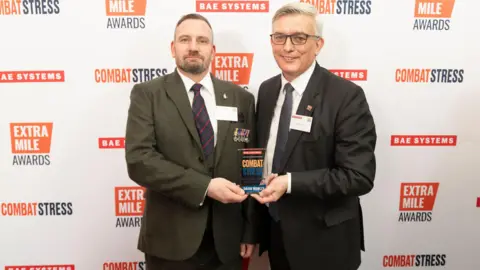
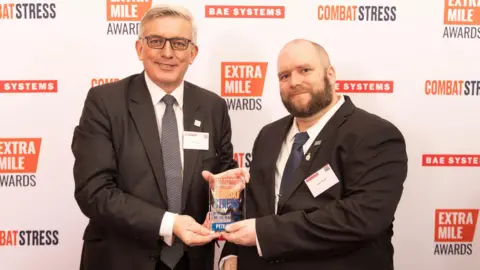
David Rowley, an Army veteran from Ludlow, and Newport RAF veteran Pete White, were presented the awards by former First Sea Lord, Admiral Sir Philip Jones.
Rowley was named Veteran Ambassador of the Year and White named Veteran Advocate of the Year.
The awards were held by Combat Stress, a mental health charity for former service personnel across the UK. Both men were treated by the charity in 2023.
Since their treatment, they have told their stories to increase public awareness of veterans' mental health issues, as well as fundraising for the charity.
 Combat Stress
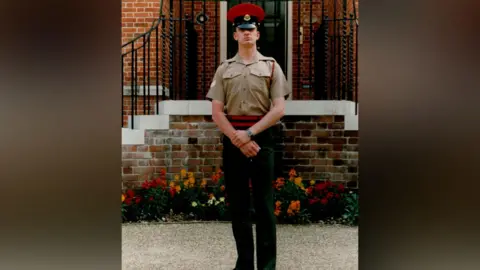
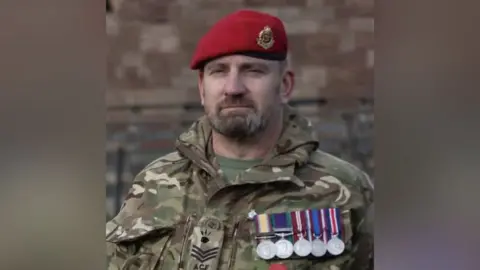
Rowley, 53, joined the Army in 1988 at 16, joining the Junior Leaders Regiment, Royal Armoured Corps and then moving on to the Royal Military Police.
He was deployed to Operation Granby in the first Gulf War, and Northern Ireland later.
"There were two episodes within my military life that affected me," he said.
"The first was the first Gulf War. Basra Highway was known as carnage carriageway, and it was exactly like it sounds."
In 1996 while in Northern Ireland, he said he was 20 to 30 metres away from the second improvised explosive device at the Thiepval Barracks in Lisburn and was blown onto a nearby sports field.
"To be seconds away from death brings it all home to you," he said.
He left the Army in 1997 after nine years, spending five years as a police officer before becoming a paramedic.
 Combat Stress
The death of a child at work was "the straw that broke the camel's back," he said.
Rowley was put on antidepressants in 2018, which he said allowed him to "work, not live".
He called Combat Stress in 2023 and started receiving support and treatment.
"If Combat Stress didn't exist, you'd have a lot of dead veterans," he said.
"They were there when nobody else was - I wish I'd known about them years ago. They understand veterans, so don't ever think you're on your own."
On the award, he said: "It's amazing to be recognised for my efforts, and it's a real reminder of how far I've come, but I'm simply happy doing whatever is in my power to help support veterans who are going through what I once was."
 Combat Stress
White, 38, was 21 when he joined the Air Force. He followed a long line of family members serving before him.
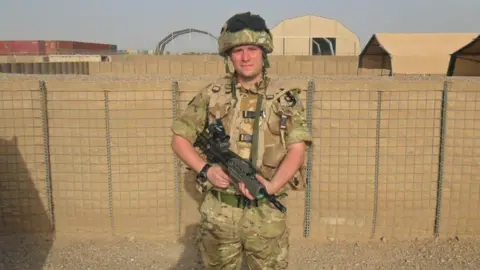
He became a communications engineer, and during his nine years in the RAF was mainly based in the UK, as well as a five-month deployment to Afghanistan in 2011.
There, at Camp Bastion, his role was to monitor military messaging channels overnight for casualties, creating reports which included viewing footage and photos of the incidents.
After 10 weeks he moved to a new role, reclassifying documents including interrogation reports, and videos and photos of Afghan civilians and combatants being killed.
"One thing I remember is reporting on the death of a very young child... who was killed by the Taliban," he said.
"Add to that the sheer volume of death and injury I witnessed, there was a lot of secondary trauma with no support."
His PTSD symptoms started after his tour, and he attempted to take his own life before having a psychotic episode.
He was medically discharged in 2017.
 Combat Stress
White began to improve after being discharged, but when the Taliban took over Afghanistan in 2021, he tried getting help from the NHS and was experiencing symptoms again.
He called the Combat Stress helpline in 2023, and was referred to a psychologist, undertaking the charity's intensive treatment service in 2024.
On the award, he said: "I'm blown away as I wasn't expecting to win an award."
"I just hope that my efforts will give veterans the courage to seek help with their trauma as I'm proof that recovery is possible."
If you have been affected by any of the issues raised in this story, information and support can be found at the BBC's Action Line.
Follow BBC Shropshire on BBC Sounds, Facebook, X and Instagram.
