'We're not getting rid of the water fast enough'

 PA Media
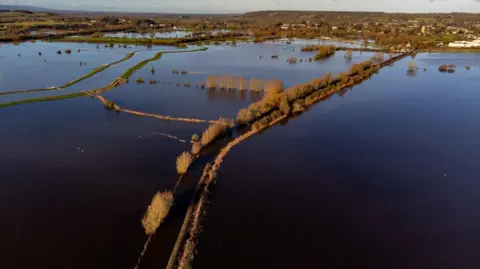
A key road across the Somerset Levels is at risk of being lost unless "permanent pumps" are installed, councillors have warned.
In 2014, the village of Muchelney was cut off for about 10 weeks when all four roads into the hamlet were submerged under deep flood water.
A year later, a 500m (1,64 ft) stretch of the main road into the village was raised by more than a metre to create a causeway to ensure it stayed open during flooding.
But councillor Mike Stanton said in the recent "near-flood event" the flood water "got very near to the top of that causeway" and is calling for the Environment Agency (EA) to install permanent rather than temporary pumps.
The Somerset Rivers Authority (SRA) was set up after devastating floods in 2014.
Stanton, chairman of the SRA, said it had been more than a decade since the road between Drayton and Muchelney was raised.
"That's 10 years of climate change and rainfall, and maybe a bit of natural subsidence," he said.
"We're constantly playing catch-up to keep up with what the climate is doing to us.
"It was every 50 years, then it was every 10 years, and now it seems to be every two years."
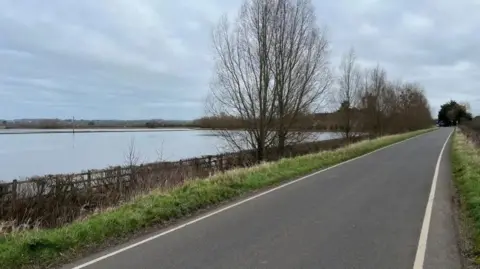
Councillor Richard Wilkins, Somerset Council's lead member for transport, said the causeway between Drayton and Muchelney "is at risk" and if Drayton was to be cut off along with the other three roads "Muchelney would again be an island".
"We're not getting rid of the water fast enough," he said.
"I'm very keen that we really do pursue the EA to put in better, more permanent pumps."
Last month the government confirmed a review was under way to decide if installing pumps all year round could help prevent future floods in Somerset.
At the time Floods Minister Emma Hardy, said: "The review will look at several important questions: when pumps should be activated, whether the current trigger points are right and whether permanent pumps in certain locations could present better value for money in the long term."
Speaking to BBC Radio Somerset, this week, she said conversations about new pumps were "ongoing".
She said residents should get an answer "in the next few weeks" on whether more permanent pumps would be installed.
Follow BBC Somerset on Facebook and X. Send your story ideas to us on email or via WhatsApp on 0800 313 4630.
