Why does Somerset keep flooding?

 BBC
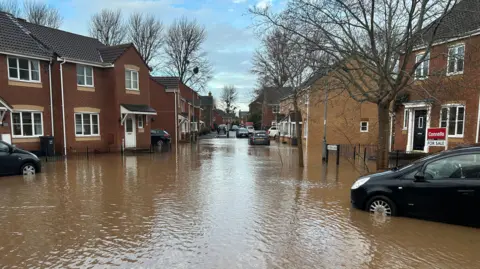
BBCIt has been another wet January in Somerset, the wettest since the great floods of 2014.
Declaring a "major incident", council officials reported the water came up even faster this year than it did 12 years ago.
One seasoned local flood campaigner said the water rose "ridiculously fast", with some fields and roads going underwater in 36 hours.
People are asking questions. Namely, as the climate changes, should we expect huge downpours like this more often?
Is flooding made worse by new homes built on the floodplains?
And is it time to stop farming land that one environmentalist called "England's greatest wetland"?
Is Somerset flooding the new normal?
"What we see with climate change is it pushes the extremes," said Alex Deakin, a meterologist at the Met Office.
Warmer air carries more moisture, he explained. Since 1850, the world has warmed about 1.3C and that warmer air can take about 10% more water.
"It's fairly straightforward that when it rains, it rains that much harder," Deakin explained.
"But also climate change is pushing those extremes, so when you get heavy rain it's just that much heavier as well."
But January 2026 only came in at number six in the top 10 wettest Somerset Januaries. For example, in at number five was 1943.
That is because weather systems are complicated and lots of factors produce a prolonged wet spell, Deakin said.
But overall, he explained, a warmer world is bringing wetter winters, especially in the south-west of England.
"The last 30-year average rainfall in Somerset is quite a bit higher than the same period at the start of the last century.
"So we're seeing across these climatological periods an increase in the amount of wet weather, especially through the winter months," Deakin added.
 PA Media
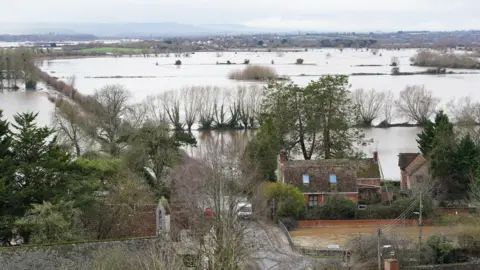
Is it foolish to build on Somerset flood plains?
On the outskirts of Yatton, in North Somerset, a small field has become the centre of a high court battle over the future of planning policy.
Yatton Batch, as it is known, lies just 5m (16ft) above sea level and is entirely within "flood zone 3a", commonly known as the flood plain.
Developers want to build 190 homes here and were turned down by North Somerset Council. But on appeal, the planning inspector gave the new estate the green light.
Praising the planned biodiversity improvements, orchards and children's play area, the inspector said: "I have found that the wider sustainability benefits outweigh the flood risk."
But Steve Bridger, Yatton's local councillor, is appalled.
"As climate change accelerates and rainfall intensifies in the South West, building new homes in Flood Zone 3 is increasingly indefensible," he said.
The council has challenged the planning inspector's decision in the High Court, and awaits a judgement.
Bridger believes the decision will be nationally significant, as it could be cited as precedent by other developers wishing to build on flood-prone land.
He said: "Allowing housing permissions in an area at high risk of flooding will put existing and future residents at real and unnecessary risk - as well as creating financial and insurance uncertainty."
Is it time to stop farming the Somerset Levels?
Building on flood plains is contentious enough. Even more divisive is the suggestion that farming on the Somerset Levels should come to an end.
Every year, much of the Levels floods. Some years, this is more widespread, turning roads into rivers and lapping at the thresholds of nervous residents.
Everyone here knows that centuries ago, people lived on the high ground, and only came down onto the Levels in the summer to graze their animals.
They were known, after all, as the Summer People. Hence Somerset.
These days, the fields are drained by a network of ditches, or rhynes, and rivers. When the wetlands flood, huge pumps are brought in to move vast amounts of water off the land.
 Ben Goldsmith
One man calls this process "insanity".
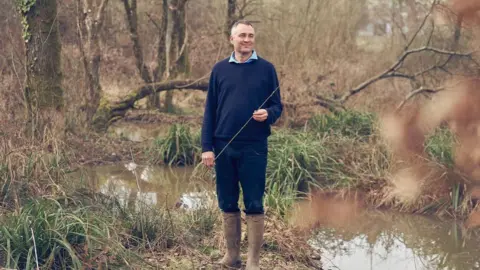
"I wonder why are we spending oceans of public money pumping water out of a wetland?" asks Ben Goldsmith.
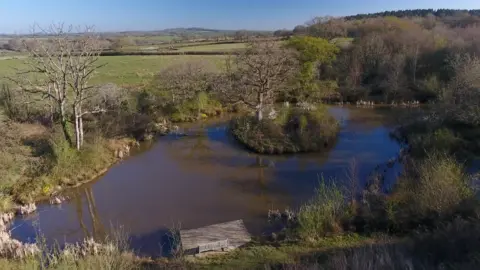
He owns a farm in south Somerset and is an environmentalist. He has been transforming his own land into a wild place, tearing down barbed wire fences and breaking field drains. Allowing the land to flood, beavers to build dams, pigs and cattle to roam free.
 Leander Ward /Wayfarer Media
He says the Levels are "meant to be our Camargue or our Danube Delta - the most important wetland in southern England".
"There are tremendous amounts of wildlife, and salmon and trout and eels and huge aggregations of migrating wading birds and geese and ducks," he adds.
His challenge is controversial, not least to the families who farm here. He recognises that and argues the government should help farmers move to more productive land, instead of spending "huge amounts of public money pumping the water out of the wetland".
Is it time to stop trying to grow maize, rear sheep and cattle on land which often floods? And if so, how will the families whose livelihoods are uprooted be compensated?
While the debate rages on, Somerset is still clearing up after another wet January.
Follow BBC Somerset on Facebook and X. Send your story ideas to us on email or via WhatsApp on 0800 313 4630.
