Deaf patients condemn lack of NHS interpreters

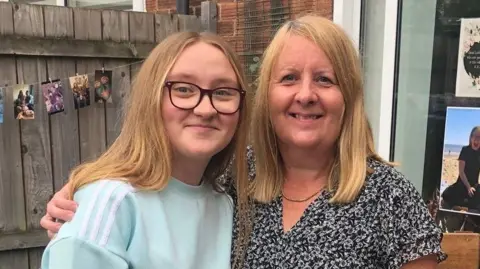 Millie Neadley
Deaf people say a shortage of interpreters working with the NHS has left them feeling misunderstood, frustrated and facing delays to treatment.
Millie Neadley, 22, from Hull, said she had a "frustrating" year-long wait for surgery on a broken nose after appointments were cancelled because a British Sign Language (BSL) interpreter was not available.
A survey by hearing loss charities RNID and SignHealth, published in 2025, found 7% of respondents who required a professional to help with communication at appointments always had one.
NHS Humber and North Yorkshire Integrated Care Board (ICB) said the small number of qualified BSL interpreters was a long-term challenge needing national attention.
Millie said not having an interpreter made her "feel like I'm being ignored" and at risk of "missing out on essential information".
According to Millie, staff have called her on the telephone to discuss appointments despite her explaining she cannot hear.
"They still carry on ringing, which is frustrating as I have to rely on other people to find out what they want – meaning I have no independence," she added.
On the day of her surgery, she was told the interpreter had cancelled, but an available nurse was capable of basic signing.
Millie's mother Joanne Neadley, who is also deaf, said: "It had been delayed, delayed, delayed and she just wanted it over with, because she couldn't breathe.
"So to arrive at 7am and be told, 'no interpreter' it's just not appropriate."
Joanne said the nurse was "lovely", but the situation was "not acceptable". She added: "We want a proper BSL-qualified interpreter."
According to RNID and SignHealth, more than 15 million adults in England are deaf or have hearing loss, with about one million unable to hear most conversational speech. There are an estimated 73,000 deaf BSL users.
The charities surveyed 1,114 people who were deaf or had hearing loss and lived in England.
Of the 208 respondents who said they needed a communication support professional, such as a BSL interpreter, 63% said one was rarely or never provided for appointments, while 28% said one was sometimes provided.
Their report, titled Still Ignored: The Fight for Accessible Healthcare, concluded that the NHS lacked "the systems in place to fulfil the right to accessible healthcare" within the deaf community.
It also found deaf people felt "disrespected", "excluded" and often had to rely on friends and family members to translate.
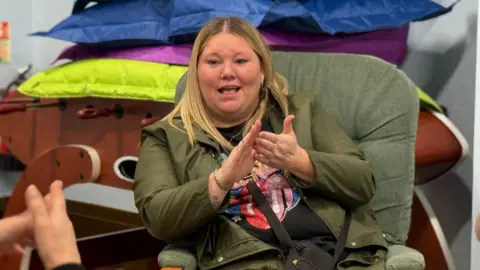 Charlie O'Loughlin
Rachel Duke, 38, from Hull, said she was a sixth-generation member of a profoundly deaf family.
She described how the simple act of calling her GP surgery by telephone at 8am for an appointment was not possible and she had to ask someone to help.
She often arrived at appointments to find no interpreter had been arranged, which left her relying on family members.
On one occasion, she took her son, who is also deaf, to the GP and watched a display screen to see when his appointment was called.
"I was waiting a long time," she said. "I went to reception and said, 'I've been waiting for my son's appointment'. They said, 'We called your name, but you never came?'.
"There was nothing on the display screen.
"Then they said: 'Sorry, we have to delay it now and book another appointment because you've missed it'."
Rachel added: "I don't want to rely on hearing people. I want to do it myself. Equality, that's what we need.
"I feel like we're at the bottom. We're never understood."
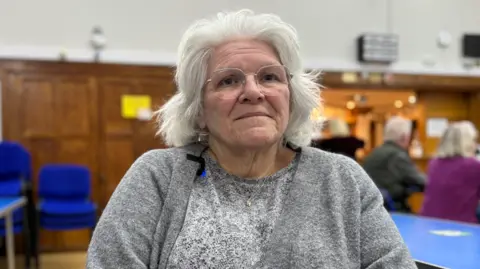 Charlie O'Loughlin
Heather Peachey, a level 6 BSL interpreter from Barton-upon-Humber, said she was the only qualified, registered interpreter in North or North-East Lincolnshire.
She began signing when her younger sister was diagnosed profoundly deaf aged five.
However, she said becoming a qualified interpreter was not easy.
"I had to stop part way because I ran out of money. I eventually became registered about 14 years ago after my dad left me the money to complete the training.
"It's the same as learning any other language, it's all self funded. There are very few universities offering BSL units.
"If you take somebody who's never signed before, they're probably looking at six, seven years to become competent and qualified as an interpreter."
Signature, the BSL exam board, said learning to become a level 6 interpreter was likely to cost about £6,000, depending on the training provider.
'Few and far between'
Only experienced, level 6 interpreters can attend medical appointments and surgeries, according to the NRCPD, a voluntary regulator for language service professionals.
It lists five interpreters living within 25 miles of Hull.
Sarah Regan, the residential manager at the Hull Deaf Centre, said qualified individuals were "few and far between".
"There's just not enough training. If you went into any school in Hull and asked them what they want to do, I doubt you'd get one coming back saying they want to be a BSL interpreter.
"The people who are learning sign language, paying out of their own pockets, should be applauded and encouraged financially with some money from the government."
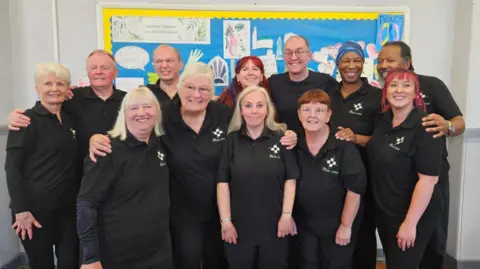 Hull Deaf Centre
A spokesperson for RNID said equal access to healthcare was "a basic human right", but their research had "exposed widespread failings affecting people who are deaf when accessing NHS services".
The BBC asked NHS England and the Department of Health and Social Care to comment. Both referred us to the ICB, which works to reduce health inequalities across the Humber and North Yorkshire region.
A spokesperson for the ICB acknowledged interpreter provision needed to be improved and the body had been working closelywith the Hull Deaf Centre to highlight the barriers people faced.
It had created new training tools for NHS staff, including films made with deaf people.
"The small number of fully qualified BSL interpreters in the region, and the seven‑year training route, is a long-term challenge that needs national attention," the spokesperson said.
"We are working with NHS partners to make real and urgent improvements.
"This includes looking at the deaf patient journey from first contact through to complaints, making better use of BSL‑enabled technology, improving how interpreters are booked, increasing deaf awareness training for staff and making sure services meet the Accessible Information Standard."
Listen to highlights fromHull and East Yorkshire on BBC Sounds, watch the latest episode of Look Northor tell us about a story you think we should be coveringhere.
Download the BBC News app from the App Storefor iPhone and iPad orGoogle Play for Android devices
