'Crumbling concrete' courts will not reopen

 BBC/Richard Sowersby
A court building which closed after the discovery of unsafe "crumbling" concrete will not be brought back into use.
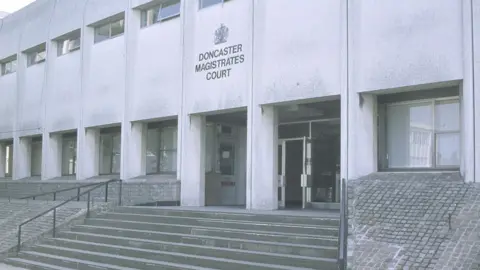
Doncaster Justice Centre North, which housed the city's magistrates' court, was found to contain reinforced autoclaved aerated concrete (RAAC) in 2023.
His Majesty's Courts and Tribunals Service, an executive agency of the Ministry of Justice, has confirmed the building will remain closed permanently.
A spokesperson said the service was exploring how to "make best use" of Doncaster Justice Centre South, the existing combined court building opposite the disused centre on College Road.
They said efforts to increase courtroom capacity and take on additional cases at the combined court would improve the facilities and provide better value for money.
Magistrates' court hearings have been held at other venues including Doncaster Justice Centre South, Sheffield Magistrates' Court and Barnsley Law Courts.
Coroner's inquests and civil cases are also heard at the South site, which was previously Doncaster Crown Court, and it still hosts a small number of Crown court trials.
Doncaster's mayor Ros Jones said the existing court was due to be refurbished later this year, "indicating the [Ministry of Justice's] intent to continue a Doncaster-based court provision".
In a statement on Facebook, she said the future of the disused, RAAC-containing building would be incorporated into city centre regeneration plans.
It is unclear whether the site will be sold.
Doncaster Magistrates' Court was built in 1969 at the same time as the brutalist-style police station next door, and both were designed by the same architect.
RAAC is a lightweight concrete which was used in floors, walls and roofing between the 50s and 90s.
It is cheaper and quicker to produce and install than standard concrete but is susceptible to collapse when exposed to moisture.
Listen to highlights from South Yorkshire on BBC Sounds, catch up with the latest episode of Look North
