'People do appreciate what we do': On the road with Doncaster's refuse workers

 Hayley Coyle/BBC
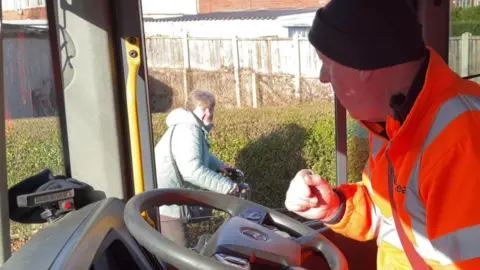
"You know you've got a job for life as long as you behave yourself", says refuse worker Gary Atkinson as he sits behind the wheel of his bin lorry on a street in Doncaster.
He has just reassured an elderly resident he will remember to empty the bin that she had forgotten to put out.
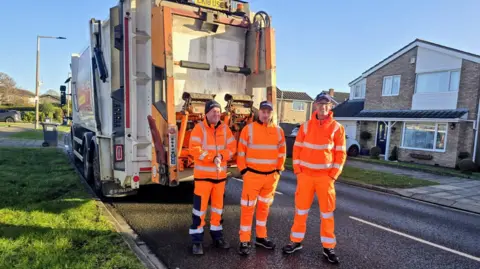
Atkinson, 63, and his team of two loaders have been on shift since about 05:00, all playing their part in the vital task of emptying the city's 17,000 bins.
Come rain or shine - or in this case, sub-zero February conditions - they will walk the equivalent of a half-marathon each day, while their lorry covers more than 60 miles (100km).
Atkinson says he has not looked back since he was made redundant from another job and decided to "give it a go" becoming a refuse wagon driver.
There are, of course, downsides to the job.
As well as the cold and early starts, other challenges include the inevitable unpleasant smells, people cramming their bins to bursting point and even being threatened by bad-tempered residents.
So, what makes these workers keep on showing up for work day in, day out?
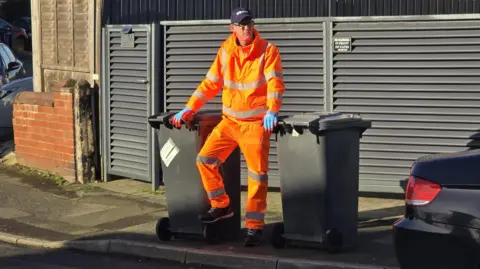
"It's good exercise," explains bin loader Rick Brown.
"You're out in the fresh air and I get to spend time with my family every weekend.
"We also get a four-day week and we are helping people", the 44-year-old adds.
Fellow loader Ricky Taylor, 40, agrees - adding that, for him, the camaraderie with colleagues is also a bonus.
Taylor has been working at Suez, the company to which City of Doncaster Council outsources its waste management, for 21 years and says he "more or less started his career" at the firm.
"We're a close-knit community and you have to get on," he says.
 Hayley Coyle/BBC
As well as being physically fit, bin loaders are highly-trained professionals and carry out "safety critical" responsibilities, according to Suez.
In Doncaster, the refuse wagons collect and transport 325 tonnes of domestic refuse every day as well as 111 tonnes of waste set for recycling.
Therefore, with so much work to do, it is clearly important to keep the refuse workers' task as smooth an operation as possible.
But, of course, various challenges often crop up to hinder progress for the teams out on the streets of Doncaster.
For instance, every damaged bin needs to be logged, other drivers often refuse to let the wagon pass, and overflowing bins mean either the loaders have to repack them - or in some cases, leave them - meaning a bigger job for another day.
"If they don't get collected, we have to just come back," says Brown.
"It unfortunately means we are then under pressure for the rest of the week - but they have to be collected - it's a must."
 Hayley Coyle/BBC
There is also plenty going on behind the scenes back at the seven-acre (28,000 sq m) depot.
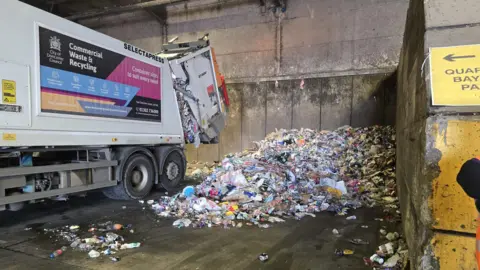
It is to that depot that the 29 wagons in operation in Doncaster every weekday - together with their crews - must return halfway through the shift to tip their collections so they can be transported to nearby recycling centres.
Almost everything at the site is streamlined, with a strict parking and traffic light system to ensure there are no bottlenecks.
Gary Booth, assistant site manager, says this stage of the recycling journey is important because it means refuse and recycling can be moved "in bulk", saving time and reducing costs.
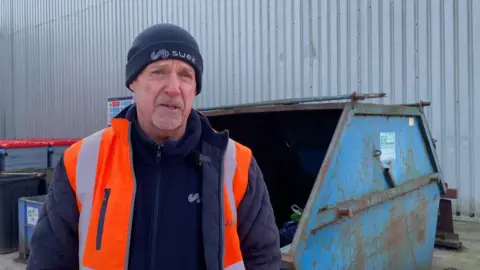
Booth says that to work in waste management and disposal, you have to be "genuinely passionate" about recycling.
"It's the way of the world now", he says.
However, according to Booth, the job is not without its dangers.
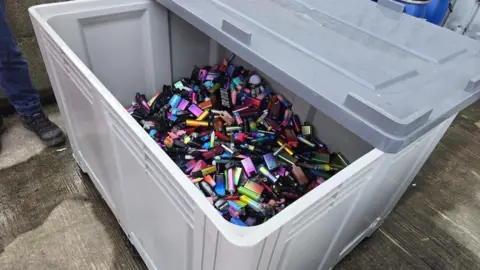
He highlights the fact that the disposal of vapes and lithium batteries in household waste has become a real issue in recent years.
People not disposing of such items properly can lead to fires inside the lorries which then means all the refuse they contain has to be immediately tipped on to the street before having to be shovelled back in by hand, he explains.
That is a task which is always "a really unpleasant and avoidable job for the loaders", he says.
While the loaders and wagon drivers are considered the "front-line" staff, Suez employs 176 other staff at its Doncaster site as well, from mechanics to weighbridge operators to administrative staff.
Danni Kelly, an assistant contract manager, says that these days more women seem to be drawn to the waste and recycling industry, and she has both female loaders and drivers on her team.
"Women fit in really well here and there is great progression," she says.
"A lot of loaders are now supervisors and have senior roles.
"It's not just a case of emptying a bin, there's a lot more behind it.
"Everyone has to do a strict induction to keep the public and our own workers safe."
"It's an essential service and everyone needs their bin collected," Kelly adds.
 Hayley Coyle/BBC
Back on their wagon, Gary Atkinson, Ricky Taylor and Rick Brown are all getting close to the end of their shift.
Despite the long days and the punishing weather, Doncaster residents seem to have a soft spot for their bin loaders.
Brown says that they are given biscuits, chocolate bars and even Christmas cards from people - all very gratefully received.
"It shows people do appreciate what we do for them", he smiles.
Listen to highlights from South Yorkshire on BBC Sounds, catch up with the latest episode of Look North
