Public to help shape plans for 'crumbling' hospital

 LDRS
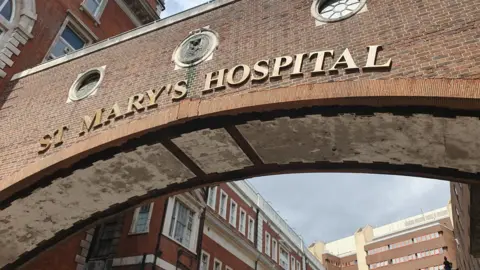
LDRSA west London hospital that is due to shut its outpatient building over safety concerns is asking the public for feedback on plans to redevelop the site.
The building at St Mary's Hospital in Paddington is due to close at the end of March following the discovery of reinforced autoclaved aerated concrete (RAAC).
Imperial College Healthcare NHS Trust, which owns the Paddington hospital, has launched a public consultation to help inform the first stage of its masterplan.
Redevelopment director Matthew Tulley said the move "marks an important step on our journey to finally deliver the urgently needed new St Mary's".
On the public consultation website he added: "We want as many patients, staff and local people as possible to help shape our masterplan for the redevelopment of the site."
Parts of St Mary's Hospital date back to 1845 and are in a state of disrepair.
Imperial described the buildings as "crumbling", and a new St Mary's Hospital had become "increasingly urgent" to ensure that services and patients were not put at risk.
In November last year, the Trust discovered RAAC - which is prone to collapse - in its main outpatient building.
It later announced the building would shut from the end of March due to safety concerns.
'Significant issues'
"Significant issues" were also found in the foundations of another building on the estate, used to deliver clinical services as well as an education centre.
On a visit to the hospital last year, Local Democracy Reporting Service (LDRS) reporters found rusty pipes, patched flooring, and leaks.
Imperial's three hospitals, which alongside St Mary's include Hammersmith and Charing Cross, were shunted into the final tranche of the Government's New Hospital Programme (NHP) last January.
This means that works at St Mary's are not expected to start for another decade and will not be complete until the 2040s, despite it having the largest maintenance backlog out of all of the NHS Trusts in the UK.
The hospital's maintenance backlog, which has increased by 22.5% (£157m) in the last four years, is £53m above what the trust had been able to spend on addressing issues, according to Imperial.
Mr Tulley told LDRS the Trust "simply can't keep up with the rate of deterioration", despite hemorrhaging millions each year on basic maintenance and repairs.
Funding redevelopment
Imperial is exploring additional ways of funding redevelopment and hopes to submit a planning application by Spring 2027, enabling it to deliver a new hospital by 2035 - eight years earlier than the NHP timeline.
The Trust is proposing to build a new, taller hospital on a smaller footprint and use the surplus land to expand Paddington Life Sciences - a cluster of life and sciences businesses which they hope will boost economic growth and help attract additional investment in a new hospital.
The online survey can be found on the Trust's website and is open until March 20.
The public are also invited to share their views on the design of the hospital and plans for the wider site in person at pop-up events in the Bays Building, Church Street Market and at the QEQM Building, on three separate dates running from late February to early March.
Listen to the best of BBC Radio London on Sounds and follow BBC London on Facebook, X and Instagram. Send your story ideas to hello.bbclondon@bbc.co.uk
