Charity to trial 'gold-standard' cancer scan

 BBC
BBCA "gold standard" scan to improve the detection of prostate cancer will soon be offered in East Yorkshire, according to a medical charity.
The Daisy Appeal said the PET scan would involve injecting patients with a radioactive "tracer", called Gallium-68, to highlight areas where cancer is present.
It has been made possible by a £9m molecular imaging research centre at Castle Hill Hospital, Cottingham, which opened in September after years of fundraising by the charity.
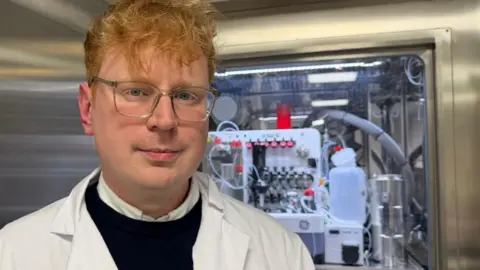
Dr Louis Allott, director of radiochemistry at the Daisy Appeal, said scans would be offered to a "select group" of people on a clinical trial later this year. He added: "Hopefully we can improve the quality of patients' lives."
Because Gallium-68 is only radioactive for a few hours, it has to be made on the day of the scan.
This is now possible at the facility at Castle Hill because it is one of only a handful of hospitals in the country to contain a cyclotron – a particle accelerator that makes radioactive drugs or tracers.
According to the charity, patients currently have to travel to hospitals in London for a similar scan.
Allott said the scan would allow doctors to gain a "greater detailed understanding" of a patient's disease.
An existing scan, known as FDG, allowed them to "see some of the lesions, but potentially not all".
Using Gallium 68 would mean "we can see a greater extent of the lesion and understand how that disease is progressing for that patient".
Allott said he hoped the trial would lead to the scans being offered "more routinely" to local patients, once approval has been given by the NHS.
The Daisy Appeal funds research and equipment to detect cancer, heart disease and dementia on behalf of the NHS.
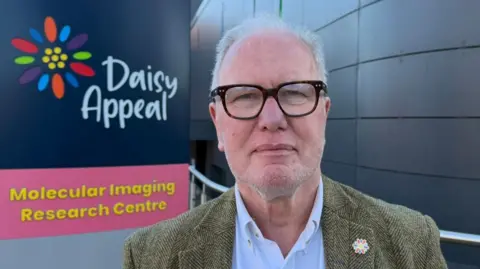
Prof Nick Stafford, chairman of charity's committee of trustees, said he thought the new technologies would "improve patient outcomes".
"I think it will bring prestige to the charity, it will bring income to the charity which will be fed back directly into the project, into the development of new radio tracers and new equipment," he added.
Listen to highlights fromHull and East Yorkshire on BBC Sounds, watch the latest episode of Look North.
Download the BBC News app from the App Storefor iPhone and iPad orGoogle Play for Android devices
