Teaching union announces details of new strike ballot

 PA Media
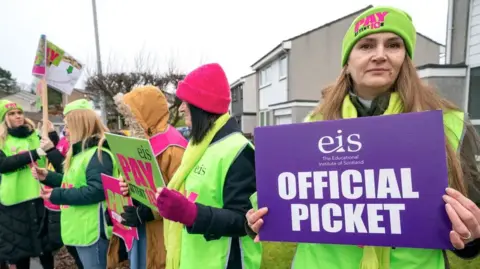
Scotland's largest teaching union has given details of its new strike ballot over workload.
The EIS union is asking its members to vote for a second time as too few took part in a previous ballot which closed last week. Those who did vote, overwhelmingly backed action.
Current laws require a turnout of at least 50%, although this is due to change soon.
Education Secretary Jenny Gilruth said discussion rather than strike action was needed to reach an agreement on class contact time.
The new vote will run from 2 February to 4 March.
The union's general secretary, Andrea Bradley, said the Scottish government had "failed to meet commitments" to reduce the maximum class contact time from 22.5 to 21 hours per week.
They also alleged promises to recruit 3,500 new teachers had not been delivered.
Bradley said reopening the ballot sent a "signal" teachers would not back down in the dispute.
She said: "Promises were made five years ago to tackle teacher workload, to recruit 3,500 additional teachers in schools, and to reduce teachers' maximum class contact time to 21 hours per week.
"None of these commitments have been met, despite pledges by the Scottish government and local authorities to work to deliver them 'at pace'.
"This failure to deliver has let down pupils and teachers the length and breadth of Scotland."
Almost 86% of those who voted in the original ballot, which closed last Wednesday, backed industrial action.
But, under current laws, the 46.57% turnout was too low for the decision to be ratified.
The NASUWT union also failed to secure a mandate for a strike last week as the turnout was too low. Members of the other main teachers' union, the SSTA, are still voting.
The education secretary Jenny Gilruth recently outlined ways class contact time might be reduced.
She suggested that teachers might be in the class for four days a week, freeing up the fifth for other professional activities.
This could potentially lead to changes in the structure of school days and weeks.
The UK government is set to abandon higher thresholds for strike ballots after legislation introduced by the previous Conservative government raised the bar to 50%.
The requirement in key public services for at least 40% of those entitled to vote to back strike action will also go.
Education Secretary Jenny Gilruth said: "Regardless of the outcome of these ballots, we hope these discussions will continue to reach an agreed position on how to free up teacher time so we can focus on reducing workload and improving educational outcomes for children.
"People getting round the table is the way to resolve matters and reach a common agreement."