Largest octopus bloom in 75 years inspires film

 Keith Hiscock
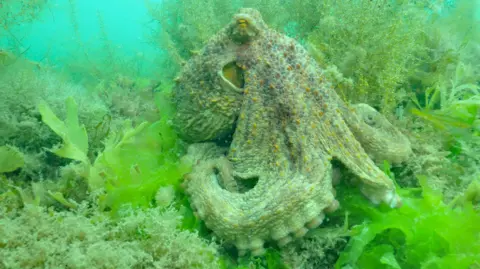
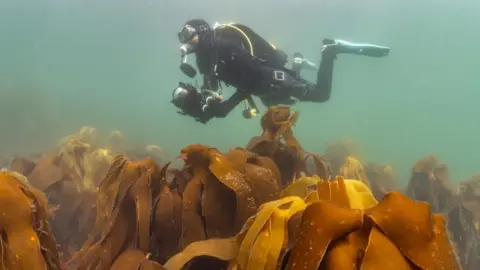
When filmmaker David Palfrey visited Cornwall, he was expecting a week of leisurely diving but instead he found himself face-to-face with octopus after octopus in the open water.
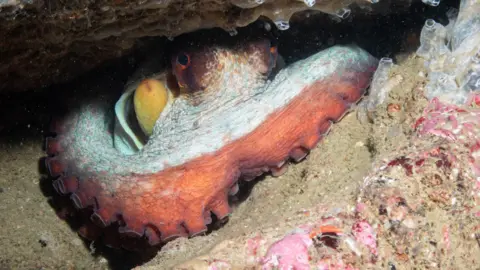
A report led by the Marine Biological Association (MBA) in Plymouth said more octopus had been seen off the south-west coast of the UK in 2025 than for at least 75 years.
The MBA said the population spike, known as a bloom, had coincided with unusually warm conditions, which it said were becoming more frequent due to climate change.
Palfrey said his experiences while diving "exceeded anything we imagined" and inspired him to make a short film which launched on 12 May, Bloomin' Octopus! A Tentacular Spectacular.
 Lewis Jeffries
The Bristol-based filmmaker said: "I couldn't stop thinking 'there's a story here'.
"Dive after dive there were octopus out and about and what struck me was how curious they can be.
"They're often shy, but sometimes they'll interact, investigate and seem to watch you as much as you watch them."
The MBA said only four major octopus blooms have been recorded in the past 125 years: in 1899 to1900, 1932 to 1933, 1950 to 1951 and the one which began in 2025 and is ongoing.
Palfrey contacted the MBA report's lead author, University of Plymouth associate professor Dr Bryce Stewart to contribute to the film.
In the film Stewart connected what was being observed in the water to what data showed about oceans warming and wider ecosystem change.
He said: "The octopus bloom is an extraordinary event that tells us a lot about how marine life is responding to a warming ocean."
 Olivia Langmead
Some in the fishing industry have warned they are being negatively impacted by the octopus preying heavily on crabs, lobsters and scallops.
Palfrey filmed fishermen and restaurateurs to illustrate the differing consequences of the blooms and invite viewers "to consider the uncertainty of ecological change, happening in real time".
The MBA said scientists would continue to investigate what was driving the bloom and what it meant for shellfish stocks, marine life and coastal livelihoods.
