Cornwall joins Surfers Against Sewage protest

 BBC
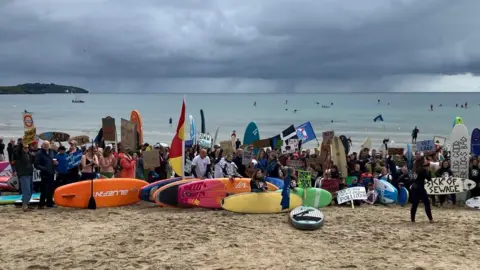
BBCDozens of protesters have taken part in a paddle out protest against water pollution to demand reform of the water industry.
The protest at Gyllingvase Beach in Falmouth, Cornwall, was arranged by Surfers Against Sewage as part of nationwide campaign involving more than 50 beaches, rivers and lakes.
Among those speaking was the mother of Heather Preen, who died after contracting E Coli during a family holiday in Devon in 1999.
Her story featured in the C4 docu-drama Dirty Business.
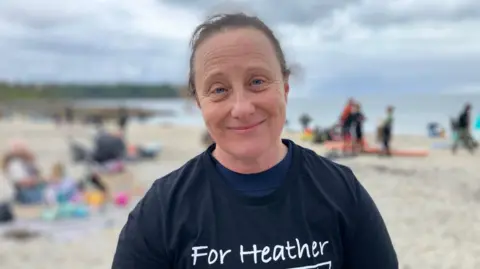
Heather's mother Julie Maughan said attending the event was important for her on many levels.
"After Heather died I wouldn't go near a beach and I didn't want anything to do with the sea," she said.
Heather, aged eight and from Rednal in Birmingham, died 12 days into a family holiday to Dawlish Warren after a beach walk in the south Devon town.
"After a little bit of time I realised that these would have been Heather's last memories ... so it's become more like a church to me now," her mother added.
She said the Surfers Against Sewage event was a "great opportunity" to raise awareness and to "let people know what's going on and to kind of say this needs to stop".
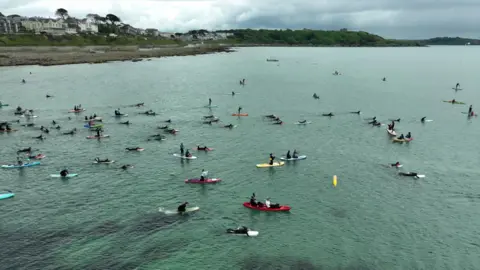
Giles Bristow, Chief Executive Officer of Surfers Against Sewage, said "We expect today about 10,000 people around the country to come outm but they are literally the tip of the iceberg."
He said recent polls carried out by Surfers Against Sewage showed only 7% of the British public believed the current privatised system would "sort this mess out".
He added: "We've got to change the system otherwise this sewage crisis is not ending.
"Change happens slowly and then it happens quickly, so if this government listens to this tidal wave of protest then change will happen."
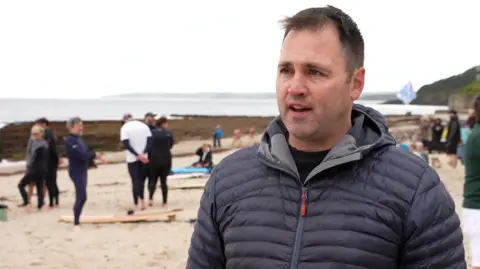
Rob Forrester, a former Environment Agency employee who was the whistleblower featured in Dirty Business, said he worked there for 21 years.
Forrester, who was also at the Falmouth protest, said he first blew the whistle seven or eight years ago.
He said: "It was kind of a steady build up, and there was probably two or three triggers back in 2017, 2018 that led me to believe that water was being deprioritised.
"I'm confident that with events like this the public outrage can't be ignored now.
"So whether that changes within this government, or a potential new leadership coming in or the next government, I think there will be change in the future," he added.
'More to do'
South West Water said it recognised and respected the views of all customers, and the right to engage in peaceful protest.
It said the South West saw 62% more rain than the rest of England in 2025 and despite this, it still cut storm overflow spills by 17% and spill duration by 25%.
It said it also prevented more than 8,300 spills due to operational improvement with a focus on bathing season - claiming this was a sign its £760m investment plan was producing strong results.
"There's more to do, but the direction is clear: fewer spills, shorter durations, and investment where it matters most," South West Water added.
In January the government announced a plan to overhaul the water industry including inspections without notice and regular MOT-style checks of water companies.
In the King's Speech on 13 May, King Charles outlined The Clean Water Bill which will merge the functions of several existing regulators, including Ofwat, in a bid to end the "fragmented oversight" over the sector.
