Second bird flu outbreak hits major egg producer

 Getty Images
A second outbreak of bird flu has been confirmed on a farm owned by Scotland's largest egg supplier, Glenrath Farms, near West Linton in the Borders.
It is the fourth such incident in the area since 18 December and tens of thousands of birds have already been destroyed.
The spate of outbreaks has led to strict biosecurity measures and movement restrictions being put in place across much of the area between Peebles and Penicuik.
Despite that action, Scotland's chief veterinary officer has confirmed that birds at Glenrath's main egg factory - Millennium Farm - tested positive on Sunday for the H5N1 subtype of avian influenza.
A 1.8 mile (3km) protection zone has been put in place and a 6.6 mile (10km) surveillance zone.
Anyone with birds in one of the zones must inspect them for signs of infection and immediately report any signs of the disease.
They are also asked to keep records of their flock and anyone visiting the premises.
A first outbreak in the area - across the boundary between the Borders and Midlothian - was reported a week before Christmas.
Since then there have been three more, as well as one near Blairgowrie in Perth and Kinross.
Impact on egg supplies in the UK
Scotland's deputy chief veterinary officer Jesus Gallego Garnica told BBC Radio Scotland's Lunchtime Live the situation was concerning but not unexpected.
"Bird flu is seasonal, it is a winter disease, it follows the pattern we have seen for the last few years where around December and January we expect to see an increase in cases," he said.
Garnica said keepers could reduce risks by increasing biosecurity but there was only so much could be done to prevent the infection spreading from wild birds.
He added that the effect on egg supplies to the public was limited.
"It does have an impact on egg production although we have to remember that the farms that have been affected in Scotland and the UK at any time only represent a small fraction of the total volume of eggs that are sold," he said.
"So it does have an impact - particularly on those producers that are affected - but not so much on the overall market."
Glenrath Farms is a family-owned business and was established in the Borders in 1959.
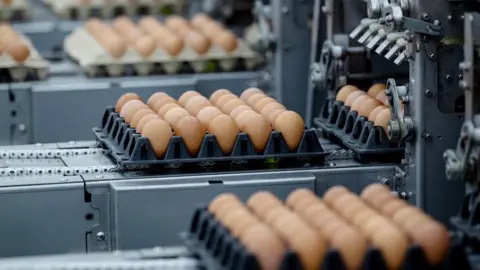
Its operations have grown over the years and it is now one of the UK's leading egg production and marketing companies, producing more than a million eggs a day.
However, that remains a relatively small slice of the UK's overall egg production which has been estimated at nearly 12bn eggs per year with a further 2bn imported eggs.
The company has been approached for comment on the impact of the outbreak.
Bird flu is caused by a virus which infects birds and sometimes other animals, including mammals.
The H5N1 strain, the dominant version of the disease, emerged in China in the 1990s.
Transmission between birds and humans is rare and no human-to-human transmission has ever been sustained.
Egg availability to 'remain as normal'
Nick Allen, British Egg Industry Council chief executive, said: "Any outbreak is deeply disappointing, and our sympathies lie with the producer at what is a very challenging time.
"Protecting animal health and welfare remains our highest priority, and the situation is being managed in line with established biosecurity and disease-control procedures.
"From a supply perspective, the national laying flock is larger and more stable than it has been for several years.
"As a result, we expect availability to remain as normal for consumers."
