'Christmas with sister who saved my life - twice'

 Sharuna Sagar/BBC
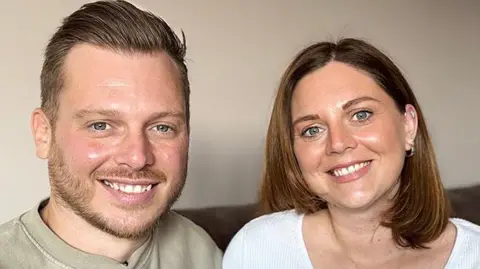
Siblings only have a 25% chance of being a bone marrow match with each other, but a brother and sister are heading towards their first Christmas after not one, but two, transplants.
Ben Uttley remembers feeling slightly unwell.
"I just had a strange feeling, a little bit like a hangover," he says.
At first, the then 34-year-old from High Shincliffe in County Durham found it easy to dismiss.
But then complete strangers began stopping him in the street, worried that his face had taken on a "strange colour".
In 2018, Mr Uttley finally sought help and was given an appointment at the Freeman Hospital in Newcastle.
After a series of tests to rule out blood cancers, doctors diagnosed him with aplastic anaemia, a rare condition where the body stops producing white blood cells.
He had no immune system and no defence against infection.
The only hope was a bone marrow transplant.
His younger sister, Holly Murdy, came forward immediately.
 Supplied
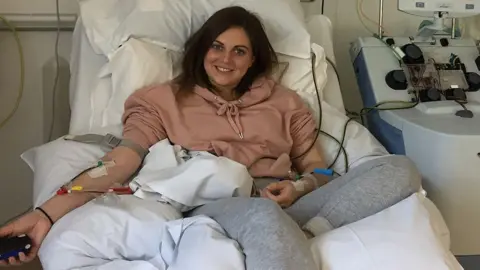
"There was never any doubt in my mind that I would do it," she says. "They said it was quite remarkable how close a match we were."
Siblings have only a one in four chance of matching and most patients rely on strangers from the Anthony Nolan register.
The procedure took place at the Freeman, one of the UK's leading transplant centres.
Ms Murdy remembers the process as being simple and non-invasive. Doctors took stem cells from a vein in the same way they would collect blood from a donor.
Consultant haematologist Dr Erin Hurst wants more people to understand how easy donation can be.
"It's quite straightforward," she says. "A blood test to begin with, a medical to check that you're fit enough to donate, and then a process of having your blood taken on a machine for a couple of hours to get the stem cells that we need.
"Potentially a day or two off work in total, and then people return to their normal life having known they have helped us provide life-saving treatment."
 Supplied
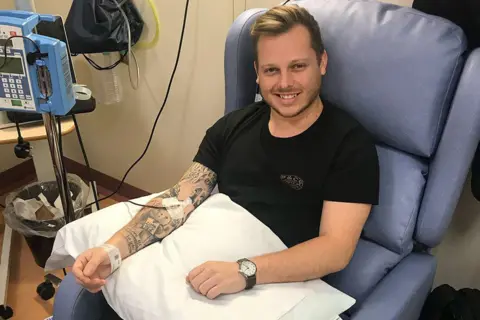
After the first transplant, Mr Uttley, now 41, returned to his job as a bank manager and felt well for a long time.
Then, last year, the transplant began to fail. He developed sepsis and ended up in intensive care, in urgent need of another transplant and at risk of dying.
Once again, his sister was his donor, giving what she describes as "that bag of magic that goes into his blood and makes him better".
"Without that transplant, especially the second time, I just simply would not be sat here," Mr Uttley says.
This Christmas will be his first healthy one since the transplants.
After years of fear and uncertainty, the prospect of normality feels extraordinary, he says.
"I cannot wait for it," he says. "I cannot tell you how much it means to have normality back and to really enjoy myself, and have everybody around me not worried or on edge about how I am."
Ms Murdy says the experience has changed her view of life.
"It teaches you that life is for living," she says. "Grab everybody around you, have fun, and live it.
"There was a point last year where you did not know if there was going to be a future - and now we have got one."
