Remains of lost medieval bridge found in river

 Supplied
The remains of a lost medieval bridge have been found in a river.
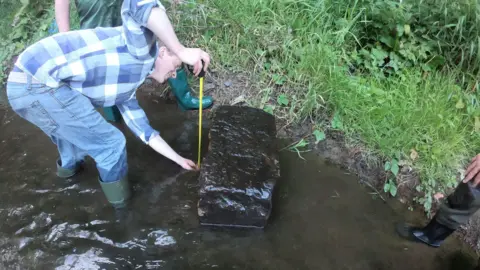
More than seven stone blocks, believed to be from the Bishop Skirlaw bridge at Shincliffe, County Durham, were discovered in the River Wear between 2024 and 2025.
The bridge was built around 1400 and was damaged several times before it was demolished in the 1800s. It is thought the bridge would have been part of a major route to Durham Cathedral.
Gary Bankhead, the underwater archaeologist who found the blocks, said he initially thought they were gravestones and the discovery was "completely unexpected".
He said he had been approached by Shincliffe Local History Society to look into a timber structure under the water.
It ended up being part of a different 18th Century bridge - but Bankhead said that while looking, he noticed "out of the blue" large work stone blocks on the riverbed.
"Totally unexpectedly, at the deepest, darkest part of the river, I saw these dark blocks looming out and it was almost scary at first, and it dawned on me that these were something really significant," he said.
 Supplied
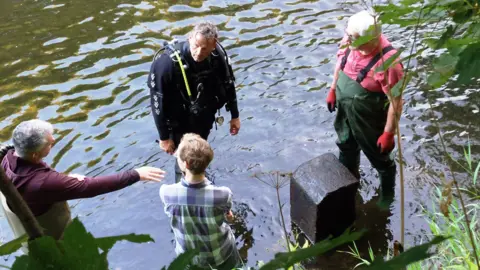
About seven of the blocks were lifted from the water and Bankhead said analysis of the mason marks showed they were made by the same stone masons who worked at Durham Cathedral.
"That was a really exciting breakthrough," he said.
"It narrowed down the age range in which the stones were actually first manufactured and it was a consensus of opinion that the stone blocks I found in the river were part of the original Bishop Skirlaw's Bridge."
The stones have since been returned to the river.
Bankhead said they were "pieces of a jigsaw puzzle" and the bridge would have been part of a major route to Durham Cathedral.
"If you just think about pilgrims who would have been approaching the cathedral, it would have just been a really special place," he said.
"It unravels into this incredible story that's now lost. It's been lost to history and we've only gone along and rediscovered it."
