The Medieval version of 'Yes Day' where kids ruled

 Getty
GettyFor many people today, the main Christmas tradition is all about getting together with family, exchanging presents, sharing a huge feast - and slumping in front of the TV.
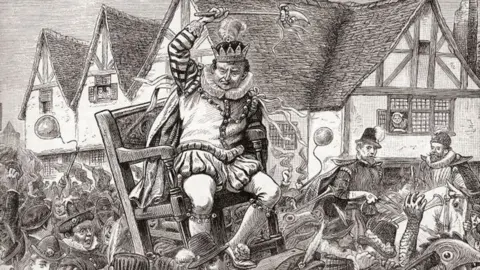
But in the medieval period, the festival included larking about and turning the world upside in a practice known as "misrule".
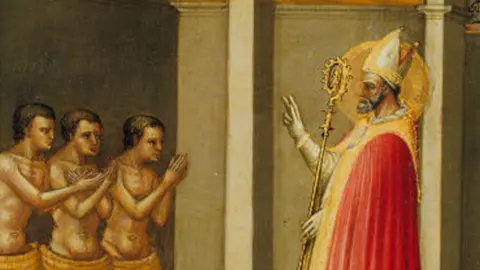
This included the election of a boy bishop who could make laws, dress up in vestments and even declare holidays - like an early version of the modern phenomenon called "yes day", where children get to call the shots for 24 hours.
At King's College, Cambridge, he led services, while York Minster's boy bishop travelled the region, delivering his sermon at other churches.
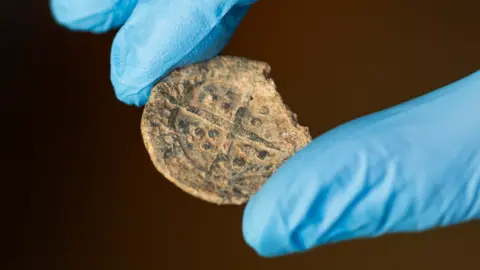
In Bury St Edmunds, Suffolk, he gave out lead tokens - hundreds of which have been found in recent years by metal detectorists.
The BBC has been finding out more.
Lord of Misrule
 Cassell's History Of England
"The medieval world was ordered and conventional, so at moments of the year, you were encouraged to let off a bit of steam, turn the world upside down - to go from rule to misrule," said Norfolk finds liaison officer Helen Geake.
This initially led to the creation of a rule-breaking role known as the Lord of Misrule, but by the early 15th Century, boy bishops were the main focus of this status inversion.
Dr Geake said: "Having a boy bishop is so transgressive, there's a very strong norm of the grown-ups being in charge and children being ignored."
In most cases, the chosen youngster seems to have been elected from a church or abbey's choir boys.
The idea that a child told everyone what to do was the ultimate transgression.
The role of St Nicholas
 Getty
GettyThe office was assumed from St Nicholas' Day on 6 December until Holy Innocents' Day on 28 December.
"Boy bishops are tied up with St Nicholas, the patron saint of children, who in later centuries was popularised as Santa Claus," said Dr Geake.
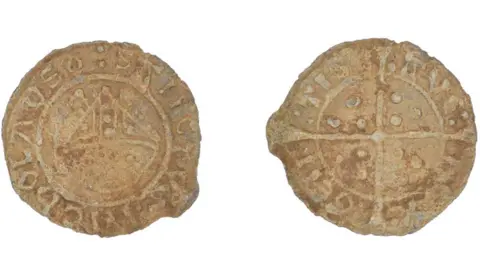
Bury St Edmunds' tiny tokens showed a bishop's head on one side and a long cross on the reverse and were made between about 1470 to about 1560.
Many were engraved in Latin "St Nicholas pray for us".
About 200 were known prior to the creation of the Portable Antiquities Site (PAS) in 1997, and nearly all were found in the town.
It was long-assumed they were like trading tokens, designed to be exchanged for goods, sweets or essentials at the city's shops, explained Dr Geake.
Bishop on tour?
 National Trust
Metal detectorist have since discovered more than 700 bishop boy tokens and about 600 of them are from Suffolk, according to the PAS database.
Dr Geake said: "They tend to turn up in groups close to rural churches, so 21 came from a field in Brockley, right next to St Andrew's Church, 32 from a single field in Hessett, again near the church, and 36 from two fields opposite the church in Wordwell."
Other clusters have turned up nowhere near a church, but near or in villages, including West Stow, Beyton and Lavenham.
As a result, she wonders if they were distributed to rural areas by the abbey, or if - like York Minster's boy bishop - the abbot was sending his boy on a tour of outlying parishes.
 Suffolk County Council
It also raises questions about whether the tokens were actually designed for trade - or were seen as offering protection.
"Childhood is a risky thing at this time, there were no vaccinations and new diseases were on the scene, like the sweating sickness which killed Thomas Cromwell's wife and two daughters within a year," the archaeologist said.
"St Nicholas was the patron saint of children and perhaps parents hoped the tokens might protect their child."
'Unfitting and inconvenient'
This Christmas tradition proved popular across England.
"In the 1530s, Lincoln Cathedral's boy bishop celebrated vespers on the vigil of Holy Innocents, Exeter Cathedral's chapter lent him garments and a mitre, and the boy at Westminster Abbey had his own special mitre, made of white silk," added Dr Geake.
More than 20 tokens appear to have been made in Ely, Cambridgeshire, while one or two have been found that name Ipswich, and there is a single one that was made and found in Blaxhall.
Henry VIII appears to have thought boy bishops were "unfitting and inconvenient", but it was not until the reign of Elizabeth I that the tradition was finally stamped out - until Salisbury Cathedral revived a version of it in the 1980s.
Despite the apparent popularity of Bury St Edmunds' tokens - and one was found 30 miles (48km) away on the Oxburgh Estate in Norfolk in 2023 - nothing was written in medieval records about their purpose or why they were issued.
"There's so much to find out about them," said Dr Geake.
"It's a really good example of if you do something about prestigious rich people, it gets into the history books - but if you do something mainly centred on ordinary people, it might not get into history books and archaeology is the only way of seeing what ordinary people get up to."
Follow Suffolk news on BBC Sounds, Facebook, Instagram and X.
