Lost home linked to American War of Independence

 Historical Research Group of Sittingbourne
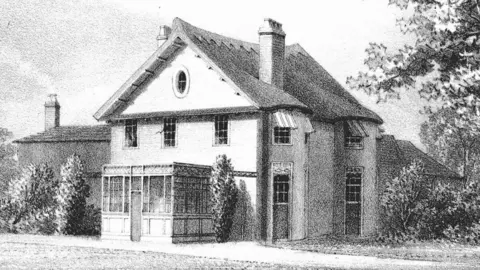
Woods off the A249 hide the remains of a long‑demolished Kent house once linked to the American War of Independence.
The Rose Hill estate, later renamed the Grove, drew the attention of local historians decades after its demolition in the 1970s.
With the help of 360 pupils from Grove Park School, the Historical Research Group of Sittingbourne (HRGS) uncovered the estate's remains in in 2015.
Richard Emmett, chair of the HRGS, said: "The ground is now owned by Swale Borough Council, but as you walk round you will still see traces of the building above ground. The house is gone, but the footprint is still there."
The house was the home of Frances Montresor, whose portrait still hangs in the diplomatic reception rooms in the US Department of State, in Washington DC.
Her husband John Montresor had been a military engineer for the British Army in America during the War of Independence.
He died in 1799 of jail fever at Maidstone Prison,
"He's extremely well though of in America, because of his connection to the American spy Nathan Hale", Emmett said.
Nathan Hale was caught by the British for spying on behalf of the Continental Army, which led to him being tried and executed.
On the morning of his execution, John Montresor invited him into his tent and allowed him to write his last letters home, later taking them back to George Washington's camp.
"Nathan Hale said, 'My one regret is I've only one life to give for my country.' So he became a national hero," Emmett said.
Because of their connection to Hale, the Montresors had their portraits painted by a Copely, a man considered one of the foremost Anglo-American artists.
Following the end of the War of Independence, Montresor and his family, moved back to England and settled down at Belmont House.
However, when the government audited his journals and receipts for his time in America, they found that he was deficient of receipts and said that he owed them £40K.
He challenged it for several years until they finally seized Belmont House and put him in jail, causing Francis and the family to move to Rose Hill.
"It is very likely she had the house clad in yellow mathematical tiles, as had been done at her former home, Belmont House," Emmett said.
Mathematical tiles, the connection between the two estates, are ceramics which people would add to wooden buildings to give them the appearance of brickwork.
Upon Francis' death in 1826, the houses passed down through many notable people, including a rear admiral immediately after the First World War.
Follow BBC Kent on Facebook, on X, and on Instagram. Send your story ideas to southeasttoday@bbc.co.uk or WhatsApp us on 08081 002250.
