Granddaughter's mission prompted by Olympian's suicide

 Jim Pennington
A woman said the impact of her grandfather's suicide has had lasting impact on her life and she is now working to break down stigma.
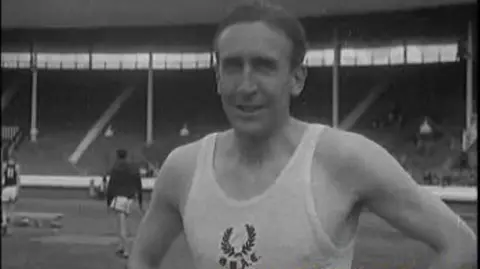
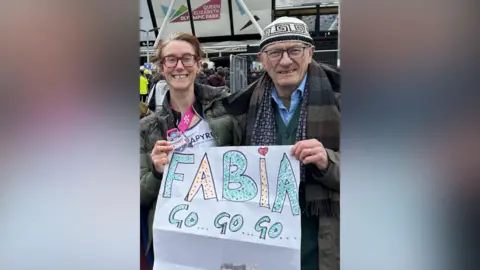
Fabia Jeddere-Fisher, whose grandfather was an Olympic sprinter in the 1930s and took his own life aged 45, now works at the University of West of England with students on suicide prevention.
Jeddere-Fisher, from Henbury, has also taken up running herself and recently ran 10k ( six miles) to fundraise for the charity Papyrus Prevention of Young Suicide.
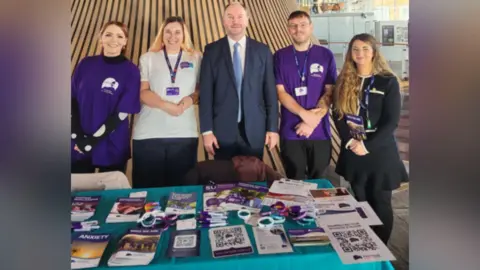
Emma Lacey, Papyrus area manager for Wales and the West of England, said sponsors like Jeddere-Fisher helped increase the profile of the charity and its work to "reduce the stigma" of suicide.
 Jim Pennington
- If you have been affected by any of the issues raised in this story, information and support can be found at the BBC's Action Line
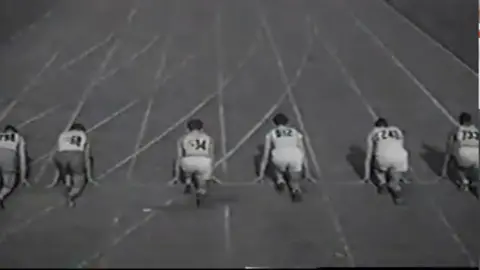
Alan Pennington competed in the 100m in the 1936 Olympic Games when Jesse Owens, an African American athlete, made history by winning four golds.
Jeddere-Fisher said her family had a treasured photograph of her grandfather lined up in a 100m semi-final heat alongside the famous American sprinter.
"He was running about 10.6 seconds, which was a really competitive time," she told BBC Somerset.
"It's a proud part of our family history."
Aside from Pennington's sprinting prowess, he served as a captain in the Border Regiment during the World War Two and then became an insurance broker.
However, his considerable accomplishments were not enough to save him from taking his life in 1961, aged 45, leaving behind his wife and four children.
His son, Jim Pennington, who was 11 years old at the time, said not many further details were known.
"The family was so ashamed they didn't talk about it," he said.
 Jim Pennington
Jeddere-Fisher, academic school director at the University of the West of England, said her grandfather's suicide indirectly guided her own work with students.
She said she often dealt with "complex cases" of mental health.
"I am sometimes quite front-facing in some of these tricky cases where someone might be, for the first time, talking about their suicidal thoughts.
"It's personal to me and I've had to start to address it really, really intentionally in my work life," she said.
According to Papyrus, suicide is the main cause of death in young people under the age of 35 in the UK with 1,796 such suicides registered in 2022, including around 200 teenagers.
Lacey said the charity works to raise awareness around suicide prevention and provides training and a 24-hour helpline.
"The lack of education around suicide and being able to talk openly about it is a contributing factor," she said.
"There's a lot of stigma and we're working to reduce that because we know it can be very difficult."
Sonya Trivedy, executive director of external engagement at Samaritans, said that encouraging open conversations about suicidal feelings is "at the core of what we do".
"Our volunteers answer a call for help every 10 seconds from people in crisis, so we know first hand the power human connection can have to save lives," she said.
 Papyrus
Papyrus continues to press the government for changes to current legislation around suicide prevention.
Lacey said that following a recent campaign, schools in England have introduced the subject as part of the curriculum.
"Talking more about suicide will ultimately reduce the stigma," she said.
A spokesperson for the Department of Health and Social Care said a five-year suicide prevention strategy was identifying "priority" areas for reducing suicides and "expanding mental health support teams in schools and colleges to cover all pupils by 2029".
Follow BBC Bristol on Facebook, X and Instagram. Send your story ideas to us on email or via WhatsApp on 0800 313 4630.
