Boy, 8, in race against time to find kidney donor

 Supplied
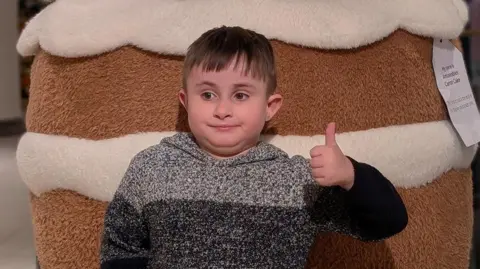
An eight-year-old boy is in a race against time to find a kidney donor, according to his grandad.
Issac Bruce-Whitely, from Debenham, Suffolk, was diagnosed with stage three chronic kidney disease (CKD) when he was two years old.
His condition has progressed to stage five and his kidneys are functioning at 9-12% capacity.
In a desperate appeal, his grandad, Hughie Bruce, 60, told BBC Suffolk his grandson needed a transplant to help save his life.
"There's certainly a time element to it, because Issac may survive to leave primary school, but he will not leave high school without a healthy kidney," he said.
"He vomits and becomes increasingly fatigued and there are times when we have to carry him to the car or get him from school as he is too fatigued to carry on.
"So, we are hoping we can encourage someone to consider becoming a living donor, because familial donors are not available."
 Supplied
According to Kidney Care UK, patients are deemed to have stage five CKD when their kidneys have stopped working or are close to stopping, resulting in a "a significant reduction in life expectancy".
At this point, the kidneys would have stopped filtering waste and fluid from the blood, resulting in serious health issues such as anaemia, high blood pressure and a build-up of substances including acid.
Issac, who lives with his grandad and grandmother Emma Bruce, has been on the waiting list for a kidney transplant for more than two years.
Someone is considered a suitable donor if their blood type is compatible with the recipient's, they are physically and psychologically healthy, and they have not been pressured into being a donor or offered money.
 Supplied
Neither of Issac's grandparents can be donors due to having various health problems. His mum and dad are a match, but they also have their own health issues, the family said.
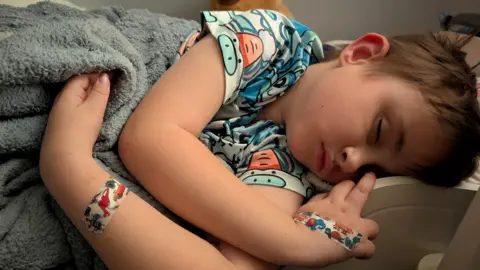
To keep him alive until a donor can be found, for the last three years his grandparents have been giving him peritoneal dialysis - a method of cleaning the blood - six times a week at home.
"We are trained and supported by Great Ormond Street Hospital [Gosh] and that takes place pretty much whilst he's asleep, thankfully," added Hughie.
"The dialysis is absolutely keeping him alive, but it only lasts for so long."
 Supplied
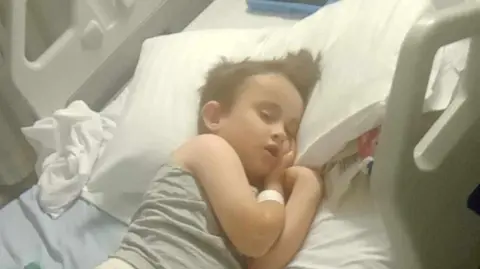
Since being diagnosed, Issac, who is blood group O, has endured countless operations and emergency, close-call trips to hospital.
In October and November, he was admitted to Ipswich Hospital for enhanced dialysis and further treatments, spending about four weeks on a ward.
In December, having had little luck finding a suitable deceased kidney donor, Issac's family was told it might be time to start looking for a living one.
His grandad said he had since been identified as the child most in need of a campaign for donorship by Gosh and Guy's & St Thomas' Hospital NHS Foundation Trust, in London.
Anita Copley, clinical nurse specialist in living kidney donations at Guy's Hospital, helped them curate the appeal.
"It's incredibly tough for these families, but the rewards are there when we do find a kidney donor for children," she said.
"These lovely grandparents have learned how to perform dialysis, and they're doing their very best, but it certainly is burdensome and taxing."
 Supplied
According to Kidney Care UK, CKD causes about 40,000-45,000 premature deaths in the UK every year, but 90% of patients who receive a living donor transplant are alive after 10 years.
Kidney Research UK says there are nearly 7,000 people in the UK who are waiting for a kidney transplant, and the numbers have been steadily increasing.
Copley holds out hope it will happen, emphasising that a donor can come from anywhere.
"We've had neighbours, school teachers, work colleagues, friends all donate kidneys," she said.
"So, more and more people are realising that, if you are suitable, you will be able to live the rest of your life safely with a single kidney."
 Supplied
Donors must be "fit and healthy people" over the age of 18 who do not have any serious chronic illnesses or diseases.
Those who are deemed to be suitable undergo a keyhole operation under general anaesthetic before spending a few days recovering in hospital.
According to the NHS, recovery time can vary, but donors should be able to return to normal activities within about six weeks.
"Living kidney donation is a precious gift, which can give recipients freedom and a far better quality of life," said Lucy Sreeves, chief engagement officer for Kidney Research UK.
"Many people don't realise it's possible to donate a kidney and still live a healthy, normal life, while giving someone else the chance to thrive."
Follow Suffolk news on BBC Sounds, Facebook, Instagram and X.
