Can solar panels turn around one of Scotland's most deprived communities?

 BBC
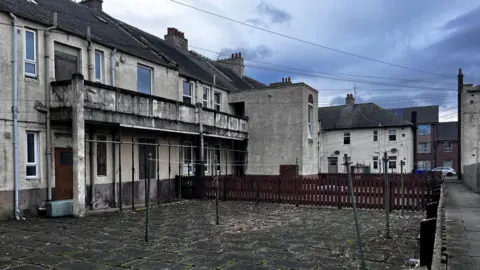
BBCWallacetown in Ayr is one of the most socially and economically deprived communities in Scotland.
But some people in the area are doing everything in their power to make it a more attractive place to call home.
They include Denise Sommerville, who says she wants to create a place where "people want to live, not leave".
She is one of the local residents spearheading a project which has installed solar panels on three schools.
The scheme is expected to raise about £1m over the next 25 years – money which will be spent in the local community.
"It brings people together and gives them purpose, and something to hope for in the future," says Denise.
"It also gives them their own bank account which can be used for what Wallacetown people need."
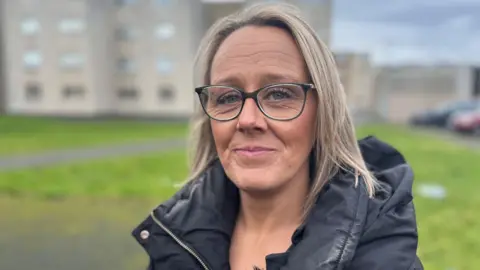
Denise raised the area's problems with deprivation, drug use and anti-social behaviour at a community council meeting five years ago.
The community energy project was suggested by local engineering lecturer Alan Roseweir as a way to generate income that could be spent enhancing the lives of local people.
The UK government wants to encourage more schemes of this kind and has announced a £1bn fund focusing on community buildings like libraries, leisure centres and miners' welfare clubs.
After lots of hard work, the solar panels were fitted over the summer holidays on the roofs of Wallacetown Early Years Centre, St John's Primary and Newton Primary in Ayr.
The £320,000 cost of buying and installing the panels was funded jointly by the Scottish government and Scottish Power Energy Networks, but the devices themselves are owned by the community.
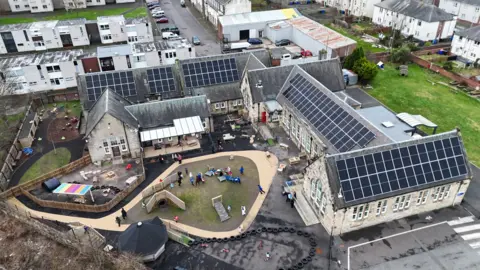
The scheme then sells electricity to the schools at a discounted rate, with the excess being exported to the national grid.
It began generating electricity in August and profits are already flowing into the fund which is controlled by representatives from the community.
Cash will start to be allocated to individual projects once the panels have been generating electricity for a full year.
Local people are being asked for their ideas about how the funds should be spent.
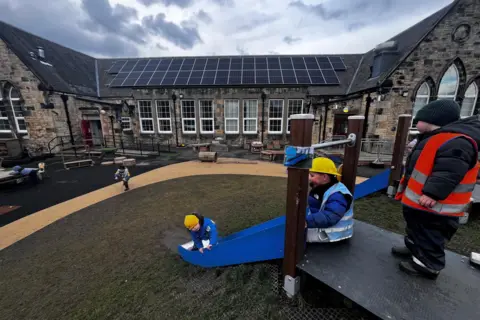
Pupils at St Johns Primary have already been considering the ways they would like to see the money used.
Six-year-old Liam says he would like more laptops and iPads for the schools, while 11-year-old Chaviva wants to see it going on toys, clothes and food for families who are struggling.
Denise Sommerville has a vision for creating community allotments to help children learn about sustainability and where their food comes from.
The vision for a community energy project came from an engineering lecturer at the University of Strathclyde, who lives in Ayr.
Alan Roseweir, who has now retired as associate director of the Engineering Academy, felt previous "top down" attempts at regeneration had created a community that was cynical about promises of change.
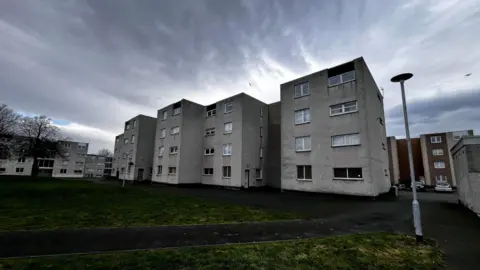
He believes that using the schools, which were already a focal point, was an effective way to bring the area together.
He said: "I think it's built a belief in the community. I certainly saw that with the three head teachers.
"There was an excitement when we started, to see that this could really engage the kids."
The vision is to create a 'net-zero village' in Wallacetown.
The projects allocated for community funding will be required to demonstrate carbon reduction, tackling fuel poverty or environmental improvements.
Projects which support learning and educational developments, particularly around science, technology, engineering and maths, will also qualify.
