Trump's tariffs lead to production increase at Lochaber smelter

 Alvance British Aluminium
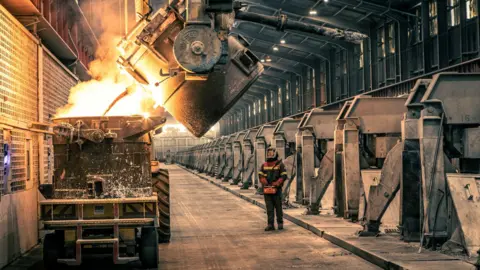
The owners of the UK's only aluminium smelter have increased production by about 10% after exporting to the US for the first time.
Alvance British Aluminium said US tariff changes had opened up new opportunities for its plant in Fort William.
Last year, President Donald Trump imposed a 50% global tariff on imports of steel and aluminium with the UK being the only country to get a preferential lower rate of 25%.
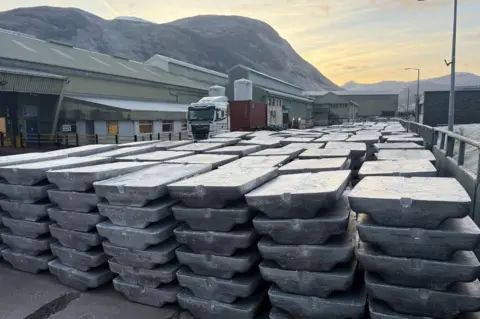
About half of the aluminium produced at the smelter is now being exported to the US.
Trump increased tariffs on steel and aluminium imports to encourage domestic production, but the US is still dependent on foreign metals for various industries including its automotive and aerospace sectors.
Making aluminium is energy intensive and a significant number of smelters have closed over the last 50 years in both the US and the UK, often due to high electricity costs.
The Fort William plant, which has been owned since 2016 by the GFG Alliance, stayed open because it has a major advantage - its own supply of cheap electricity from a major hydro scheme.
It also supplies power from the scheme to the national grid.
Wheels factory
The site has a smelting capacity of 48,000 tonnes per annum - which is equivalent to producing about three billion soft drinks cans a year.
It employs just over 200 workers.
The recent breakthrough into the US market and 10% rise in production has been seen as welcome news for the site following earlier disappointment about expansion plans falling through.
The GFG Alliance scrapped its proposals for an alloy car wheels factory in 2020 due to a "significant decline" in car manufacturing.
Smaller scale plans for an aluminium recycling plant have also been delayed.
 Alvance British Aluminium
US tariffs are not the only thing altering the global trade in aluminium.
Over six million tonnes of aluminium is produced annually by members of the Gulf Cooperation Council - Bahrain, Kuwait, Oman, Qatar, Saudi Arabia, and UAE.
Their ready access to low cost energy from oil and gas has allowed them to capture about 8% of the global market, according to the International Aluminium Institute.
However, the US-Israel war with Iran and attacks on shipping in the Strait of Hormuz has severely disrupted supply chains and affected prices.
'Stronger prices'
Tom Uppington, managing director of Alvance British Aluminium, said: "We've increased production by around 10% in recent months in response to changing global trade flows following US tariffs, allowing us to enter the US markets for the first time as well as supplying existing and new customers in the UK and Europe."
He added: "While the conflict in the Middle East has pushed aluminium prices higher, it has also contributed to rising energy costs.
"Because aluminium production is very energy intensive, higher UK electricity prices currently offset the benefit of stronger metal prices, meaning we continue to cap production broadly in line with our self-generated power."
UK Minister for Trade Chris Bryant said it was "fantastic" Alvance British Aluminium had taken full advantage of "trade wins" secured by the UK government.
He said the UK was the only country in the world to secure a 25% tariff on steel and aluminium tariffs.
