The Yorkshire recyclers who 'throw nothing away'

 Yorkshire Blankets
Yorkshire's textile mills, once key to the region's industry, are now playing their part in saving surplus material from landfill.
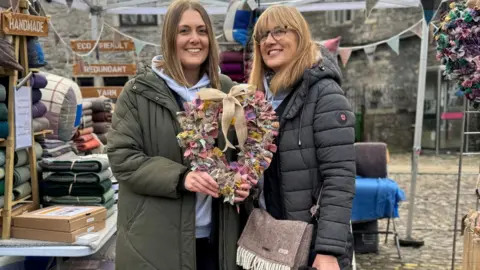
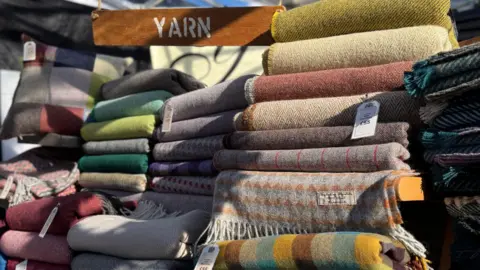
The leftover yarn used to weave fabric at three of them never goes to waste - instead, it is bought by a mother and daughter from Barnsley who commission the same mills to make it into blankets.
Their business, Yorkshire Blankets, sells goods at farmer's markets, fairs and music festivals, alongside gifts and craft kits made from any leftover cloth or wool.
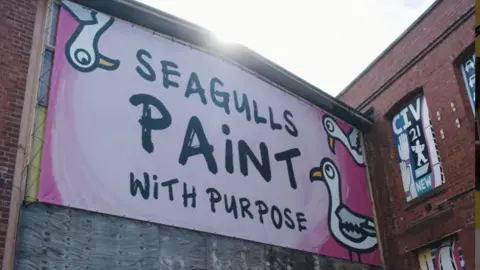
They're not alone in saving material from landfill. Social enterprise Seagulls Reuse in Leeds has been repurposing paint for more than 20 years, and Mytholmroyd-based British Recycled Plastic makes benches and decking from things like empty reels and surplus packaging.
Yorkshire Blankets was set up by Vicky Cawthorne, a former banker from Stairfoot who was offered some blanket "seconds" by a friend of a friend, to sell at a school fair.
She sold out that day, and realising she was on to something, approached the mills directly to buy more.
She is now in business with her daughter, Fran Merrett, and the pair sell not only blankets but kits to make rag wreaths, foot pouffes and small gifts like keyrings, as well as balls of surplus yarn.
 Yorkshire Blankets
Cawthorne said none of the leftover yarn goes to waste. They started selling rag wreaths as a way of using up the spare blanket pieces which are cut from the edges.
"If we have any leftover odds and scraps of material, we use those in the wreaths as well," she said.
"And because we're from Yorkshire, as the bits get tinier and tinier, if they're not big enough to make anything with they end up as padding for the foot pouffes.
"We literally throw nothing away, it all goes in there.
"We are very frugal!"
 Seagulls
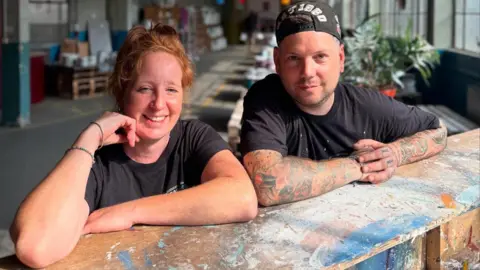
Cat Hyde set up Seagulls Reuse in 2004, after finishing university in Leeds and thinking that the city could improve its recycling record.
"I wanted to do something that married the environment and people," she said.
Seagulls now has a contract with Leeds City Council to collect old paint cans left in metal shipping containers at council waste sites.
"When people go to the tip, they leave their paint there and we pick it up," she said.
"Then we work out whether we can reuse it for the purpose of our shop, or whether we have to reprocess it to dispose of it safely.
"In a nutshell, we reprocess the paint and sell it at a discount in our paint store."
 Seagulls
Seagulls collects about 350,000 litres - 490 tonnes of paint each year - about 60% of which is suitable to be blended and sold.
That amount is the equivalent of filling six average-sized swimming pools or the weight of 98 male elephants.
Back at their premises in Holbeck, the paint is separated by type then blended together, with pigment added to colour-match to a range of popular shades or to order.
"We do it by scraping out the tins with a spatula and then whizzing the new paint with a drill with a paint mixing paddle on it.
"It's quite labour intensive, but it kind of works. All the paint goes back into the pots that it came in, so we're not creating more waste."
Seagulls not only helps the environment, it also helps people, as it welcomes volunteers from diverse backgrounds to help prepare them for working life.
Hyde said: "It could be that they've come from open prison, it could be they've just left prison, they could be a young adult with a learning disability, a young person who is over 18 and not in education, training and employment.
"It could be somebody who's just become very isolated because of their mental health or just lacking in skills and experience in a workplace."
 British Recycled Plastic
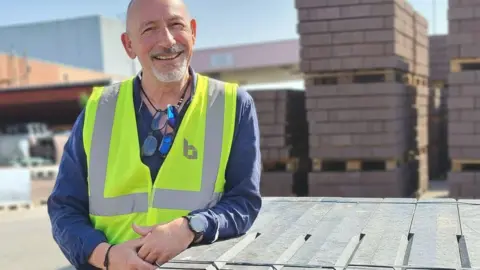
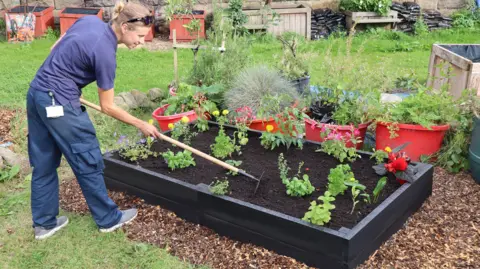
At British Recycled Plastic, durable, sustainable outdoor furniture and landscaping products are made from recycled plastics - again, from manufacturing.
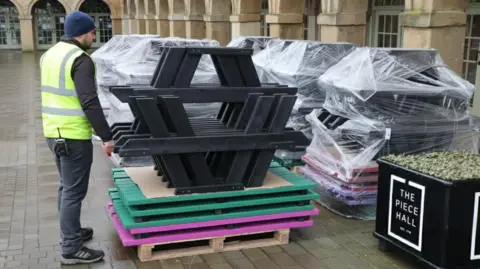
Managing director Jason Elliott said their products are often bought by schools, community projects and even event spaces - including The Piece Hall in Halifax.
Based in Mytholmroyd, the company prides itself in manufacturing only in the UK, using factories in Derbyshire, Lancashire, Greater Manchester and Dumfries, Scotland.
Elliott said: "We tend to mainly use things that come from manufacturing because they're consistently using the same polymers, the same plastics for the wing mirrors on the cars or the lids on the tubs of paint or whatever.
"We want good engineered solutions that are going to consistently perform for people.
"So the picnic table is not going to sag after two years or, you know, we know the next ones are going to come out the same colour."
 British Recycled Plastics
He added: "If a school ordered their previous batch of picnic tables two years ago, the next ones are going to be the same."
As well as using surpus raw materials - Elliott said they recently sourced plastic tubes from reels of thread used to make Harris Tweed - British Recycled Plastic also tells customers how much carbon they have saved by buying each product.
"We're just trying to educate people about this, this is why this is important," Elliott said.
 British Recycled Plastic
Listen to highlights from West Yorkshire on BBC Sounds, catch up with the latest episode of Look North.
