'FND has turned my life upside down – I hate it'

 Supplied
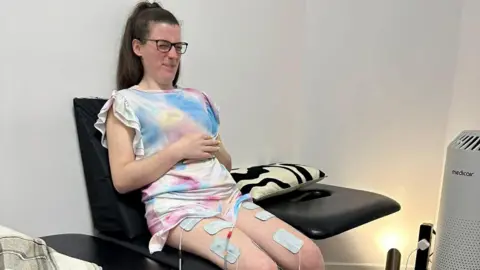
"I hate it, it's turned my life upside down," says Hannah Dickerson about how her life has changed since being diagnosed with functional neurological disorder (FND).
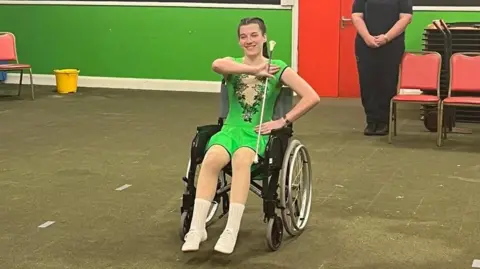
The 30-year-old was once a fit, healthy, and active majorette who would walk over a mile to and from her admin and marketing job in Ipswich every day.
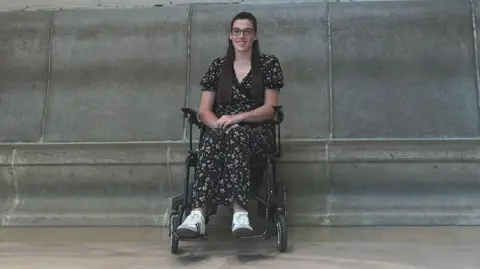
But she now relies on a wheelchair or crutches and needs help getting out of bed and going to the toilet.
"It's very hard to constantly feel like you're a bit of a burden and you can't just easily do something," she said.
"Unfortunately, it is what it is, and I can't change it as such, but I also still have some fight in me."
 Supplied
FND is estimated to affect 50,000-100,000 people in the UK.
It limits the brain and nervous system's ability to send and receive signals.
Its underlying cause is not known, but some experts think it could be linked to stress, trauma or a response to a virus or other inflammatory condition.
Mark Edwards, professor of neurology and interface disorders at King's College London, says it causes "significant disability" and can have a similar impact to conditions such as Parkinson's and multiple sclerosis.
For Hannah, it has proved absolutely debilitating.
"I have a lot of fatigue and my speech isn't great. I have seizures, paralysis, loss of mobility, gait problems, breathing problems, limb weakness and brain fog," she said.
"I can't walk unaided. I can probably do six steps before I'm out of breath, so I'm in a wheelchair and heavily reliant on people to help me."
 Supplied
Hannah's health started to decline rapidly in March 2022.
She lost feeling in her legs and feet and the symptoms soon spread to her arms and hands, and she started struggling to talk.
After 10 long months of uncertainty she was diagnosed with FND.
"I was confused and quite shocked because it wasn't something I had heard of," she said.
"It was quite scary and I didn't know what I was expecting and what it meant — it was total confusion."
'Falling through the gaps'
According to the FND Action charity, access to diagnosis, rehabilitation and care remains extremely limited across much of the UK.
Many patients face long or growing waiting lists, leaving families to manage complex symptoms with little specialist support.
"We hear from people every day who are falling through the gaps," said Kim Rosser, the charity's chief executive.
"We urgently need equitable, properly commissioned pathways so everyone diagnosed receives the care they deserve."
'There is a stigma'
Hannah had to be diagnosed by a private neurologist before Ipswich Hospital would officially confirm the diagnosis, but after that, she says, she was left to fend for herself.
"I was just told to look up neuro symptoms, 'there's no cure; see you later' kind of thing," she said.
"So, there is a stigma in the sense that it's unknown, but still super common, and it's been sort of my fight to then get further help.
"Part of me thought, 'well, this is it, this is my life now and I've got to adapt', but part of me still has that hope that this isn't how I'm going to be."
 George King/BBC
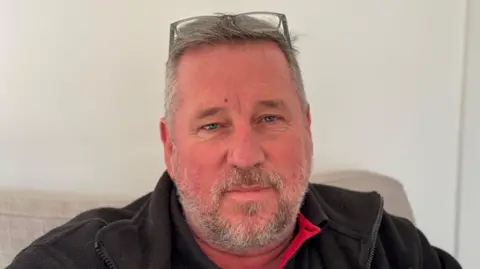
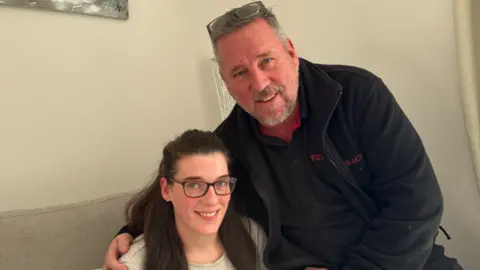
While Hannah says she has not had much in the way of support from the NHS, she has from her family, not least her dad, Peter Lenney.
"I'm very proud of her because she has taken on the challenge of keeping optimistic, accepting what she's got, and getting on with it," he said.
"I think you have to keep positive and we live in hope one day she will get back to some sort of independence and back to the old Hannah."
 George King/BBC
While grateful for everything the NHS does, Mr Lenney says it is a shame it cannot do more for people like Hannah.
"I cannot criticise the NHS because they are a fantastic organisation, but it is frustrating because it is almost like they don't know [how to deal with it]," he said.
Hannah does acknowledge, however, that FND is complex and may well prove difficult for doctors to treat patients.
"I think there is a lack of understanding and knowledge because it is so different for everyone," she said.
"It's a minefield and even I'm still trying to get my head around it."
However, hope could be on the horizon.
The Department of Health and Social Care previously told the BBC it was taking decisive action to transform care for patients with conditions such as FND, including “funding cutting-edge research”.
In August, NHS England formally recognised FND as a core neurology sub-speciality and new national standards were set.
It was hoped this would make accessing timely, well-explained diagnosis and suitable treatment a reality for more patients.
 Supplied
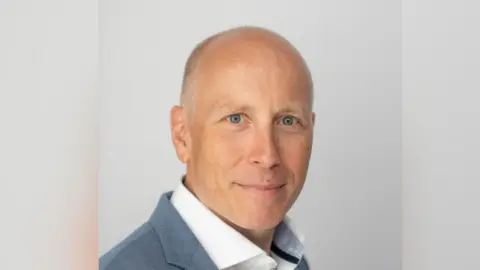
Prof Edwards, who works at the Institute of Psychiatry, Psychology and Neuroscience at King's College, said “in theory” patients could recover.
"The underlying problem is a malfunction of the way the brain is working rather than irreversible damage or degeneration," he said.
"Many people do remain with difficult symptoms, but I have seen many people improve and even recover, particularly when they can access good quality care and treatment.
"Unfortunately this is often very difficult given the limited number of NHS services for people with FND and also ongoing stigma about the condition."
'Why not me?'
 George King/BBC
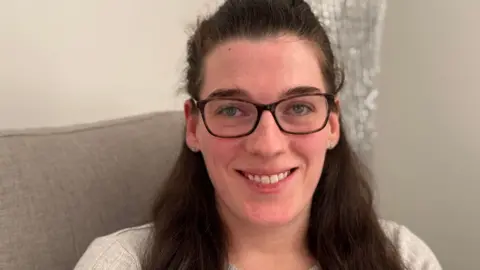
Hannah is currently exploring costly private treatments, such as electric shock stimulation, although evidence about its effectiveness is currently limited and inconclusive.
"I've seen and spoken to people who are living near enough back to a normal life," she said.
"That would be brilliant for me, but I'm also realistic. I would love to be a lot more independent, and I've seen it happen for other people, so why not me?"
NHS England has been contacted for comment.
Follow Suffolk news on BBC Sounds, Facebook, Instagram and X.
