'Our disabled child needs more than a B&B'

 BBC
BBCA family of four that has been living in one B&B room with their disabled son for nine months say they are desperate for more suitable accommodation.
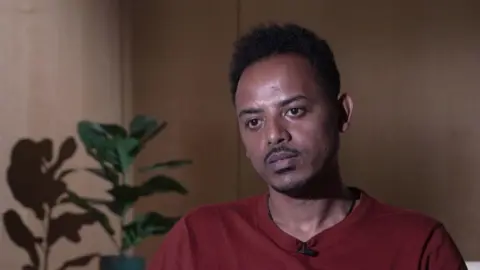
Million Bogale was granted asylum in the UK in 2024 after fleeing persecution in Eritrea, and his family joined him the following June.
They are in temporary accommodation in Birmingham with their sons, 5 and 7, the elder of whom has cerebral palsy and is non-verbal and non-mobile.
Birmingham City Council says it is aware the situation is not ideal but housing is scarce, and adds it is in contact the family about a more appropriate property.
The BBC has been speaking to the Bogale family as part of an investigation into social housing issues for people with disabilities in Birmingham.
According to Home Office statistics, almost 9,000 Eritreans claimed asylum in the UK in the year ending December 2025, with 87% of cases granted.
Bogale says he also moved to seek better healthcare for his disabled son, who he would have been unable to look after in Eritrea due to forced military conscription.
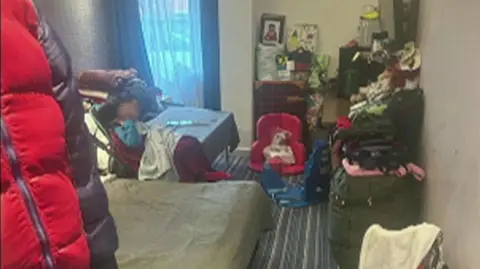
But the family has been living in one standard size hotel-type room and bathroom, without any specialist equipment or facilities to aid with washing or hoisting.
"There is no kitchen... we're living on the first floor. Sometimes the lift is not working," he said. "He's on the bed all the time... it's a very difficult life."
The father feels fortunate to have escaped a turbulent situation in Eritrea, however says the council initially indicated they would have improved living circumstances within six weeks.
"I'm very happy [to be here], because it's safe, we need to be safe," he said. "But our situation is a problem."
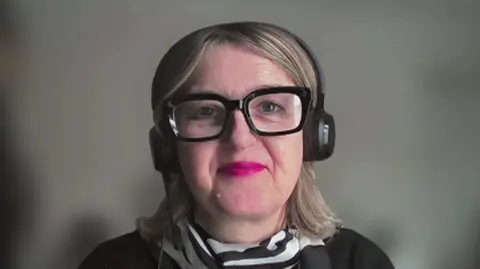
Shelter UK has told the BBC that if people are homeless or have additional needs, including disabilities, they should have reasonable preference for a social rent home.
But, while legally there is an entitlement to accommodation that meets a household's requirements, the reality is there are not enough suitable properties.
The charity's policy manager Deborah Garvie said it saw "many many families" with disabled members who were struggling.
"Often they will be in the highest bands of the waiting list," she said. "But that will be alongside thousands of other households.
"If a parent is disabled or if one of the children is disabled, then it's very, very difficult to earn enough money to afford the private rented sector."
Assessments by Birmingham Children's Trust and the NHS both recommended the Bogales should be rehoused urgently.
Birmingham City Council has said it understands the significant challenges the family is facing and takes such situations extremely seriously.
It previously offered one other property but it was temporary accommodation the family claims was equally unsuitable for a disabled child.
The authority says it is committed to supporting them, and has now identified a two-bedroom property for them to view.
In a separate case, a mother with secondary progressive multiple sclerosis, says she has been waiting seven months for more suitable accommodation from her housing association.
Beth - not her real name - lives on the second-floor of a large block that takes her about 15 minutes to get in and out of due to mobility issues, with extreme fatigue causing her a lot of pain.
"I can't open the doors, so someone has to assist me. So if I'm on my own, I need to mobilise with my walking sticks."
She said the property worked for her before she became severely ill, but now every day was a struggle. "That is not living, that's suffering."
A letter from Citizen Housing, dated October 2025, states Beth is eligible to be moved.
They offered another property in January, but she says it is not wheelchair accessible and will become unsuitable quickly as her condition worsens.
Citizen Housing added it offered a bungalow in 2022, which would have met her "essential needs". She says this property was 13 miles (20.9km) away and too far from her support network and children's schools.
Citizen's director of housing care and support Peter Gill apologised for her experience, and said accessible homes were in high demand.
"While we always try our best to find homes which meet our customers' needs, this isn't always easy," he said.
While the association continues to work with Beth, he has also encouraged her to register with the council for "access to more options".
In a statement, Birmingham City Council said it was experiencing the "severe effects" of a national housing crisis.
"There is a severe shortage of accessible, family-sized properties, making it exceptionally challenging to find the right home for households with specific needs," it added.
"Despite these pressures, our priority is always to work with families to find the safest and most appropriate accommodation available."
Follow BBC Birmingham on BBC Sounds, Facebook, X and Instagram.
